Posted in: Disc Reviews by Archive Authors on July 21st, 2008
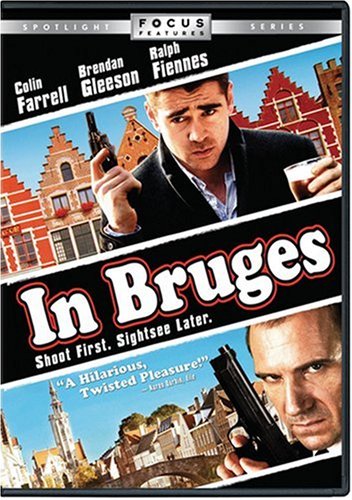
According to Wikipedia, Bruges is the capital of Belgium and home to the college of Europe. Much of the architecture from the 12th and 13th centuries is in good shape and preserved fairly well. The Church of Our Lady is one of the tallest brick buildings in the world. The Basilica of the Holy Blood purports to be a church that houses some blood from Christ. It also serves as the backdrop for a couple of hitmen who have to find comfort in the town for awhile in the film set in Bruges, called In Bruges.
The film was written and directed by Martin McDonagh, whose previous work was in the Oscar-winning short film Shooter. Ray (Colin Farrell, The Recruit) and Ken (Brendan Gleeson, Kingdom of Heaven) are forced to stay in the town for two weeks, after an assassination assignment given to Ray turns particularly brutal. The two look at this presumed exile in two different ways; Ray thinks of it as purgatory; he loves the lifestyle of London and access to anything he wishes. Ken rather enjoys it. He views it as an opportunity to enjoy a place he’s never been before. The nuances of Bruges are also memorable; aside from a little person in a movie and a drug dealing local named Chloe (Clemence Poesy, Harry Potter and the Goblet of Fire), the film is chock full of hilarity and hijinks. When Ken and Ray’s boss Harry (Ralph Fiennes, Schindler’s List) comes to meet with the boys, things take a bit of a dramatic turn.
Posted in: Disc Reviews by Michael Durr on July 19th, 2008
To be bloody honest, I was never a huge fan of Speed Racer. Actually I spent most half hours watching the cartoon (in college) poking fun at it and wondering how many drinking games could be compiled by just analyzing various components. It was a serious cartoon with some brief comedic relief that did not come off as funny, what was funny was all of the seriousness of driving the Mach 5 and figuring out who this Racer X character was (it was Speed's Older Brother, sorry if I spoiled it). Anyhow, it's 2008. Speed Racer has experienced a resurgence including a movie and a new cartoon series. The movie hasn't done very well but many times the cartoon can be the saving grace. It was supposed to follow a new Speed, with a mysterious past. Ooooo, well as long as no Chim-Chim or Spritle is around, we'll be okay.
In the not too distant future, a hopeful racer who goes by the name of Speed wants to attend the Racer Academy founded by the original Racer bunch. However he knows nothing of his past and finds that his name & lack of friends is a source of much teasing and criticism as he tries to ascend to the top of his class. There are other major players such as Headmaster Spritle (he grew up? I thought he would have gotten run over by the Mach 5 by now), X who is Speed Racer's son and X's girlfriend Annalise, both of which try to thwart the young Speed. Annalise's father, Zile Zazic is the main funder for the school and serves as the evil mastermind and antagonist to Speedy.
Posted in: Disc Reviews by Michael Durr on July 19th, 2008
The movies of National Lampoon haven't always had the best track record. On on the good side, we have Christmas Vacation, Van Wilder or European Vacation (Chevy Chase is gold after all). On the bad side we have movies like Senior Trip, Dorm Daze, or Dorm Daze 2 (Wretchedness has sequels?) But every once in a while, you can take a bad movie and suddenly realize that you are holding something that is worse than any National Lampoon movie to date (I don't care what anybody says but Loaded Weapon wasn't half bad). A movie so bad, that even Jonathan Winters or Diedrich Bader could not save it.
Richie (played by Thomas Ian Nicholas) doesn't have the greatest luck in love. His best friend, Sherman (played by Andrew Katos) wants to bed as many chicks as possible regardless of the fallout that might occur. They hatch an idea that involves taking discarded casting call pictures and actually having their own casting call to find their perfect soulmate (or in Sherman's case, just a hot chick or several). However, they have to impersonate having a real film in place before they get any real girls to fall to their claim. They also need an office and resources. They decide to include their friend Glenn (played by Diedrich Bader) who has the office space and resources to make it happen.
Posted in: Disc Reviews by David Annandale on July 16th, 2008
If it's Wednesday, that must mean another batch of SpongeBob cartoons. The lead-off here is the is title episode, a 22-minute piece that recounts the adventures of SpongeBuck SquarePants, our hero's 19th-Century ancestor. The rest of the episodes are an eclectic bunch, and the thematic consistency is less than that of some other collections (there is a vague adventure link that runs through several of the stories). At any rate, the silliness is just as engaging and bizarre as ever, and there are plenty of quick absurdist sight gags to keep you chuckling.
Audio
Posted in: Disc Reviews by David Annandale on July 15th, 2008
Some years back, I reviewed Elite's Millennium Edition of the NOTLD. That was certainly the most definitive edition at that time. So now we have another deluxe edition. How does it stack up? Before we get to that, a few (largely unnecessary) words about the film. There's a blurb on the box that calls this “the most influential horror film since Psycho,” and there is a great deal of truth to that. As has been pointed out before, the film single-handedly transformed the mythology of the zombie, changing the monster from mindless slave to flesh-eating ghoul. I can't think of any other instance where a mythology was changed so completely and with such finality. And there are plenty of reasons why it had such impact. Sure, there's the gore. And while the intestine-gobbling was pretty intense for 1968, H.G. Lewis had been pumping out gore films just as (if not more) excessive for half a decade. Unlike Lewis' films, George Romero's picture is extremely well made. The pace is lightning-fast (we have our heroine pursued by a zombie less than ten minutes into the film); the cinematography is imaginative, with plenty of energetic editing and lively camera work; and the lighting is dramatic exercise in stark high contrast. I haven't even mentioned the intelligence of the script. So let's just place this among the greatest horror films ever made and leave it at that.
Audio
Posted in: Disc Reviews by Archive Authors on July 14th, 2008
I don’t remember that much about Diva growing up; it was a film that I heard about as a kid, and a lot of people liked it, but that was the first time I can honestly say I was exposed to the arthouse film, and that it was something that I wanted to find out more about. Through the years, I’ve seen many a foreign or independent film, however the one that started all of it off for me I hadn’t seen, until now.
Diva was adapted from the Daniel Odier novel by Jean-Jacques Beineix, who previously directed a documentary version of The Diving Bell and the Butterfly long before Julian Schnabel put together a dramatic version of Jean-Dominique Bauby’s life. The story of Diva is a little complicated, but I’ll give it a go; a young messenger attends the concert of an opera singer, and creates a recording of the performance, which is a rarity for the singer, who normally frowns on recording her work. A line is said in the film along the lines of “art shapes itself around business, when business should actually shape itself around art.” A woman is murdered and drops a separate recording that is criminally linked to the police, and the tape winds up with the messenger. When the messenger, named Jules, is spotted recording the singer’s concert, they threaten him and demand to obtain the tape, so that it can be sold to the highest bidder. Unbeknownst to Jules, the participants of the other tape include a crooked police chief, who wants to try and get the other tape by any means necessary.
Posted in: Disc Reviews by Archive Authors on July 14th, 2008
It’s not that these fantasy-epic films that feature a young child in the starring roles bore me, it goes to the larger notion that Hollywood will remake every child’s fantasy novel into some sort of cinematic product, so a buck or two can be made. For every Harry Potter, there’s a Golden Compass or even Spiderwick Chronicles. The well is rapidly running dry, and you needn’t look much further than The Seeker: The Dark is Rising, a film about a young lonely boy who finds himself in circumstances and an adventure beyond what he might initially suspect. Wait, doesn’t that sound like EVERY children’s movie lately?
The novel was written by Susan Cooper and edited by John Hodge, who did Trainspotting, of all films, and was directed by David Cunningham (To End All Wars). In this, Will (Alexander Ludwig, Race to Witch Mountain) plays the youngest in a family of six Americans who have moved to London for their father’s job. He soon finds out about his real roots, continuing a lineage of warriors, protected by the old ones in Miss Greythorne (Frances Conroy, Six Feet Under) and Merriman Lyon (Ian McShane, Deadwood). No other performers from HBO television series were involved in the making of the production.
Posted in: Disc Reviews by Gino Sassani on July 12th, 2008
When The Ruins opens, it doesn’t look quite so promising. We’ve got two American couples sharing a vacation in
Posted in: Disc Reviews by Gino Sassani on July 12th, 2008
They say that it isn’t over until the Fat Lady sings. Did you ever wonder what “it” was or who the heck this Fat Lady is they keep talking about? I can’t help you there, but I do know who the Fat Man is. It’s William Conrad, who came back to television in 1987 as J.L. McCabe, better known as “the Fatman”. McCabe was one of those tough as nails district attorneys. He was actually an ex-cop, so had great criminal instincts. McCabe wasn’t above bending the law to put away the bad guy, and he wasn’t considered a very friendly type of fellow. He majored in stubbornness and plain speaking. He relied on Jake Styles, his private investigator, to do much of the leg work for the office. Jake was a bit of a flashy playboy, but he always delivered the goods for his boss. Again, Styles wasn’t against breaking a few rules to get what he needed. Styles was played by Joe Penny. McCabe also served as a mentor, of sorts, to young District Attorney Derek Mitchell, played by Alan Campbell. Mitchell was quite wet behind the ears and a little too eager sometimes. His ambition often got the better of him, and it was the gruff McCabe who kept him out of trouble. Finally, the team was completed by Gertrude, McCabe’s loyal and trusty secretary, played by Lu Leonard. While The Fatman put crooks away instead of defending innocent defendants, there could be no mistaking the parallels between Jake And The Fatman and Perry Mason. The two shows were from different times and the styles might not have been the same, but the dynamic was very much the same. You can see a lot of
Posted in: Disc Reviews by Gino Sassani on July 12th, 2008
William Conrad was no stranger to audiences when Cannon joined the Quinn Martin stable of television dramas. In fact, most folks knew his voice before they got to know his trademark girth. Conrad was the original Matt Dillon when Gunsmoke was a radio drama. When the drama entered the visual medium of television, even Conrad admitted later that the audience, who thought of him as tall and handsome, would have been disappointed. His voice lent authority to any role he played, and on radio his size was never an issue. He was famous as the voice of the stern narrator in the Rocky and Bullwinkle cartoons who often crossed the laws of the trade and interacted with the titular characters. He was also the voice that narrated the struggles of Dr. Richard Kimble on The Fugitive, another Quinn Martin Production. He continued to narrate series intros even after his own success. He gave us the informative opening dialog in Buck Rogers In The 25th Century. As a voice, Conrad, was one of the bes, but when CBS approached Quinn Martin asking for a television vehicle for Conrad, it was a huge gamble. The gamble, of course, paid off… well… huge, and Cannon became an iconic figure in television. Cannon was so popular he was showing up on other shows as well. He appeared on the pilot for Barnaby Jones. The show ran 5 seasons and returned with appropriately enough The Return Of Frank Cannon tele-film in 1980. It is also interesting to note that Conrad, while greatly overweight, lived to be 74.