Genre

As one could probably surmise from reading many of my reviews, I don't know a thing about women. I am after all a man, that is really the only reason I need. But then again, we are slow witted creatures. But I do know I like watching women (that does not sound too perverted does it?). So perhaps when I saw a list of titles to review, I gravitated towards one called Tanner Hall which follows the story of four teenage girls becoming women. I probably still will not learn a thing.

They say the first time in life you have a chance to do something wrong, you end up doing it anyway. Fernanda finds out first hand that bad things can happen to people on purpose when she witnesses her childhood friend, Victoria release a pet bird that is not hers. But that was many years ago and we rejoin the present day. Fern (played by Rooney Mara) is taking the five hour journey to Tanner Hall, a boarding school for young women.

A bar owner hires a hitman to assassinate his wife and her lover upon discovering their affair. What proceeds is a neo-noir packed with ample murder, betrayal and suspicions throughout.

This film is the directorial debut of Joel Cohen, thus making it the first in the line of “Coen Bros.” productions (Joel's brother Ethan naturally contributing as co-writer and co-editor). As well, Barry Sonnenfield is the Director of Photography, which helps to explain the outstanding visual composition of this film. With the combined efforts of the Coens and Sonnenfield, Blood Simple takes a modern, Southern US setting (in full colour I should note) and turns the mise-en-scene into something unmistakably of the noir genre. There are a few more hand held jostling than one would be acclimatized to in Coen Brothers films, which sometimes take away from the strictly “noir” style of framing shots, but do keep it from feeling too stifling or striated.

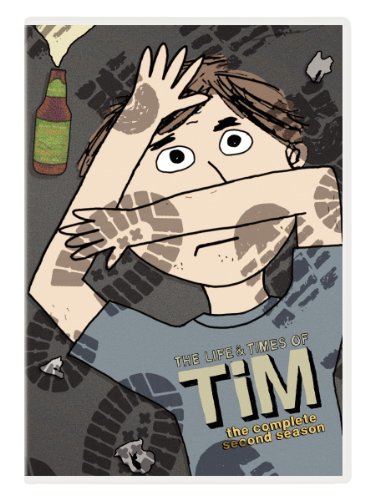
Tim is the lone passive, sane voice in an insane world that whirls around him. Take the kooky scenarios you might find in an episode of Seinfeld, animated them (barely) and pepper it with some HBO-acceptable crassness, and you're looking at this show. Done in a minimalist 2D animation, each episode consists of two separate stories. By splitting the episodes in half, the two chapters make the show resemble the current trend of 10 to 15 minute long cartoons, popularized by Cartoon Network's “Adult Swim” programs.

Stories often end without complete resolution, but always cap themselves off with a punchline. The conflicts he finds himself in range from the domestic, such as work or relationship issues, to the ridiculous, like Tim needing to break a bond he developed with a circus elephant.

At one point or another, most all family friendly television programs air some sort of holiday special. Just one special you say? Well smurf that! How about two?! Taken from their TV show, that ran for nine seasons, we are offered two Christmas (not Holiday) specials starring those tiny blue...whatever they are. The animation quality signifies that one special comes from the earliest seasons, while the other come from somewhere later in the nine year run.

The simply titled The Smurfs Christmas Special is the older offering. It is a tale of two lost children whom the Smurfs attempt to save from a mysterious, magical stranger. Meanwhile, Gargamel uses a spell from this same stranger to try and destroy the Smurf village once and for all. The tale is simple and once again, love is used to conquer all (expressed in song).

A small town girl named Lorie Walker is injured, which forces her to abandon her dreams of becoming a professional ballerina. After a chance encounter with an old friend, she is convinced to appear in a rap music video. The director of said video is immediately smitten with her beauty and takes her away to Los Angeles to become a Video Model.

The music video's Lorie appears in are of the lowest common denominator standard (her debut video seems to only consist of the lyrics “I got a big booty cutie” repeated over and over) and her roles only demand that she stand around and look pretty for the camera. If you are not a casual fan of modern (and may I say, low grade) hip-hop, these will be the first hurdles you have to cross to become invested in this film.

By proxy, I get to see a lot of Tyler Perry movies. Whether it would be a review for this site or perhaps my wife wanting to see something with Madea, I have seen just about every movie the director has put out there. Most of the time I found myself laughing quite a bit but sometimes his movies find themselves a bit preachier than I can tolerate. But what would I think of a Tyler Perry play? Well, I found out the answer when I watched: A Madea Christmas.

We open to a rendition of Oh Come All Ye Faithful. I guess I should expect lots of singing in this one. The stage re-opens as we see Lilian Mansell (played by Chandra Currelley Young) lecturing Margaret (played by Cheryl Pepsii Riley) her maid. It seems that Margaret wants to go home to see her family on Christmas but Lilian needs her to help around the house. It appears that Lilian’s daughter, China is bringing home a man this holiday season.

"On every world wherever people are, in the deepest part of the winter, at the exact midpoint, everybody stops and turns and hugs. As if to say, "Well done! Well done, everyone! We're halfway out of the dark." Back on Earth, we call this Christmas, or the Winter Solstice. On this world, the first settlers called it the Crystal Feast. You know what I call it? I call it expecting something for nothing!"

In 2005 the BBC decided to bring back the gone-but-never-forgotten character. Christopher Eccleston would become the ninth Doctor, and a brand new series was started. The Doctor was revived in a more traditional hour long episodic format. Gone were the cheap f/x, and now with the use of CGI and a more respectable budget, Dr. Who could be given the high-end treatment it deserved. But would all this new slick production be able to retain the magic of the original? As it turns out, much of that charm remains, and a brand new generation has gained access to Dr. Who. Sadly, Eccleston would retain the part for only a year. In the second season David Tennant would take over the role. It is this tenth  Doctor who has changed twice more to the one you’ll find in this sixth season (or series as the British like to call them). The old theme is back but far more modernized and performed by the National Orchestra of Wales.

There have been a lot of films out that deal with the Iraq war and the various political situations that region of the world has had to deal with since that time. Most of these efforts are trying so hard to make some radical political point that they tend to serve their audiences poorly as entertaining films. Happily, that's not the case with Lee Tamahori's The Devil's Double. The film cuts through the polarizing political elements and provides a brutal view of the Hussein regime through the actions of one of Saddam's sons, Uday. Tamahori has created a modern Scarface by using those regime elements to paint the picture of a man overwhelmed with power and driven to excess. Unlike Scarface, Uday is not an outlaw; rather in this environment he is the law, and suddenly we have a film that delivers a unique take on the theme of the corruption of power.

Latif (Cooper) is a simple soldier in the Iraq army in the days before the Kuwait invasion. He has been called to the Royal Palace, summoned by Prince Uday (Cooper) whom he had known in his school days. The two share a remarkable resemblance that Uday intends to exploit. He wants a body double to help protect him from the various threats that his position elicits. Latif attempts to decline, but Uday threatens his entire family if he doesn't accept. Acceptance means that Latif is now dead, and he is to live in the palace with all of the luxury of a prince. Uday refers to him as his brother. But instead of having Latif take his place in public, he merely drags him around with him. It's a poor plan for a body double, because it soon becomes pretty much general knowledge that this look-alike exists. Latif finds himself more and more disgusted as he is drawn closer in toward this world. All he wants now is to escape.

"Your mission, should you decide to accept it..."

Those words have certainly been a part of the American pop culture for almost 50 years. It all started with the Desilu television series that hit the airwaves in 1966. That first year is probably unfamiliar to most of us. It was in black & white and starred Steven Hill as the leader of the Impossible Mission Force. A year later the show jumped to color and Peter Graves took over the team as the indomitable Jim Phelps. The show lasted a good 7 seasons. The Impossible Mission Force was a black-ops team that worked under the "secretary" who would disavow their mission should any of the team be caught or killed. The show had a pretty good run before ending in 1973. Gone, but never forgotten.

A couple in their 30s decide to adopt an injured cat and have 30 days before receiving it. In that time, the burden of responsibility becomes too much and they start making drastic changes to their lives. I have reviewed enough films to realise that, unless it is a science documentary, a film title such as “The Future” can only imply a pessimistic view of it's namesake when coming out of the “indie” film scene. This film validates such fears to a tee.

SPOILERS AHEAD. BE WARNED.