Genre

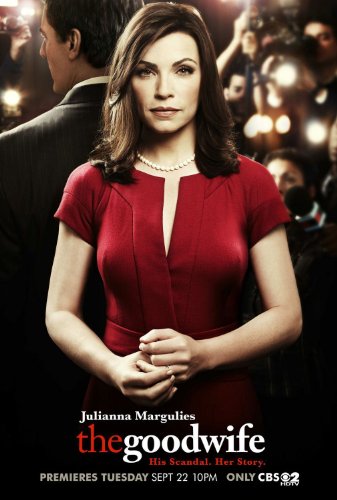
I've seen a ton of lawyer shows over the years. Pretty much any variation that's been tried, I've likely seen at least an episode. I generally like lawyer shows. I thought I'd seen pretty much everything in the genre until The Good Wife came to me from CBS Home Video. I was surprised that the series had somehow escaped my notice the last television season. I couldn't really find anyone who had seen even an episode of the freshman drama. It was time to give it a try. Turns out that there are still a few new tricks out there in the field, and The Good Wife has done a pretty good job of grabbing my attention, as it should yours.

The series is not really a lawyer procedural, at least not on the surface. The first images of the pilot lead us to believe we aren't getting a legal drama at all, but a political one. Chicago's State's Attorney Peter Florrick (Noth) is walking to a podium with a large anxious crowd of press with microphones and cameras flashing. He's clutching the hand of his wife Alicia (Margulies) as he approaches the buzzing audience. The event turns into a scene we've seen quite frequently of late. A politician must apologize for a sex scandal with his bewildered wife standing beside him trying to hide all of those feelings of anger and betrayal that you know she must be feeling. Florrick is resigning his office, admitting to indiscretions but denying reports of corruption that have apparently been looming over his administration. At first you are sure, in spite of the show's title, that this is Peter Florrick's story. It's not. From this point on the focus will be almost entirely upon Alicia.

"We are pioneers and trailblazers. We fight for freedom. We transform our dreams into the truth. Our struggles will become a nation."

I was really looking forward to this release. From the moment I was made aware that it was going to be arriving here for review, I made a mental note to put it at the top of my viewing list. Fact is, I'm a history junkie, particularly American history. I taught the subject in AP and honors classes along with American Government and Law for over seven years. The History Channel is also one of my favorite places on the dial. There are many thought-provoking and informative shows to be found there to help you explore almost every aspect of history. I truly expected this to be one of those milestone releases. Unfortunately, it isn't.

"Sherlock Holmes, the immortal character of fiction. Created by Sir Arthur Conan Doyle, he's ageless, invincible and unchanging. In solving significant problems of the present day, he remains -- as ever -- the supreme master of deductive reasoning."

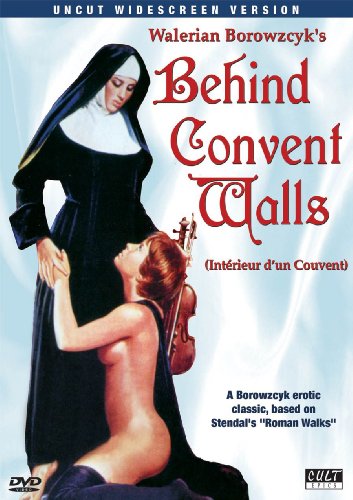
A nunsploitation box set was always an inevitability, and here the good people at Cult Epics chime in with just such a collection, one limited to 2500 copies. There are only two films here, but they are two good ones, the works of strong directors. One is a distinctively idiosyncratic work, showing the unmistakable hand of its filmmaker. The other will quite simply knock you out the back wall.

Behind Convent Walls is Walerian Borowczyk's contribution to the subgenre. A repressive abbess rules her convent with an iron fist (not to mention the blade concealed in her cane), but the sexuality of the nuns will not be repressed, and it will make its presence known, whether through rebellion or madness. The film defies any linear summary, given that it is almost impossible to tell the nuns apart, and the various incidents are not only disconnected, they take place with very little motivation or logic. Instead, we have a strikingly beautiful exercise in pure cinema. The Aurum Film Encyclopedia: Horror, on the subject of Borowczyk's Docteur Jekyll et les Femmes, notes, “Borowczyk's imagery, here fed by his fetishistic fascination with all things antiquarian, is often stunning and the film becomes a sort of still life in which familiar yet alien objects … seem imbued with a secret significance all their own.” Exactly the same is true for Behind Convent Walls. While nowhere near as powerful a film as The Beast, it is nonetheless well worth one's full attention.

Abstraction indicates a departure from reality in depiction of imagery in art. It is an interpretation of a visual that is different from what most perceive as normal. Art is no longer simply drawing a bowl of fruit but rather what the fruit means to the artist. Recently, I found myself trying to interpret a film named (Untitled), which takes a journey down the road of abstract art and music. After a great deal of reflection, I believe I am still confused.

Adrian Jacobs (played by Adam Goldberg) is a composer who makes music by kicking buckets, breaking glass and occasionally playing notes on a piano(usually without any rhythm and described as nonsense). He makes a living by working at restaurants, weddings and any other function in need of a piano player. Those engagements usually don’t last too long as he is annoyed by most of his clientele.

This documentary follows four different families as they await the date for a charter school lottery in Harlem. As the date approaches, we bear witness to the heated debates that go on between those that wish to implement more charter schools (a charter school being one similar to public schools but relies on stringent academic results and standards from its students and operates as an autonomous public school) into a “project” area, and members of the community who believe that their children would be excluded and object to the idea of closing public schools who have failed to produce positive results.

This film clearly has an agenda, and so comparisons to the likes of An Inconvenient Truth have been made. The key difference between this film and Al Gore's, aside from style and topic, is that The Lottery allows both sides to speak their minds and address their concerns. It is the difference between simply saying the other side is wrong versus allowing them to speak so that the folly in their arguments will present themselves naturally. Harlem Success Academy is the organization running the charter schools, and have proven their worth to both the neighbourhoods they exist in, and the nation as a whole. The debates they enter can be frustrating to watch as they are often vicious attempts to mudsling (politicians) or ignorant bravado (community members led by a hired protest group) versus reason (Harlem Success Academy) and endorsements (members of the Harlem community whose children have all been accepted into the schools despite parental history of prison, drugs, lack of money etc.). If they are not entered into unnecessary and hurtful debates, they are also bogged down by bureaucracy and challenges presented by the teacher's unions.

This documentary is a mainly a sea of praise for the late guitar legend, as it promises to not focus on “drudging up scandal and outworn hypothesis about his lifestyle and ultimate death.” historical footage tells the biographical portions while high-profile interviws with the likes of Lemmy Kilmister (Motorhead), Eric Clapton, Mick Taylor (Rolling Stones), Stephen Stills (Crosby, Stills & Nash) and moany more, plus narration by super-fan Slash (Guns N Roses).

As the early history of Hendrix is told, namely when he was brought to England, where he made a name for himself, a baffling series of celebrities' names are dropped as noted admirers. For example, one London club concert featured in its first few rows, all of the Beatles, most of the Rolling Stones, Cream, Steve Winwood, and The Who...all there to see Hendrix redefine the sound of the electric guitar. The filmmakers use this explosion of legendary names to gain interest in the audience, which is a fine tactic. They save biographical details for the second act but never let up on the limitless line of admirers, celebrity or otherwise. As a matter of fact, the amount of praise borders on being redundant for it seems relentless, but such a subject truly deserves every word the interviewees have to say.

After a series of releases from erotic cinema specialist Tinto Brass's early career, Cult Epics now gives us one of his latest works. Marta (Anna Jimskaia) loves her husband Dario (Max Parodi), but he has become inattentive and selfish in bad, when he shows any interest in sex at all. Feeling lonely and unappreciated, Marta takes in the sights of Mantua, and in a museum she encounters Leon (Riccardo Marino, who is no more French than I am Martian), a sexually aggressive alpha male with whom she begins a passionate affair, with an eye (of course) to re-igniting Dario through jealousy.

As one would expect of a Tinto Brass film, this is a very handsome, lush affair, with some striking compositions and sets. There are moments at a swanky outdoor party that bring to mind the likes of Peter Greenaway. At this party, various characters (including Brass himself) get into a brief philosophical discussion on pornography and sex, and this moment encapsulates the Achilles' Heel of Brass's oeuvre. He has always struck me as a filmmaker who is nowhere near as clever as he thinks he is. His early work, especially Deadly Sweet, is, I think, the most interesting, because its self-indulgence is married to an insanely excessive cinematic frenzy. Bored with what's on screen? Wait five seconds. Here, though, the more disciplined technique is accompanied by a deeply pedestrian story. Revive your marriage through an affair? Ye godz, that's a storyline that dates back to the Triassic period. Meanwhile, Brass gives his obsession with rear ends free rein. He's certainly a filmmaker who is true to his passion, but the drooling male fantasy can get a bit embarrassing.

Zeus' mighty bolt has been stolen, and whomever holds it may have the power to topple the king of the Gods. Zeus suspects Poseidon's estranged, half-human son is the Lighting Thief and threatens his wrath upon the entire realm if it is not returned. Percy Jackson is Poseidon's son, making him a Demi-God, but as far as he knows, he is a just a high school student living with Dyslexia, ADHD and struggling to live with his abusive step-father. As mythic monsters and Gods all start to threaten Percy's life, his best friend and his mother both reveal themselves to be protectors of his life, both with connections to Greek Mythology. Percy;s mother is taken to the underworld and so he sets out on a quest to discover the truth about his Demi-God heritage while fighting to get his mother back from the clutches of Hades, as well as discover who the true Lighting Thief is.

The story moves by at a fast pace, which helps keep the attention of younger, easy to bore audiences, but the conflict set-ups and exposition are a bit too been-there, see-that for my liking. We are meant to assume that Percy is an outsider, thus easier to relate to and sympathize with, because he has issues, but his Earthly problems (step-father, dyslexia) seem hastily tacked on and it doesn't take long before his super-human capabilities are revealed. This is especially aggravating during a wickedly illogical training scene where all of the demi-God children of Camp Half-Blood play capture the flag (fighting with real swords for no good reason!) and Percy earns the respect of the entire camp simply by being able to heal from any wound by touching water and inheriting a wondrous fighting ability from his father's side, without having picked up a sword before. The friends who join him on his quest also have amazing agility and skill, so we have a pack of kids with Superman syndrome, but none of them have enough have that 'Clark Kent' side to give them a mien of humility (do enough people reading this understand where I'm going with that analogy?).

Written by Diane Tillis

Only once in a blue moon will a filmmaker come along to change the way films are created…for an entire country! Kazakhstan – born director Timur Bekmambetov is best known in America as the director for Wanted (2008) and for producing 9 (2009) alongside Tim Burton, but in Russia he is known as the man who changed the film industry after the collapse of the Soviet Union. His plan was to shake up the whole Russian film world with a feature film that was unlike anything done in the country before. Night Watch was his answer: a visionary fantasy horror film with an astonishing collaboration of mind-altering visual effects, suspenseful terror, and adrenaline-fueled action.