Genre

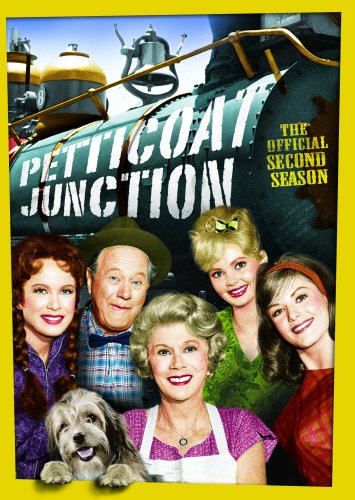
Once upon a time, there was an age of TV where hit shows where women in their 20s played high school students, and an entire episode could revolve around the burning crisis of whether the dog that followed one daughter home could stay. It is from this era that Petticoat Junction hails. This series about a widowed mother and her three daughters tending the Shady Rest Hotel ran for seven years, and begat both Green Acres and The Beverly Hillbillies, in that characters from all three series would interact with each other.

So our principle cast here consists of mother Kate Bradley (Bea Benaderet), daughters Billie Jo (the flirt, played by Jeannine Riley), Bobbie Jo (the bookworm, played by Pat Woodell, who would leave after this season), and Betty Jo (the tomboy, played by Linda Kaye Henning, daughter of series creator Paul Henning). Throwing in his two bits is lazy Uncle Joe (Edgar Buchanan). Joining the cast this season is Higgins the dog, who would subsequently star as Benji, and thus eclipse his human co-stars.

The Green Lantern character has always been one of my favorite DC comic book heroes, right after the likes of Batman and the Flash. As far as Earth-born GL’s, Hal Jordan has always been first in my heart and even though the John Stewart was shown predominantly in the cartoon series: Justice League Unlimited, it was hard wrapping my head around him as the Green Lantern. I was excited to see that due to recent success with other characters, the people at DC decided to release a direct to disc release for the Green Lantern sub-titled: First Flight.

Hal Jordan is a test pilot for the military. He’s testing one of the newest planes when suddenly his ship is enveloped in a green energy beam to a crash site. There he finds a dying Abin Sur, the current Green Lantern of sector 2814. Before he dies, he bequeaths his ring to Hal Jordan, proclaiming him the new Green Lantern. Moments later after the passing of Abin Sur, several current members of the Green Lantern corps arrive and take Hal Jordan to the headquarters where the Lanterns and Guardians of the Universe meet.

According to the Chinese calendar, during the seventh month of every year vengeful spirits are allowed to break free from hell and mix it up with mortals.  Throughout this month, there are precautions that need to be taken in order to avoid any terrifying contact with these demons. It is during this month, that housekeeper Alyssa (Marina Resa) decides to take a job at a wealthy Chinese family’s home in the desert and the thrills begin.

Since the events of 911 there has been a lot more appreciation, at least publicly, for the real life heroes who populate fire and police stations all over the country. Few jobs offer so little reward for such high risk all in the name of protecting our society from harm. It’s likely no coincidence that while Third Watch began a couple of years before those events, it reached its peak in popularity in the months and years that followed. A better than average procedural drama, Third Watch offered a look at both police officers and firefighters along with their paramedics. You could call it a cross between Hill Street Blues and Emergency.

The police officers and the fire fighters are all members of New York’s 55th Precinct. The Precinct carries the nickname of Camelot. While they work from separate facilities, they are across the street from each other and their duties often find them working together. The two houses share a bond, but there are also moments of stress and rivalry. But when there’s a crisis, these men and women are the best and get the job done.

I grew up on the Peanuts creations of Charles M. Schulz. Most of us have, in some way or another. His newspaper comic strip is one of the longest running and most successful strips of all time. The work has been translated into every language currently spoken on the planet. The images of Charlie Brown, Snoopy, Linus, and the rest of the Peanuts gang have appeared on just about any kind of product imaginable. Our pop culture contains too many references to the strip to mention briefly. For me, it was the television specials starting in the mid 1960’s that brought the gang into my life. The classics are running annually, still after nearly 50 years. A Charlie Brown Christmas and It’s The Great Pumpkin, Charlie Brown are the most mentioned and certainly beloved by generations of children and adults. I thought I never missed an airing.

Now Warner Home Video has brought together a special collection of the cartoon specials that started it all. It includes those annual greats and a few that I don’t really remember so much. The two discs include the following Peanuts specials:

The third season of Matlock brought more of the same. If you’re a fan, that’s very good news indeed. What is that, you ask? Imagine Sheriff Andy Taylor older and now an attorney, and you pretty much have the setup for Matlock. Forget for a second that both characters were played by Andy Griffith. That’s not all they have in common. Matlock is every bit the “southern gentleman” that Taylor was. He might be a little smarter, but he walks and talks like Andy Taylor.

Matlock began life as a television movie from Dean Hargrove, who brought us Columbo. Hargrove would later work the same magic with Dick Van Dyke in Diagnosis Murder. In fact the two shows could easily have been companion pieces. Both featured sit-com stars from the 1950’s and 60’s that had become somewhat iconic characters. Both would don the role of professionals. Both shows would subscribe to the “formula” mode of storytelling. Diary Of A Perfect Murder would set up the Matlock formula. It’s simple, really. Matlock was a lawyer in Atlanta. Some wronged defendant, usually charged with murder, would show up asking for Matlock’s help. Matlock and his team would investigate the crime with an eye toward, as OJ Simpson is fond of saying, finding the real killer. His team consisted of his daughter Charlene, herself a competent lawyer, and Tyler Hudson (Holliday), his private investigator. In the pilot the Matlock character was less Andy Taylor and a little more slick at first. I’m sure that while it was intended to show Matlock’s prowess as a high priced attorney, somewhere along the line it became obvious that the show’s finest asset was Griffith himself and that southern charm he was already famous for. Whatever the reason, you can see the character soften significantly during the early episodes of the season. And that decision was a smart one, as Matlock would continue for nearly a decade.

This, the final season of the series, opens with Samantha (Elizabeth Montgomery) and Darrin (Dick Sargent) on a European tour. This means stock shots of various European landmarks before we return to rather unconvincingly dressed-up studio backlots. There are a few two-parters in the mix, including the opening episodes, where Samantha is zapped back to the court of Henry VIII, and a late-season adventure where the time travel goes the other way, and George Washington is brought forward to the present. Special note should be made of Episode 3, where the Loch Ness Monster shows up, in all his googly-eyed, man-in-a-costume glory.

There's a certain brazenness, it seems to me, for any show, even a budget-conscious one in 1972, to limit itself to the special effects technology of 1896. Indeed, there is nary a moment that couldn't have been accomplished by Georges Méliès. As for the humour, well, it's very much of its period – in other words, it creaks very badly, with the laugh track kicking in at every single line. I remember watching this show as a kid, and getting some fun out of it, though preferring the identically themed I Dream of Jeannie (for reasons now that I cannot recall). Basically, this is mildly entertaining for the nostalgic, but not much more.

As a Henry Mancini score swells with unapologetic cheese, we are swept into the world of the luxurious St. Gregory Hotel in San Francisco. Owned by aging matriarch Bette Davis (replaced, when she had to pull out due to illness, by Anne Baxter, as her sister-in-law), the Hotel's General Manager is James Brolin, who has lots of time to wander around the lobby greeting the various guest stars. In other words, he's Mr. Roarke to the St. Gregory's Fantasy Island. What follows is pure fromage of the Aaron Spelling variety, with every other guest star a fading Familiar Face, no end of improbable crises, painful comic relief, unintentional comedy gold in the dramatic moments, and much of the feel of a 1970s disaster movie minus, sadly, the disaster itself (but you can always re-watch The Towering Inferno to make yourself feel better).

The colours are strong, and the picture quality is generally what one would expect for a mid-80s television program. The grain is minimal, but the image is a bit soft – features and details tend to bleach out and disappear when in the middle distance. That said, the transfer gets the job done, and looks true to original broadcast quality.

In the 1970’s, Ted Bundy murdered over 30 women across several states. He was jailed only to escape two times, and was finally captured and languished on death row until 1989, when he was put to death in the electric chair.

In 1954, Coco Chanel (Shirley MacLaine) unveils her first collection in 15 years. The reception is disastrous. As she struggles to bounce back from the fiasco, she flashes back over her life. The bulk of the film then follows the young Chanel (Barbora Bobulova) and her love affairs, first with a callow playboy (Sagamore Stévenin), then with the Englishman (Olivier Sitruk) who will be the great love of her life. Along the way, we see a little bit of her development as a fashion designer.

If you're sitting down for a soap opera in period dress, then you could certainly do worse. As silly as it often is, Coco Chanel is consistently entertaining. Its desire to worship its subject does mean for some unfortunate choices, however. Setting aside the fact that there is too little time spent on what made her one of the world's most famous designers, the film decides to pretend that nothing much happened to her between 1925 and 1954, when the most cursory Wikipeida search reveals all kinds of juicy incident (shacking up with a Nazi officer during occupation, espionage games, post-WWII arrest) that would have made for wonderful storytelling. Oh well. Malcolm McDowell is rather oddly cast as the older Chanel's confidant, and perhaps the fact that he has nothing much to do is the reason why he can't seem to get rid of that sneer of contempt, even when he supposed to be genuinely moved. Still, suds and all, its 139 minutes clips by quite efficiently.