Genre

So there's this group of flight attendants, and we follow their swinging adventures and affairs on and off planes. One, for instance, hopes to be an actress, and hooks up with an advertising executive. And if you care what the plot of “the first 3D sex film” is, you need your head examined. Much of the what goes on  is mind-numbingly banal (SEE  Wine being poured  SEE  Drinks being mixed  HEAR  Dull conversations ), though the acid trip that leads one woman to make out with a lamp in the form of a greco-roman head is something you don't see every day.

The film is an object lesson on how far mere novelty can take a film – it was a huge success at the time, and 3D was, in 1969, a rarity again after its initial craze in the 50s. So there are numerous shots of legs and pool cues (and feet) jabbing at the camera, enough, presumably, to have kept audiences entertained while everything else remained mundane beyond words. Or, so the situation is for most of the running time. But the last act takes a sudden turn into the starkly dramatic, and becomes very dark indeed. It is also rather more imaginatively shot than most of the rest of the film. The ending is a vicious sucker punch that must be seen to be believed, and suggests that the filmmakers were storing all of their creative juices for the cruel finale. In fact, as the accompanying featurettes reveal, the dramatic plot was added to the film after the rest of it was completed, and indeed, after it had already been released in some markets. In the final analysis, this is a vital piece of low culture.

On July 20th, 1973; Bruce Lee left our world. The world he left was never the same, but somehow his fans and directors carried on in their own way. The fans he left behind were hoping for a great martial artist that could be just as good as the late Bruce Lee. The directors he left behind were hoping to capitalize on the look of Bruce Lee and find one who not only looked like Lee but performed like him. What happened as a result of all this? A whole lot of bad kung-fu films known as Bruceploitation films. These films ranged from the normal to the obscene including one where Bruce Lee fights James Bond & Dracula in Hell. Unfortunately for the Dragon Immortal set, that one did not make it. But this collection brings together ten that did.

This boxset of 10 movies on three discs brings together the best and worst of the films in the Bruceploitation era. Who am I kidding? These are all pretty bad. But let us analyze the wreckage and see if anything is salvageable. There is one movie called Fist of Death (Jackie & Bruce to the Rescue) where the old kung-fu master of the village gets killed by a gang simply known as the YMCA. The YMCA? Are they lead by an Indian and a cowboy who sing about a “Macho Man”? Incidentally the gang's logo says YMGA but every actor in the movie calls them the YMCA. This all leads to some rickshaw driver who plays the Bruce Lee role and beats the gang and saves the day.

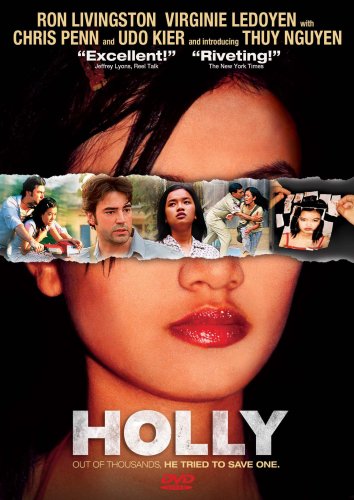
The Cambodia’s K11 red light district might sound to some like a good time. The fact is that the K11 district is home to such horrific acts such as child slavery & prostitution. It’s sleazy, filthy and about as immoral as you could imagine. Guy Moshe decided to tackle this subject when he directed the 2006 movie: Holly. Guy had to make sure that he brought the harsh reality to screen in a proper fashion. In doing so, he made quite possibly the most uncomfortable film this reviewer has seen in a long time.

Patrick (played by Ron Livingston) lives in Cambodia playing cards and getting rid of stolen goods for his pal Freddy (played by Chris Penn). He’s become immune to the effects of the world in chaos around him. Crime is rampant and the Cambodian world is oozing with underage women who are sold in slavery. Then they are forced to work in brothels catering to everybody from locals to the government to travelers who come to the area just for the immoral delights.

“This motion picture is principally based upon the book “Wallace” by Marshall Frady and other historical sources. Certain events, characters, and dialog have, nonetheless, been created or altered for dramatic purposes”.

In other words, this should not be taken as an historical record of the controversial George Wallace. If anything, the film attempts to soften his personality some. One of those created characters is Archie, a trustee attending to the needs of the residents at Alabama’s Governor’s Mansion. We are meant to see Wallace and the events of the tumultuous era through his eyes. It’s not told from his perspective, mind you, but we are intended to share his reactions and emotions along the way.

“They’re longtime friends on separate life paths, but they share a horrific destination, where a seemingly innocent incident from their school days comes back to terrify them. Something, someone wants payback.”

If there was an award for cramming the most horror movie conventions into one film, Amusement should win it hands down. You’ve seen it all before: young couple stranded on a trip, that pesky rural shortcut, psycho truck driver, isolated house in the woods, spooky gothic looking hotel, ingenious little torture contraptions, a maze of traps and filthy bloody rooms, a demented clown, escaped psycho returning to the scene of his childhood to kill, and the usual assortment of sundry death scenes. In just a little under an hour and a half you get to see parts of Saw, Nightmare On Elm Street, Friday The 13th, Hostel, Texas Chainsaw Massacre, Halloween, and even Killer Clowns From Outer Space. A pretty solid collection of hits, but ultimately Amusement is a jack of all trades and the master of none.

“When one starts to perceive one’s own reflection as a completely separate being, one is suddenly confronted with two entirely separate egos, two entirely separate worlds that can surface at any given moment. A feeling of self hatred usually triggered by a psychological shock can split the personality in two, hence creating two or more personalities with distinct memories and distinct behavior patterns within the same individual. The patient has the false perception of the existence of two distinct worlds, the real world and the world inside the mirror.”

Or maybe not so false, at least according to the 20th Century Fox thriller, Mirrors.

I have to admit that I’m usually very wary of direct to video sequels to films that weren’t exactly box office smash material to begin with. The original film was a typical and predictable mess of a film that didn’t even make use of a better than average cast for this kind of film. It took me by surprise when Boogeyman 2 came out, but I’m a glutton for punishment, so I rented the title mostly because it had Saw franchise star Tobin Bell in it. I ended up halfway liking the feature, and considerably more than the original film. When I saw the chance to review the third entry, I wanted to see if the DVD franchise was heading forward or backwards. Boy, was I pleased to find out that the answer is both.

Audrey (Sanderson) is the daughter of Dr. Allen (Bell) from the second film. She’s trying to deal with his death when she happens upon his journal. There she reads about the Boogeyman and his need for people to believe in him, which gives him power. So what does she do? She tries to get people to believe that it was he who killed the victims of the second film. She gets killed in an apparent suicide, but her roommate and best friend Sarah (Cahill) witnesses the event and is the only one to know it was the Boogeyman who killed her. Of course, she also comes across Dr. Allen’s journal and picks up where Audrey left off. As her friends begin disappearing and she has strange visions of the creature, she begins to understand that she is pretty much to blame. By using her spot on the campus radio station to spread the fear, she ends up feeding the beast. She attempts a noble self sacrifice in the end.

Posted by Ken Spivey

In a box, the men of importance placed a secret. They then created an underground city capable of complete autonomy, isolated from the outside world in hopes of shielding them from the trials of time. The box was given to the first mayor of “Ember City” and passed on to each successive mayor. After two hundred years the box was to open, revealing to the mayor's descendant the way out of Ember City. Yet, somewhere along the way the box was lost. Meanwhile, the city has fallen into a major state of disrepair. Houses are crumbling, pipes are corroding, and the household robots are malfunctioning. The current mayor seems unconcerned with the welfare of the city, while its residents are terrified of the impending failure of the city's power reactor and the end to their civilization. Ember City's only hope lies in the hands of a plucky young girl, Leena, who has found the box left by “the builders.” Leena is now in a race against time to figure out the mystery of the box before the reactor fails. The fate of “The City of Ember” lies in the box and the hands of young Leena.

Paramount has decided to standardize their DVD releases. This goes from everything to the DVD disc art, which is now just a two tone silver on all releases, to the cases. The new cases are a mixed deal. You get 6 discs inside of a single DVD space. That’s the good news. The bad news is that the disc holders are quite brittle and end up chipping and breaking. You save space but ultimately endanger the discs themselves. I hope someone at Paramount takes a look at the packaging and comes up with something a little better. There will also be some inconsistancy with your older sets, and because the final season was already released out of order your middle sets will look out of place. If you’re even a little OCD, you are not going to like the changes.

There was a new Cowboy in Dallas, and he wasn’t throwing touchdown passes. But Walker was almost gone before he could really get started. After just four episodes the show’s production company suffered financial collapse, and the show was rescued at the last minute by CBS Productions, who would continue to run the show for its nearly decade-long run. For nine years Norris brought us the ultimate Texas Ranger in a formula cops and robbers show. The show often became a parody of itself, but maintained a solid viewer ship throughout. Hell, Norris even sings the theme song. Truthfully, what started as a one man show (it was originally called Chuck Norris Is Walker, Texas Ranger) became a good working ensemble that probably kept the train going for so long. Walker (Norris) is a tough guy Texas Ranger. He is partnered with Sydney Cooke (Peebles) and Jimmy Trivetti (Gilyard) who’s an ex-jock with a brain. Walker had a love interest and eventual wife in the local assistant district attorney Alex Cahill (later Walker). Together they fight the evils that come to the high plains of Texas armed with their fists, six-shooters, and Stetsons. After starting with the final season, CBS is finally halfway through the series back from the beginning.

Just to look at it you would think that My 3 Sons was a Disney production. Its star Fred MacMurray had appeared in many Disney films of the 50’s and 60’s and is most likely recognizable from those appearances. Two of the three boys were also known for work with Disney. The eldest boy, Mike, was played by Tim Considine, who starred with MacMurray in Disney’s The Shaggy Dog. Middle son Robbie was played by a former Mickey Mouse Club Mouseketeer, Don Grady. The youngest son, Chip, was played by Stanley Livingston, the only non Disney alum in that group. Another reason for the confusion is the decidedly Disney-like material the series covered. Steve Douglas (MacMurray) was a widowed single parent who was trying to balance his job with that of raising his three sons. Most of the stories involved the warm and fuzzy heartwarming stuff that Disney had pretty much cornered the market on in the films. Whatever troubles arose, no problem was so bad that a heart to heart talk couldn’t fix it. The style would prosper and continue in the form of 70’s shows like The Brady Bunch. The four guys were also joined by Steve’s father-in-law, Bud, played by I Love Lucy favorite William Frawley. That was no surprise, since the show was actually produced, not by Disney, but the Desilu studios.

My 3 Sons was for some time the second longest running sit-com on television. It lasted from 1960 until 1972. The series would undergo major changes as the boys each grew older and eventually married and led their own lives. Frawley would also become very ill after 5 years and leave the show. His replacement, William Demarest as Uncle Charley, is likely better known in the show. The syndicated version of the show often ignored these early black and white versions of the series, opting for the later color ones that featured the Uncle Charley character. It’s very likely you’ve never seen these early episodes as they appeared infrequently in the syndicated markets. The theme from Frank DeVol became pretty popular in the mid 60’s and even entered the pop charts at one time. The show also originally ran on ABC, but moved to CBS in 1965, also accounting for the different syndication packages. It was during that move that many of these big changes occurred.