Genre

Welcome to the neighborhood here in Lakeview Terrace. See that house next door with the zillion watt security lights? Yeah, they’re pointed right at your bedroom window, but that’s just for your own protection. Well, that’s Abel’s house, right there. He’s a cop with the LAPD. Don’t worry about crime around here. Abel performs regular patrols in the neighborhood in his off hours. If you do something against the rules here, like litter, or park somewhere you shouldn’t, don’t worry, Abel will let you know what’s what around here. Abel will keep a close eye on you. Yes, indeed. Welcome to Lakeview Terrace.

When young couple Chris (Wilson) and Lisa (Washington) buy their first home and move into the community of Lakeview Terrace, they are giddy with excitement. They have that first time homeowners feeling, at least until they meet neighborhood big dog, Abel (Jackson). First of all, Jackson doesn’t believe in interracial marriage, which is what the Mattisons happen to be. They’re used to that. Lisa’s father, played by Barney Miller’s Ron Glass, isn’t real high on the idea either. But when Abel starts to meddle in their business, they begin to get concerned. They don’t help matters themselves when they decide to “christen” the pool with a make-out session while Abel’s young son and daughter watch from their bedroom window. Abel’s the self-appointed community enforcer, and he’s decided that the Mattisons have to go. The confrontations continue to escalate, leading to the predictable, because it’s inevitable, conclusion.

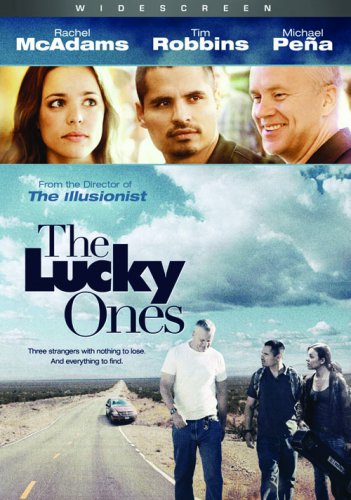
Three soldiers are on their way home from Iraq. They have each suffered injuries. Fred Cheaver (Robbins) is on his way home for good. He’s retired and looks forward to getting back to St. Louis and his wife and son. Colee Dunn (McAdams) is a young woman who was injured in her leg and now has a month leave. She’s planning on going to Las Vegas to return a guitar to the family of her boyfriend, who died in Iraq. T.K. Poole was injured in the groin and is also on his way to Las Vegas for a one month leave. He’s afraid that his fiancée won’t want him back because his injury appears to have left him impotent. He’s heard tell of sex experts in Vegas that might be able to “get him working again”. The three are strangers until a blackout cancels their flights once in the United States. They decide to carpool to St. Louis with Fred and get flights out of there for Vegas. During the trip they bond somewhat which turns out to be fortuitous for Fred. When he gets home he finds that things are not going to be the way he planned. His two new friends join him in extending the road trip, ultimately to Vegas. There no one finds what they expected.

If you’re looking for a film about the war, one side or another, you are most likely going to be disappointed. There is very little discussion on that front, and what is there is what you would expect from someone like Tim Robbins who wears his politics on his sleeve. Fortunately it is a limited scope and not really the point of the movie. What looks like a soldier film is really a very typical and unoriginal road trip film about bonding. They meet the typical odd characters and weird circumstances along the way. The acting and characters are charming to some degree. All three performers do a good job of bringing some chemistry to the film, but it all appears so pointless. The problem is that the film is ultimately claustrophobic, and while there’s tons of driving, it doesn’t end up going anywhere at all. In the end the characters are little changed by their experience, and we’re led to believe will go on with their lives. In the end it’s an innocent enough diversion, nothing more.

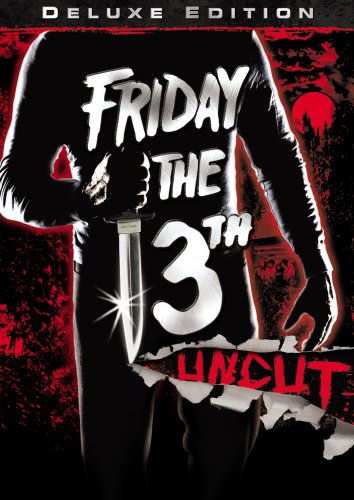
It’s 1980. The Reagan Years are upon you. The country is hopeful it will soon come out of the toilet bowl it was in for the last four years, and while things may seem bleak, you’re one of the lucky ones that still have a job, a girl, and a reason to live. As April becomes May and the days grow considerably hotter a little at a time, what better way to take a break from it all than driving you and your sweetie down to the local movie house for opening night of a new horror film you really haven’t heard all that much about entitled Friday the 13th?


If ever there was a release whose title told you everything you need to know, this is it. Yup, the second part of season 5. There you go. Which is in no way a condemnation. Well over four hours of prime silliness is reason enough to pick this up. Unless, of course, you have picked up any of the other recent SpongeBob releases, in which case the curse of double-dipping will likely befall you. Many of these episodes have already been released on the shorter compilation discs. If you held off until now, though, this is a wonderful fix for nautical nonsense junkies.

Audio

Mary Poppins was the subject of a series of books by P.L. Travers. Long before Harry Potter came on the scene, Mary was delighting children all over the world with her spectacular magical abilities. At the time Walt Disney was making a name for himself and his studio by bringing many of the children’s classics to the big screen. From fairy tales to Winnie The Pooh, the studio was providing the look and the soundtrack to the imaginative worlds already known and beloved by millions. It was a magnificent strategy, and it would pay off huge for the company. The problem with Mary Poppins was that it needed to be a live action film. Mary and her pals needed to appear as real people. The worlds themselves could be animated, of course, but Mary and Bert and the children had to be real. Walt insisted upon it. And so a painstaking effort was begun to bring the story to life on screen in a way no film had yet done before. The results were as magical as Mary herself and have captivated children of all ages ever since.

In the 1960’s Walt Disney was the center of some of the most groundbreaking f/x technology in Hollywood. Disney was that era’s Industrial Light & Magic. Even films not produced by the Mouse Factory went to their f/x wizards for their high end work. Films like Forbidden Planet made use of the Disney magic for a few of their trickier sequences. Mary Poppins is a wonderful example of the magic that Disney was capable of at the time. The film is a wonderful blend of live action and hand drawn animation work. The two worlds interface seamlessly even by today’s standards.

“You wanna be where everybody knows your name”

Cheers was that kind of place that songs have been written about. Billy Joel’s Piano Man describes such a place where the patrons are, for the most part, regulars, and pretty much family. In the days before huge screen televisions and satellite networks, Cheers would likely have been considered a sports bar. In those days the sports was more the talk of the place and not merely gathering to watch 127 games at a time. The bar’s owner was Sam Malone (Danson). Sam was a washed up baseball player for the local Boston Red Sox. He was a pitcher who liked to drink a bit too much. So, what does he do? He buys a bar. Actually the character has kicked the drinking and is always seen sporting a bottle of water. At first his bartender was his old baseball coach, until Nicholas Colasanto passed away after 3 years. Coach was replaced by Woody, played by Woody Harrelson. Woody was a farm boy with naiveté and small town charm reminiscent of Radar from MASH. His innocence was often the butt of the jokes. In a strange coincidence, the show’s popular theme song, performed by Gary Portnoy, sounded a lot like Harrelson’s voice, and for years it was believed by anyone too lazy to read the credits that Harrelson sang the tune. The barmaid was Carla, played by Danny DiVito’s wife Rhea Perlman. She reminded us a lot of her husband’s Louie character from Taxi. She was abrasive, sarcastic, and more than willing to kick a guy when he was down. She had a soft spot for Sam, however, and was often protective of him. Kirstie Alley played Rebecca Howe, an on again off again romantic interest for Sam and also on again off again owner of Cheers in later years. She replaced Shelley Long, who played Sam’s romantic interest and barmaid Diane for the first half of the show’s run. The steady customers offered most of the stories for Cheers. Cliff, played by John Ratzenberger, was a postman who spent more time nursing a beer than actually delivering the mail. He often joked about how hard it was to fire a civil service employee. He was a know-it-all and too often bored his comrades with longwinded explanations for even the simplest concepts. His best friend was Norm (George Wendt). Norm was one of the more popular patrons, greeted with shouts of “NORM” whenever he entered the bar. He sat in the same stool, usually griping about his life but unwilling to move off his seat and actually do anything about it. He was married to an unseen wife who worked while he loafed at Cheers. Finally, Kelsey Grammer played psychiatrist Dr. Frasier Crane. You might recognize that character the most, because he got his own show after 9 years on Cheers which lasted another decade. Frasier was the elitist who acted superior to the others but deep down just wanted to be one of the guys.

Humboldt County, the new independent comedy-drama from writers/directors Darren Grodsky and Danny Jacobs, sneaks on to shelves this month with a quietude as serene as its iZLER-composed musical score. Despite apt writing and direction, this slice-of-life piece simply fails to assert itself and leaves viewers with an indifference to the material.That’s not to say Humboldt County lacks competence. There isn’t a bad performance in the film. Two performances, in fact, are absolute dynamite. The always dependable Brad Dourif does what he does best, playing the crazy eccentric type, but this time he has a very human twist that endears him to the audience like never before. And Madison Davenport, a stunningly talented child actress, marks her debut with a strong performance that captures every scene she’s in.


The Great Polar Bear Adventure is indoctrination pure and simple. Disguised as a warm and fuzzy nature show in the realm of Meerkat Manor and its like, this film has really only one theme.: Humans are very bad creatures, for the most part. It follows the plight of a family of polar bears who can no longer find the frozen ice river floes that provide them with tasty seal meat. The reason, of course, is what the bears call the two legs. Somehow the bears know that it is the two legs that are causing the winter to grow shorter and the ice flows to disappear earlier every year. Of course, for the last two years ice floes have returned to normal, but let’s not confuse the issue with the facts. Eventually the bears are driven closer to a two leg settlement where they are forced to rummage through trash piles in order to survive. Eventually one of the rare good two legs darts them and takes them further north where they can roam and survive…for now.

Whatever your politics, I would hope that the idea of using children’s entertainment to push an agenda would not be why you might buy a video for the kids. There are plenty of good programs out there, so that it doesn’t seem necessary to have to have a conversation with your kids to explain why humans are so evil. Not the message I would want to send to children. Sure, the bears are cute and the CG animators did a great job of making it look like they were actually speaking. I don’t even mind a moral or a good message at the end of a kid’s show, but I assure you that you will find this program heavy handed.

Imagine waking up in the morning and opening your eyes only to be greeted by more darkness. You feel your way out of bed. Scoot your feet slowly across the floor to make sure you’re not bumping in to anything. You make it to the kitchen and feel around for cabinets. Based on the shape of the objects you find inside them, the sounds those objects make (if any), the texture of their contents, you manage to make breakfast. The rest of the day consists of listening to the TV or radio and more feeling and sensing your way through life. Now imagine having such an affliction while living in abject poverty and being looked upon by the dominant culture as demon-possessed and deserving of your state.


Here we go with four more cruel experiments inflicted on Joel, Mike, Tom Servo and Crow T. Robot on the Satellite of Love. The Mad Monster is a 1942 proverty row epic with George Zucco as a mad scientist giving future Frankenstein Monster Glenn Strange transfusions of wolf blood, with predictable results. Manhunt in Space is a Rocky Jones, Space Ranger adventure – multiple TV episodes pasted together into one dreadful piece of SF idiocy. Soultaker has the unfortunate Joe Estevez, under the orders from Angel of Death Robert Z’Dar, tracking down four teens who are supposed to have died in a car crash. Finally, Final Justice sees Joe Don Baker as a Texas Ranger confronting the mob in Malta. But of course.

Naturally, the real interest of these releases is not in the films themselves (which are, with the partial, nostalgic exception of The Mad Monster, utterly unwatchable), but in what Joel or Mike (depending on the episode) and the ‘bots do with the films. Two hits here, and two misses. The comments aimed at The Mad Monster and Final Justice are disappointingly unimaginative. The failure of the latter is a special sore point, since MST3K’s previous shot at Joe Don Baker, Mitchell, is one of the series’ masterpieces. This time around, the boys don’t have much to say other than to comment on the man’s eating and digestive habits. On the other hand, inspiration was at hand for both Soultaker and for a good chunk of Manhunt in Space (i.e. the first half, and with the accompanying episode of General Hospital).