Genre

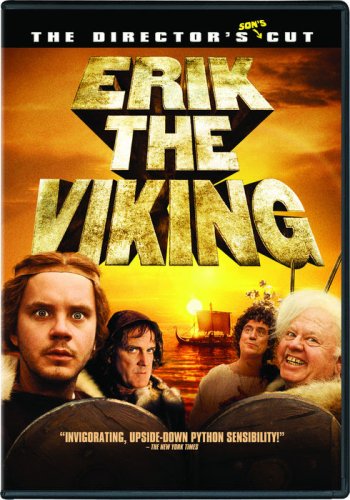
Director's cut can be a misleading term. The very definition of cut means to take away. A lot of Director's Cuts add in footage to the original release to make it longer. Then there are Director's Cuts which don't even involve the director. They involve a team which could possibly care less about whether the finished product resembles a movie or a saturday morning cartoon. Then there are Director's Cuts which involve a family member like a son. That my friends is another animal indeed.

Erik (played by Tim Robbins) never got the Viking handbook on pillaging, plundering and raping. After a bout of self realization and a talk with his grandfather (played by Mickey Rooney), he decides to take his crew aboard his ship in search of Valhalla. There he will ask the gods to end the age of Ragnorok and bring sunlight to his home once again. However, along the way he takes a Odyessey-esque journey as he encounters everything from a dragon with hay fever to the people of Hy-Brasil to a rival monarch named Halfdan the Black (played by John Cleese) that stand in his way. This begins a hilarious escapade on the Viking Life and might even involve an invisibility cloak or two.

PBS and producer Steve Boettcher have put together a rather nice time capsule. This four part series looks at four aspects of television: Late Night, Game Shows, Sit Coms, and Variety Shows. Each hour-long entry looks backward to the very infancy of the medium of television. The pieces examine the pioneers who gave birth to these genres and the innovative people who followed. There’s no question that some of the vintage clips alone are priceless, more than worth the value of a single DVD. You’ll see vintage and more recent interviews with the likes of: Dick Van Dyke, Bob Barker, Johnny Carson, Monty Hall, Merv Griffin, Andy Griffith, Betty White, and literally 100 early television personalities. From the days of live talk shows to the quiz show scandals, the series covers a lot of ground in a short amount of time. It is there that the series faces its most fatal flaw. Each of these segments will leave you wanting to know more. You’ll leave each one feeling like you’ve only heard a small part of the story.


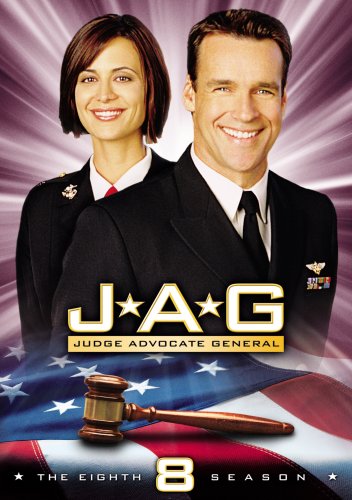
JAG or Judge Advocates General might have gone silent on our television screens in 2005, but it really remains with us in its spin-off NCIS. Both shows explore the world of military justice. Both shows are also the masterworks of successful television producer David P. Bellisario, who also brought us Magnum PI and Quantum Leap. The idea behind JAG was likely inspired by the film A Few Good Men. Most of us remember the “You can’t handle the truth” rant that Jack Nicholson delivers from the stand, but fans of the film rather enjoyed the rare look behind the Judge Advocate General’s office in our military. Like that film, JAG spends its time pretty much split in three directions.


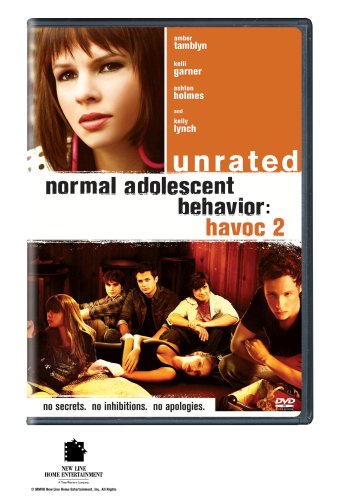
Teens seem to have a lot of angst. They like to have angst regarding what they wear or who they make friends or simply because their hair has a split end. In the middle of their angst, they form groups who share angst. These groups are more pseudo-families where they share experiences and care for each as if they resembled a sibling or a close relative. Enter Normal Adolescent Behavior: Havoc 2 where a group of 6 teenagers form a bond where only the 6 of them exists in each other's hearts. But would this bond step over the line and create a situation that one or more could not bear to take?

Wendy (played by Amber Tamblyn)is part of a group of six friends who have grown up together. They go to school together, they hang out together, and they sleep together. Yes, with each other. Any relations with other people outside of the circle are strictly forbidden. They kinda want to keep their cooties all to themselves, touching I think. Wendy and her brother Nathan (played by Daryl Sabara) meet a boy named Sean (played by Ashton Holmes). Wendy falls for the boy and the two do their best to keep it from the group. The group's un-official leader, Billie (played by Kelli Garner) finds out about the relationship and is not interested in losing her best friend or a valued member. True love is precious but hard to keep in perspective when 5 other people grow up beside and demand your utmost attention.

Fox re-releases this beloved weepie in a new edition with a number of new extras. Beyond those additions, this version is identical to the one reviewed here previously. Therefore, my deathless prose once again: “On a luxury ocean liner, playboy Cary Grant meets singer Deborah Kerr. Each is involved with someone else, but they fall deeply in love with each other. Upon arriving in New York, they decide to part and, if all goes well, reunite in six months at the top of the Empire State Building, by which time their lives should be in order. If you’ve seen Sleepless in Seattle, you know what happens next. Though this is one the most celebrated weepies ever, I found it curiously uninvolving. The banter on the ocean liner, though amusing, fails to make us believe in the depth of the relationship, and so the tragedy that comes later lacks punch. The plot meanders interminably, is padded out by Sound of Music-style songs involving sweet widdle kiddies, and the reasons for keeping the characters apart during the third act are so contrived that suspension of disbelief crashes and burns. The ‘scope cinematography is nice, and it’s always fun to watch top stars like Grant and Kerr, but if you want a more convincing heart-tugger, see Now, Voyager.”

Audio

What happened to Cuba Gooding Jr.? Since when did he have to take Eddie Murphy's sloppy seconds? The man has an Academy Award for crying out loud. OK, that was twelve years ago from Jerry McGuire, and Cuba has made Snow Dogs and Boat Trip since then, but I still kinda believe in him. After all, this is the guy who said "Show me the money" and made Tom Cruise say "I love black people!" Wasn't that great? Talent like that doesn't just fade away into bolivian like Mike Tyson would say.

Apparently Cuba didn't heed the advice that you should avoid working with kids and animals because they'll always steal the show from you. Or the advice that you should avoid crappy sequels to kids movies. Maybe he lost out to Scott Baio on Superbabies: Baby Geniuses 2 and decided never to miss an opportunity like that ever again. Maybe he needs to consider hiring a new agent. Maybe we never hear from Cuba again. Only time will tell if he can stand the test of time...

On the surface, The Kingdom appears to be a good way for Americans to relieve some stress by watching the demise of some middle-eastern terrorists. But The Kingdom is actually quite different from your standard action movie shoot 'em up. Yes, there is a lot of action, most of it occurring in the film's last half an hour, but the film asks some tough questions and is optimistic in its belief that Americans and Muslims can work towards one goal together.

Jamie Foxx plays Ronald Fleury, the leader of a FBI forensics team (Chris Cooper, Jason Bateman, Jennifer Garner) called in to investigate the bombing of a Western-workers complex in Saudi Arabia. At first his team is not wanted there, as Colonel Faris Al Ghazi (Ashraf Barhom) is leading the investigation and is determined to find those responsible himself. But when the two men realize that they are better off combining their efforts, a friendship develops between Fleury and Al Ghazi. And that is where The Kingdom works best. It gives us hope that people from different backgrounds can defeat a common enemy.

While strolling through the local Blockbuster store, I'm always amazed at how many direct-to-video sequels there are to big name movies. Sure, Bring it On was never in the Lord of the Rings echelon of franchises, but it was still a successful movie at the box-office. Yet I still can't get over the fact that Bring it On now has its own trilogy, just like LOTR.

Most of these low-budget sequels exist solely to cash in on the movie's title, which is usually unrelated to the original film. The roles are recast or characters done away with, and some dumbed-down script that rehashes the first film is approved. But every once in a while, a cheapie comes along that does more with less, and surpasses the original. See my review for I'll Always Know What You Did Last Summer for more proof of this. Usually, it has to do with the talent attached to these films. IAKWYDLS featured the sure-handed direction of up-and-comer Sylvain White, who is slated to helm the big-budget Castlevania movie, and White Noise 2: The Light was directed by Patrick Lussier of the surprisingly good Dracula 2000 and an accomplished editor.

Despite being very thoroughly dead, Jigsaw is up to his old games again. This time, SWAT commander Rigg must race against time to rescue to kidnapped fellow officers. Jigsaw's messages send him all over town, to one gruesome event after another. Meanwhile, the FBI is also on the case, interrogating the killer's ex-wife, which means the audience finds out quite a bit more about Jigsaw's backstory.

The film gets right down to work with an extremely detailed autopsy of Jigsaw, so the target audience should feel well-served. The torture devices are as baroque as ever, and the deaths are elaborately gruesome. “Elaborate” and “baroque” are pretty good terms to describe the plot as well, only not necessarily in a good way. The main problem here is excessive flashbacking (rarely a good tactic in cinematic narrative) and equally excessive reliance on the audience remembering every detail of the previous entry. On the other hand, there are some very nifty transitions between scenes, and I confess to being rather more caught up in the story than I was expecting, this many episodes in. For the most part, this is actually an improvement over the third entry. Then there's the difficulty of the ending. The need to have each film end in a twist here results in a conclusion that's borderline incomprehensible rather than shocking.

Director David Cronenberg’s masterpiece, A History of Violence catapulted him to the upper-echelon of today’s directors. Until AHOV, he’d previously worked on offbeat films that got mixed reviews, like Crash (1996), eXistenZ, and Spider, with the occasional brush with “commercial” films like The Fly.

His follow-up to AHOV is Eastern Promises, which features the same actor from AHOV (Viggo Mortensen) in another mysteriously dark role that has earned the actor a well-deserved Oscar Nomination for Best Actor although he will almost certainly lose to frontrunner Daniel Day-Lewis of There Will Be Blood.