Genre

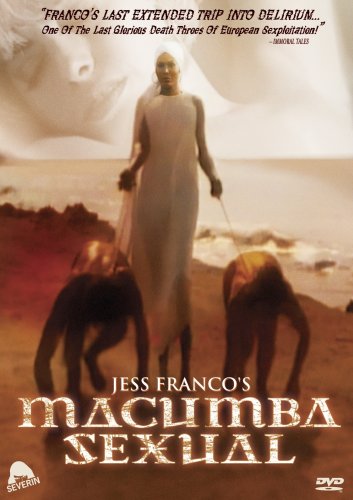
Alice (Lina Romay under her blonde pseudonym "Candy Coster") is haunted by erotic nightmares involving the Princess Obongo (the Amazonian Ajita Wilson). She therefore has her misgivings when she is ordered by her boss to travel to a remote island and sell some real estate to that very person. Doubts notwithstanding, off she goes (got up in an outfit I've never seen a real estate agent wear before) to play Jonathan Harker to Obongo's Dracula. On the island, she falls under the Obongo's spell, and becomes emmeshed in a web of sex, rituals and magic.Director Jess Franco here is reworking the plot from his Vampyros Lesbos, and even reuses some of that film's sun-bleached supernatural-by-daylight tricks. The zoom lens isn't quite as badly overused as in some of his other work, though it definitely makes its presence known. Some of the camera placements are decidedly odd (did he really want us to see Wilson's fillings as she writhes in orgasmic frenzy?), but there are plenty of very lovely shots, too, that manage to conjure a real sense of surreal beauty and mystery on a ridiculously small budget. The studied pace might well put off fans of either sex or horror, but then, that's typical Franco for you, but the film does have an oddly mesmeric effect.

Audio

Natalie Portman stars in V for Vendetta, cast in a role unlike what I typically expect from her, a dialogue driven action movie with a serious tone to it. This movie even got me thinking a little bit about mankind’s intolerance of other man and how far society has to go to protect itself. I enjoy movies of this nature, you know the kind taking place in a not to distance future and not so distant problems, but a drastically different way of life. Something these movies always have in common is the civil rights ...hat are stripped from society for “beneficiary” reasons and leadership is in the form of a dictatorship. Basically, mankind takes a step back and a docile society is brought forward. Curfew and the inability to freely express oneself via certain forms of art and music plague a futuristic England. The real question here being, would you rather live in a world with few forms of expression and the inability to be a non-conformist but with crime almost non-existent? Comparable to the movie Equilibrium before it, the people in this future must sacrifice these certain rights in order to live in a “safe” environment.

The movie also has obvious Nazi undertones; the most obvious would be the rise and rule of Chancellor Adam Sutler, which shares similar traits and action of Adolph Hitler. The way the speeches are conducted, and the way the personal army of the Chancellor have rule of the streets all seem to remind me of the Nazi regime. I believe this element of the film makes it much more real to the viewer, seeing as fear tactics have and still are being used by government officials today.

Synopsis

With Casino Royale now out in theaters and being shown to a mostly positive audience, let’s all take a step back and remember that James Bond just celebrated an anniversary in 2002 with the release of Die Another Day. The film was the twentieth in the Bond legacy, and Brosnan’s fifth (and last) in the role. How does it stack up?

(Portions of this review have been pulled from the original one-disc version of Ronin, which can also be found in the reviews portion of the site)Synopsis

I think the only thing I remember about Ronin initially was that Robert DeNiro (Heat) was involved in some scandal involving a French "house of ill-repute" or something along those lines. But when Ronin was released, people quickly forgot about that mess, as what came from it was an action film that put a little more e...fort into the characters than other action films. But that’s not to say the action scenes were neglected; the car chase scenes that negotiate through winding French country roads, and through city sidestreets so narrow you couldn’t open either car door to get out of the car, are some of the most nail biting in recent memory. Based on J.D. Zeik’s story and rewritten by Richard Weisz, a.k.a. David Mamet, Ronin’s introduction is a title card about Japanese samurai without a master, who are mission-less assassins. As a US operative named Sam, DeNiro is introduced almost immediately to the group, who include Frenchman Vincent (Jean Reno, Leon), the Russian, Gregor (Stellan Skarsgard, Dogville) and the Brit, Spence (Sean Bean, Lord of the Rings). Their liaison between them and their employer is the Irish lass Deirdre (Natascha McElhone, Solaris), and their object is a briefcase whose contents are mysterious.

Synopsis

Back when it first aired on Comedy Central in a previous incarnation as a television series, Strangers With Candy was an interesting enough premise. Take a menopausally challenged, recently released prisoner named Jerri Blank (Amy Sedaris, Elf) who decides to return home for the first time in over three decades to try and get a new start and throw her into high school. Now, not knowing how good or bad the show did, it must have had some sort of following, because there’s a movie out ...ow from which said television series is inspired.

Synopsis

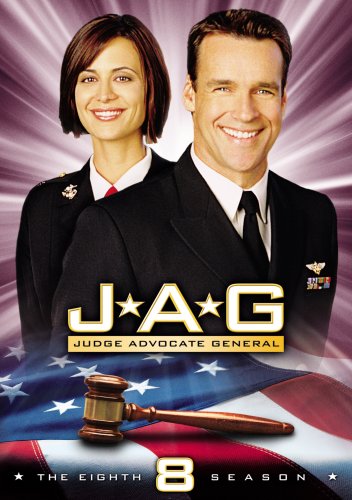
The concept of JAG is pretty simple, I mean, it’s A Few Good Men on the small screen, using sets and footage from other recent armed forces films and hopefully enough pretty people that viewers will enjoy it. However, that wasn’t the case initially, but JAG is one of those shows that helps prove how sometimes you’ve got to give enough time for people to catch onto it before it takes hold.

Synopsis

John Steinbeck, looking and sounding remarkably like James Ellroy, and coming across as surprisingly two-fisted given the overall tone of the movie, introduces a quintet of stories by O. Henry. “The Cop and the Anthem” features Charles Laughton as a dignified bum trying unsuccessfully to get himself arrested so he can spend the winter in a nice, warm prison (Marilyn Monroe is one of the top-billed, but she has only one brief scene here). “The Clarion Call” has Dale Robertson as a detective w...o realizes that a wanted murderer is, in fact, a childhood friend to whom he owes a huge debt. The friend is played by Richard Widmark, who shamelessly recycles his psycho act from Kiss of Death, right down to the hyena laugh. In “The Last Leaf,” Anne Baxter struggles to convince her pneumonic sister (Jean Peters) that life is worth living. “The Ransom of Red Chief” is the tale of two con-men (Fred Allen and Oscar Levant) who kidnap a young boy and very quickly wish they’d never clapped eyes on the holy terror. And “The Gift of the Magi,” the most famous story of the bunch, is the Christmas tale of a young couple (Jeanne Crain and Farley Granger) who give up their most treasured possessions in order to buy each other a special gift.

No monster movie is bigger than King Kong. AFI members recently considered King Kong to be the most influential film ever. The original King Kong has inspired more filmmakers, actors, and technicians than any film in Hollywood’s history. The score is considered the first modern film score. For the first time the music is timed to accent certain aspects of the action. Willis O’Brien practically invented movie special f/x with his revolutionary stop motion technique seen earlier on The Lost World. One of those filmma...ers so inspired was director Peter Jackson. It seems none of the wonderful journey that was Lord of the Rings would exist on celluloid if not for King Kong. At 12 years old, Jackson set out (unsuccessfully) to create his own version of the iconic film and has apparently dreamed of remaking it ever since. After a hopeful but aborted start in 1996, Peter Jackson finally brought his childhood fantasy to life, and was it ever worth the wait.

The first question you might ask is how does this film compare with the original or the 1976 Kong? This film simply blows away the 1976 debacle. As for the original? Obviously the 70 years of f/x progress means that Kong himself shows the greatest improvement. No question the stop motion Kong was the most spectacular thing 1933 audiences had ever seen. Today we live in a computer age where if you can imagine it someone can bring it to life. Jackson’s WETA Digital is very much like George Lucas and ILM. In New Zealand they are movie f/x. Unlike Lucas, Jackson integrates his f/x so intimately into the action that we cease to think of them as movie magic. Lucas tends to overload each scene with a “look ma what I can do” overindulgence. Andy Serkis plays the Kong character as he did with Gollum so that the other actors have something real to act against. His emotional range gives Kong a façade of realism that sucks us into the story without really thinking about the f/x. So, like the original, Kong is a real character to us, capable of feelings and deserving of our empathy When he finally slips from the tower of the Empire State Building, we share an emotional moment with Ann (Watts) that can only be possible for a real being. The film is far longer than the original. In this extended version Jackson’s Kong is about double the original’s running time. Jackson’s Skull Island, while richly detailed and far more elaborate than the original, maintains the illusion that we are in that same place. The creatures are purely magic, rivaling the best we’ve seen from Jurassic Park.

Synopsis

This is another film one feels a little silly summarising, given that it must be an exercise in redundancy. At any rate, Macy’s department store gets a new Santa, and this one (a marvellous Edmund Gwenn) insists that he is the real thing. He sets about restoring the sense of wonder in hard-nosed Maureen O’Hara and her skeptical daughter (Natalie Wood), and John Payne winds up having to prove that our boy is who he says he is in a memorable court case.

Synopsis

Michael Caine is a down-on-his-luck PI in LA. He’s hired to find the long-lost daughter of a man who is now wealthy, though being hunted by goons. Caine heads off to house of the presumed daughter’s adoptive parents. There are two women the right age here. Which one is he looking for? Could it be Natalie Wood?