Genre

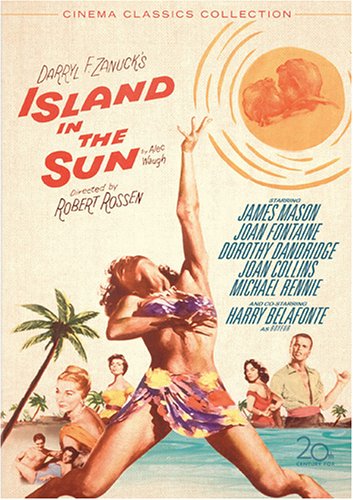
Harry Belafonte stars as an ambitious young politician, who refuses to fear the white majority that holds a foothold over his island home, in Island in the Sun. Along the way, he strikes up a romance with Joan Fontaine. Incidentally, we are supposed to believe Ms. Fontaine’s character is younger than Belafonte’s, despite the fact that she looks ten years older. Dorothy Dandridge also stars as a pharmacy clerk, who falls in love with the white aide to the island’s governor. If this seems like it’s all over the ...lace, that’s because it is. While the film was ahead of its time in factors such as race relations (with the two interracial romances above to speak of), it took a huge leap back when it came to the old standbys of narrative logic and a well-developed plot. But while I clearly did not enjoy this film, I will admit it has its values when viewed in the proper context.

The role of Island in the Sun as a classic is largely dependent on its subject matter and the time period in which it was released. A drama tackling interracial love in 1957 was hardly something that would go unnoticed, or be easily forgotten. However, when dissected by today’s audiences, the film proves to be pretty lightweight. For one, affection between interracial couples was limited to only the occasional embrace. In no way could the couples share an on-screen kiss, even if it were simply a peck on the cheek. Secondly, the story wanders about with no real plot to speak of. It’s as if the filmmakers had some ideas of what they wanted and forged ahead without the security of a well-constructed script – truly disappointing for a motion picture considered so groundbreaking. You can tell this film had Oscar aspirations. It simply didn’t realize how important a story was to achieve such lofty goals. Of course, today such omissions would not disqualify it, so long as it had an Academy-friendly agenda to support. However, there were higher standards in those days, and producer Darryl Zanuck relied on his message – and an admittedly incredible cast – to do all the work for him. The results are mediocre at best.

This short-lived series was based on the popular DC Comics character, The Flash. Barry Allen (Shipp) was a crime lab technician, long before CSI made the job trendy. When lightning interacted with an unknown chemical compound as only comic cosmic events can, Allen receives a powerful jolt. The injury results in a dramatic change in his metabolism. Now supercharged, his body is capable of moving at supersonic speeds. Complete with a bright crimson costume appropriately modeled after the swift Greek god Mercury, The ...lash uses his powers to combat crime in Central City. Help is provided by Julio (Desert), his capable lab assistant. Julio is apparently smart enough to tackle complex chemical formulas, but remains oblivious to his partner’s abilities. His secret is shared by scientist Tina McGee (Pays) who works with Allen to try to figure out the changes his body has been put through.

Every superhero has a weakness. Superman had kryptonite and Batman had… well… Robin. The Flash, it seems, can be done in by a junk food deficiency. It turns out that speed burns up an awful lot of sugar which, of course, must be replaced. I think they missed out on some great tie-in opportunities here. “Hey kids! Want to grow up big and strong with blinding speed just like The Flash? Then don’t forget a super sized bowl of Capn’ Crunch with extra sugar for a superhero breakfast.”

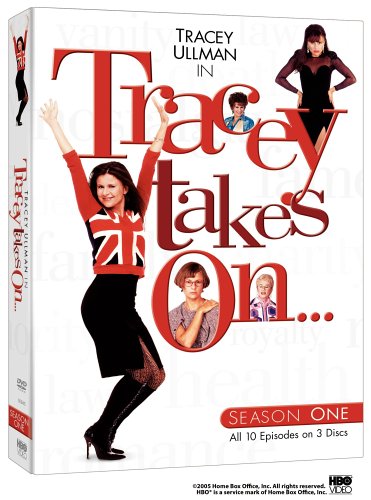
I would be a fool if I downplayed Tracey Ullman’s talent. She is a woman with anomalous abilities that most performers couldn’t dream of acquiring. She is an accomplished singer, a chameleon-like comedienne, and a serious actress – all in one unbelievable package with a multitude of awards to verify her capabilities. She’s also quite attractive when the light hits her a certain way, but she has a knack for too often burying that beauty under clever disguises. All these features result in a performer, who can do just ...bout anything she’s asked to do. But with all that said, I couldn’t bring myself to like this show. With each vignette (every 30-minute episode carries about three-to-five), I know I should be bursting with laughter, but for some reason, the material doesn’t move me. I do, however, realize a talent like Ullman’s is bound to attract fans aplenty, and to those people, I say this: I can understand your love for shows like Tracey Takes On… – but I cannot share it.

Of course, fans will be pleased to know all of the old favorites are here: the Chinese donut shop owner, the Casanova cab driver, Linda Granger, Hope Finch, Fern Rosenthal, and a large selection of other amazingly performed Tracey Ullman creations. Also, guest stars Alfred Molina, Tobey Maguire, Hugh Laurie, Danny Woodburn, and George Segal, add a degree of welcome familiarity to Ullman’s unorthodox humor. For fans of the show, this set is a must buy. It features all ten episodes of season one, which cover topics ranging from Romance to Nostalgia to Death to Fame. Each episode has clever moments. However, for me, the laughs were consistently absent. But just like some viewers are unable to rally behind Seinfeld (I’m NOT one of them), I cannot force myself to get on board with Tracey Takes On…. However, I’m certain Mrs. Ullman’s overwhelming talents and huge fan base will help her overcome the blow.

In the era of the popularity of documentaries, it seems that everywhere we look a new documentary is coming out about another subject. From Michael Moore’s look into the Bush administration’s ties with the Sauds in Fahrenheit 911, to the recent look into the world of penguins in March of the Penguins, each documentary holds something special as they bring us to a world we may have never known if it not for these filmmakers. One of the more special documentaries in recent time is an extremely powerful na...ure documentary called Grizzly Man.

Grizzly Man deals with a man named Timothy Treadwell who, for 13 summers, spent his time living in Alaska’s Katmai National Park and Reserve investigating grizzly bears. The film is like no other documentary I have ever seen. It has a certain level of power that is unheard of. The director of the film Werner Herzog, nor the actual documentary, approve of what Treadwell is doing. It’s also not too concerned with presenting the animals as marvelous creatures. The film was assembled by Herzog from some 90 plus hours of video that Treadwell shot in the wild directly interacting with these bears. Treadwell never showed any fear, despite Treadwell knowing and once saying ”If I show weakness, I’m dead. They will take me out, they will decapitate me, they will chop me up into bits and pieces---I’m dead. So far, I persevere.” Low and behold, this is exactly what does occur to Treadwell and his girlfriend.

Synopsis

Blair Underwood plays Bob Richardson, who moves from Alabama to California with his brother and parents. The African-Amercian family has high hopes of finding a new land of opportunity, but racism and poverty are just as prevalent here. Richardson becomes a reporter, and he is on the scene for the Watts riots of 1965. Families and friends are torn apart in that violence, but his reporting is a landmark work.

Synopsis

I never thought that a 90 minute documentary surrounding one joke could be so entertaining. And for all the praise that critics have heaped onto The Aristocrats, I was curious to see what the hype was. The film’s creators, comedians Paul Provenza and Penn Jillette (of Penn and Teller) spend the time interviewing many different comedians, and all of them share their thoughts about the joke. But it does a little more than that. Along with various versions of the joke, there is a deconstruction...of it from a realist’s point of view, but it takes on a deeper meaning. The joke perhaps is a larger metaphor for those who decide to go into comedy, giving them an idea of just how difficult it can be.

I will be honest and inform you that I have yet to like a video game based film since 1995’s Mortal Kombat. It seems that no matter how closely they try to follow the story based on the game, the director always fails. One of the more famous director’s in the video-game to movie based series is director Uwe Boll, who has brought us The House of the Dead and the recent Bloodrayne, These movies, as the popular consensus agrees, were extremely awful. They lacked anything redeeming, despite the orig...nal source material being pretty good. When I heard of a film being made on the game series Doom, I began to worry as I figured it would follow the typical trend of terrible video-game based movies. Can Doom reverse the horrible trend of terrible video-game based movies? Read on to find out

Doom begins with a fly in shot over the red planet Mars. We move in more and see the Olduvai Research Station, which is a remote scientific facility on Mars. And that is the last scene we see of the planet Mars. For a movie based on a game that takes place on the red planet Mars, we never fully see the planet except for the opening scene. Maybe this is me wanting what I saw in the game series. But every film director has to take a few creative liberties right? Well, I am very disappointed to report to that director Andrzej Bartkowiak and Universal seem to have taken a few too many creative liberties when making this film as the film is nothing like the game at all.

Synopsis

Disney has released a DVD that appears to be part of a compilation, and provided some karaoke subtitles and marketing it as a sing-along entitled “You Can Fly”. With animated (but dated) introductions by Disney characters, the songs featured are from such films as Peter Pan, The Jungle Book, Mary Poppins and Dumbo.

Synopsis

Danny Glover is a Sergeant in a cavalry regiment of African-American soldiers. He and his men are tasked with tracking down Apache leader Victorio, who has proven himself to be a brilliant and dangerous fighter. This mission would be difficult enough, but there is also the deep prejudice of the white commanding officers to deal with.

The opening titles of this film are a bit misleading. The font is a colorful, comical display played against animation more suitable for the opening of a Pink Panther film. Instead of a comedy, we are presented with a film likely to appeal to a very limited audience. To the film’s credit, it doesn’t abandon the themes and style it intends to portray in an effort to gain more mass appeal.

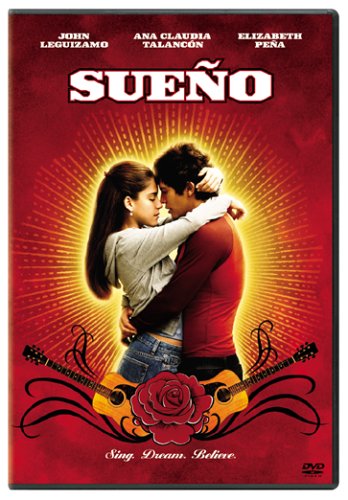
Antonio is a young man living in Mexico. His dreams are filled with playing music. Like most young ambitious music...ans he longs for the “big time”. When his mother dies, Antonio travels to America where his uncle has painted a picture of a golden field of dreams which turn out to be a rundown taco stand. We’re not really told if the move to America was under legal circumstances or not. Still, Antonio uses every spare moment to capture his musical career. The chance comes in a Latino band competition. The prize is $10,000 and a chance to perform with a big “mystery musician”. Suddenly we have a film with an abundance of clichés. Throw into the mix a mistaken romantic triangle and the stage is complete. It’s no real surprise how any of this turns out.