Genre

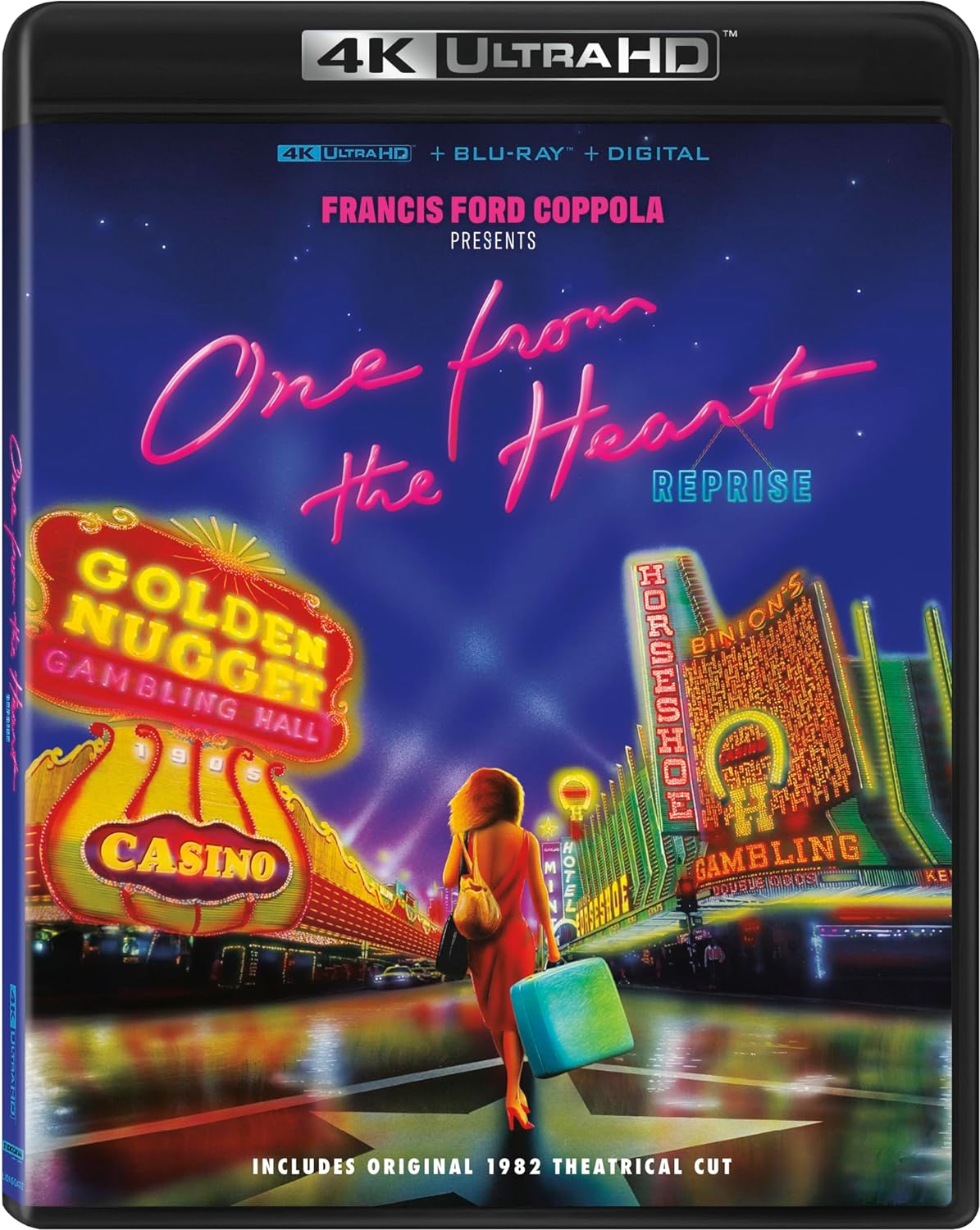
Francis Ford Coppola is one of those directors that you don’t have to love, but you have to at least appreciate his contribution to cinema. Personally my favorite film of his is Apocalypse Now, and then The Godfather II. I know other film geeks out there will argue with what his ‘best” film is, but I think it’s fair to say he’s one of the greatest film directors out there no matter how you may rank his films. When the chance to review One From The Heart came along I jumped at the opportunity, because, well, it’s a film I had never actually seen or even knew that Coppola had done. In watching the bonus features on the disc, I found it amusing that this was supposed to be a simple film for him to do after the insane task of directing Apocalypse Now. This was supposed to be a simple rom-com with a budget of $2 million, but things got out of hand. Coppola bought a studio for his American Zoetrope company and used all the studios stages to build sets for the film,

"Consider what you are about to do."

I first read Frank Herbert's initial Dune book back in the mid 1970's. I was introduced to one of the most complicated and extraordinary universes of literature I have still ever encountered. It's a masterpiece followed by several more books over the years that have more completely brought this world to life. The material's cinematic journey has been somewhat less captivating and quite a disappointment. The 1984 David Lynch film was a train wreck and quite possibly one of the greatest film failures in history. Since then a lot has changed. Today computer-generated images have progressed to the point that with enough money and artistic expertise a filmmaker can depict anything the mind can conceive. Images have become photorealistic, and the worlds of Herbert's Dune universe can finally be brought to the silver screen with almost no limitations.

"The thing that haunts me are all the guys that I couldn't save."

I have to admit I was a little skeptical that Clint Eastwood followed up his directing stint on Jersey Boys as quickly as he did to shoot American Sniper. The former was far from one of his better efforts, and he looked increasingly out of his element by the time it was said and done. He jumped into his preparation for American Sniper almost immediately, and the results could have been ... underwhelming. Instead Eastwood hit his target with the kind of profound impact I don't think I've seen from him since Unforgiven. Unforgiven won a Best Picture award, and deservedly so. American Sniper was nominated, although Eastwood himself was snubbed in the director category. It didn't win, of course, but this is one that most certainly deserves your attention.

"People scare better when they're dyin.'"

Mention the name Sergio Leone and you immediately think of Clint Eastwood and their Man With No Name trilogy. The truth is that Leone was the master of the spaghetti western and largely responsible for making Clint what he is today. When the Italian director decided to try his hand at Hollywood, he was welcomed with open arms, except they weren't interested in anything but an American copy of a spaghetti western. Leone had something else in mind. He had a "been there, done that" attitude about the westerns and wanted to do an epic called Once Upon A Time In America. But Hollywood was hearing none of that. So they compromised. If Leone delivered a stylistic western, the studio would spring for the epic he wanted to make. The result of that parlay turned out to be Once Upon A Time In The West.

As many of you know, there isn't a type of media that I don't enjoy reviewing.  Sure, my film reviews are most numerous, but I have also dabbled in books, video games, and music when it comes to critiquing.  Music is really fun, because I'm one of the few people I know that will literally dissect every song whether it is a hit or a throwaway.  Needless to say, I almost never hold back.  So imagine my excitement when I come upon a new anime that blends an interesting story with the amazing style of jazz music.  I honestly don't even listen to jazz, but the chance to expand my musical repertoire is something I crave to do.  Let's take a look at Blue Giant.

As is sometimes the case when you write a review, one does not have the fortune of doing everything in its exact order.  I was extremely excited when I found out I was reviewing the second part of Justice League: Crisis on Infinite Earth.  4K steelbooks are pretty hard to come by for review copies, and I was quite elated.  One little problem: I had not been able to watch the first part of this planned trilogy.  As I racked my brain and started to flip through some streaming channels, I was very fortunate to come upon HBO Max, which had placed the first part on their service only a few days ago.  Sometimes, it pays to be lucky more so than good.  Let's take a look at the second part and see if it can start to answer the questions left behind from the first.

"People once believed that when someone dies, a crow carries their soul to the land of the dead. But sometimes, something so bad happens that a terrible sadness is carried with it, and the soul can't rest. Then sometimes, just sometimes, the crow can bring that soul back to put the wrong things right." 

OK, let me get this out of the way. The Crow was a vehicle for Brandon Lee, son of martial arts legend and movie star Bruce Lee. The elder Lee trained Brandon in martial arts from the day he could take his first steps. When Brandon was only eight years old, his father tragically died just before finishing production on Enter the Dragon, a movie which would go on to become an international blockbuster making Bruce Lee the greatest icon of martial arts cinema. Brandon followed in his father’s footsteps studying martial arts and drama.


"The honeybee has always had a special relationship with humanity. A sacred relationship. Why? No bees, no agriculture. No agriculture, no civilization. Our nation is not unlike a beehive, with its complex systems of workers, caretakers, even royalty. If any of the beehive's complex mechanisms are compromised, the hive collapses. Someone, a long time ago, decided that a mechanism was needed to keep our nation safe -- a mechanism outside the chain of command, outside the system. It's one mission -- to keep the system safe. Beekeepers are given all resources, empowered to act on their own judgment. For decades, they have quietly worked to keep the hive safe. That is, until now. It appears that a retired Beekeeper has gone off program, and is acting in what he mistakenly believes is the hive's best interest."

On its surface, The Beekeeper seems to be another mindless action film featuring a retired assassin or skilled operator forced out of retirement to right an injustice. Granted, those themes are central to the overall story; however, in my opinion, the film embraces those themes and provides a measure of excitement and substance to a premise that could have easily become basic.

"Good to be back. We knew all along that everyone back home from the President on down was behind us 100%. It was God and faith in our families that kept us going. Speaking for myself, I'd like to say that the whole experience has made a better man, a better officer, and a better American out of me. Thank you very much."

It started in the 1970's just as the long and costly war in Vietnam was finally coming to a close. The conscience of the American people shifted from trying to stop the war to the soldiers who were now coming home and mourning the ones who didn't. There was also this group that fell somewhere in between. It took a long time to get the North Vietnamese to even acknowledge the number of POW's still held in captivity and the push was to bring them home. Suddenly Hollywood was on the bandwagon, and there appeared the war sub-genre that focused on these returnees, particularly those held prisoner. Films Like Missing In Action brought the subject to the front of moviegoers' attention, and other films like The Deer Hunter gave us a look at the psychological damage many returned to be haunted by.

by Joshua Nuances

"I don't want to be a product of my environment. I want my environment to be a product of me. Years ago we had the church. That was only a way of saying - we had each other. The Knights of Columbus were real head-breakers; true guineas. They took over their piece of the city. Twenty years after an Irishman couldn't get a f$#@&% job, we had the presidency. May he rest in peace. If I got one thing against the black chappies, it's this - no one gives it to you. You have to take it."

The Departed, a basic remake of the Hong Kong film Internal Affairs, tells the story of Boston mob boss Frank Costello (Jack Nicholson) and his ruling ways of the streets.