Posted in: Disc Reviews by Archive Authors on September 1st, 2006
Synopsis
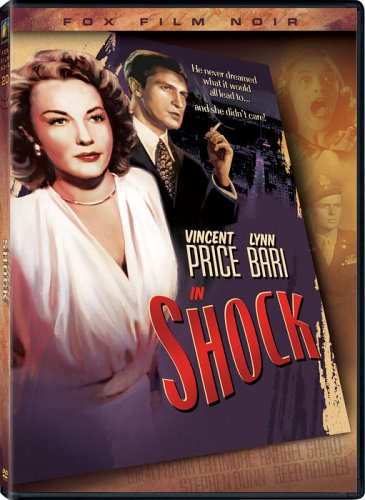
Young bride Anabel Shaw arrives at a San Francisco hotel to meet her husband, on his way back from a POW camp. His plane is late, and as she anxiously awaits him, she witnesses Vincent Price kill his wife in the next room over. She lapses into shock, and is found in this state when her husband arrives. The best psychiatrist around is summoned, and uh-oh, that turns out to be Price, who realizes why Shaw is in shock. He has her carted off to his private clinic, where he and lover Lynn Bari pl...t to keep her in shock permanently.
Posted in: Disc Reviews by Archive Authors on August 23rd, 2006
Synopsis
Imagine my surprise that there was a miniseries made about the threat of bioterror, and that this cloak and dagger miniseries (that aired at some time on network TV) sported two Oscar winners, neither of them men! Anjelica Huston (Prizzi’s Honor) and Mira Sorvino (Mighty Aphrodite) are part of a wide ranging series that is set over several continents, and explores the possibility of a bio-terror attack in the US.
Posted in: Disc Reviews by Archive Authors on August 15th, 2006
Synopsis
Robert Mitchum shows up twice here, as does Robert Ryan. The two clash in The Racket (1951), where Mitchum is the incorruptible cop, and Ryan is the old-school gangster whose brutally direct methods put him in conflict not only with Mitchum, but with the more sophisticated crime syndicate spreading over the land. The focus of the film is rather split between the two, but is pretty tense, and is further enlivened by a memorably sleazy turn by William Conrad as a VERY corrupt cop.
Posted in: Disc Reviews by Archive Authors on August 8th, 2006
Synopsis
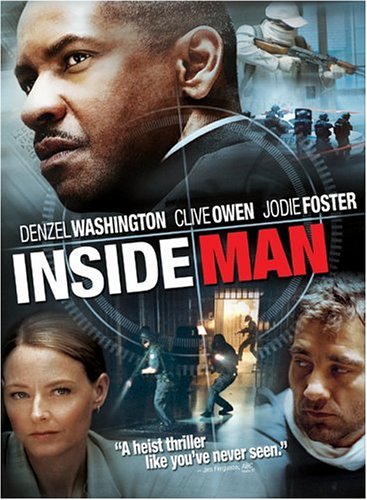
A group of masked criminals, led by Clive Owen, take over a Manhattan bank and hold everyone there hostage. Denzel Washington arrives on the scene as police negotiator, and he rapidly finds that his opponent is extremely clever, and appears to know every move the police will make even before they do. Complicating matters further is the arrival of Jodie Foster, an ice-cold fix-it woman hired by bank-owner Christopher Plummer to protect his interests: there is a safety deposit box he desperate...y wants to avoid having opened.
Posted in: Disc Reviews by Archive Authors on July 28th, 2006
Synopsis
Starting in 1937, Peter Lorre starred in a series of eight films about the Japanese detective. In this set are the first, second, fourth and fifth in the franchise. WWII put an end, of course to a series with a Japanese hero played by a German-speaking actor. Whatever one might think of racist stereotypes (and it is best, in viewing such films, to try not to think of them at all), these are enormously entertaining programmers.
Posted in: Disc Reviews by David Annandale on July 10th, 2006
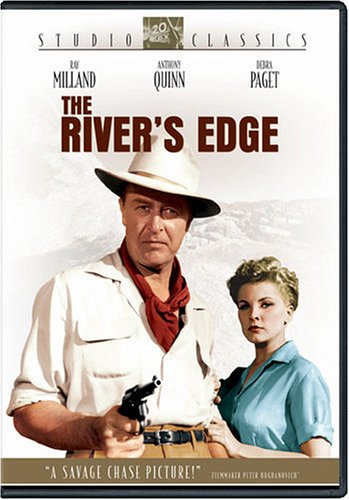
Career criminal Ray Milland shows up at the ranch of Korean vet Anthony Quinn, looking for his old flame, Debra Paget. She is now married to Quinn, but she hasn't adapted well to country life, still carries a torch for Milland, and is in the very process of leaving Quinn. She and Milland rekindle their romance, and are planning to leave town with the million dollars Milland has just scored. When Milland runs over a state trooper, he forces Quinn to guide them through the wilderness to the Mexican border. A struggle for both survival and Paget's love ensues.A welcome reminder of when thrillers didn't have to be two-and-a-half hours long, this is a tight, swiftly paced peace of work. Despite the great physical difference between them, Milland comes across as a worthy adversary for Quinn, there's a great cynical anger to the characters, and the violence is pretty brutal for its era. The location settings tend to make the studio exteriors all the more obvious, but this is a minor quibble This is a fine western noir, worthy of rediscovery.
Audio
Posted in: Disc Reviews by Archive Authors on June 22nd, 2006
Synopsis
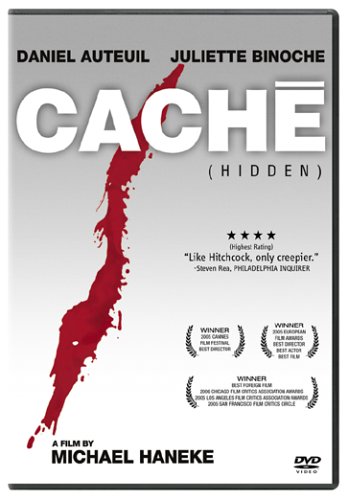
Daniel Auteuil, host of a literary TV talk show, and his wife Juliette Binoche begin receiving strange videotapes. These are hours-long recordings of the front of their house. Nothing else. No explanations. Then child-like but disturbing drawings start to accompany the tapes, and the recordings begin to be of other locations, suggesting that all of this has something to do with Auteuil’s distant past.
Posted in: Disc Reviews by Archive Authors on June 11th, 2006
OK, I hope I'm not diving into a review that may fall into the "film scholar" category, and thus rule me out of being taken seriously. When there's a lull in buying new releases, sometimes my wallet gets cabin fever, and so I went out and picked up the Hitchcock set from Criterion, entitled Wrong Men and Notorious Women: Five Hitchcock Thrillers 1935-1946, and includes the previous Criterion releases from Hitchcock, namely Rebecca, Notorious, Spellbound and The Lady Vanishes. I'm tackling the earliest release of the bunch, entitled The 39 Steps. The story very much resembles another of Hitchcock's later works, North by Northwest, in the aspect that the wrong man is thrown into a spy chase. While Cary Grant is taken through New York, a cornfield, and Mount Rushmore in the later film, in The 39 Steps, Richard Hannay, played by Robert Donat, attends a Music Hall production, meets and takes home a women (Annabella Smith, played by Lucie Mannheim), who he later finds out is a spy who is being chased by two men attempting to kill her. In the middle of the night, Annabella comes into Richard's room, and falls over him, dead of a knife in the back. As the police chase him, looking to detain him for the murder, the two men, assuming that Richard has found out about the secret she held, start to pursue him in order to kill him. And whatever he does, some of Anabella's last words to him are not to trust a man missing the tip of his right pinkie (It sounds strange to write the word "pinkie" in a review of Hitchcock, so I hope it looks out of place as you're reading it).
This was one of Hitchcock's last works before coming over to America to wow us with the movies that have become legend. For all of my DVD collecting, I'm still a bit green when it comes to the older stuff. And after seeing The 39 Steps, I now realize what I've been missing. For its time, it's a pretty suspenseful film, with a lot of shots that are still used in movies today, and even the story has been used in some fashion or another over the years, though clearly not to the same effectiveness that Hitchcock has done. Despite the "Born On" date for this film, it's a very good one, and to see many of the same devices used today, both within the story and within Hitchcock's technical realm, make it an easy recommendation to those who are even casual film fans.
Posted in: Disc Reviews by Gino Sassani on June 1st, 2006
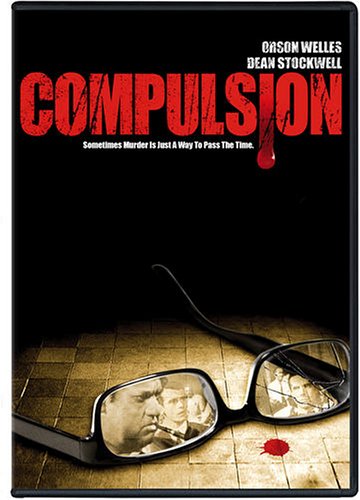
This film’s slogan was “Sometimes murder is just a way to pass the time.” A better way to fill up those empty minutes would be to watch this film. The film is based on a highly publicized real life case out of Chicago. A play was produced in the 1920’s. A book would also be written by Meyer Levin, which is the source material for this film. The story would not end there. It would be made at least twice more, including Hitchcock’s first color film, Rope. The case was perhaps made famous as much for the presence of Clarence Darrow as the defense attorney than for the senseless act of violence it represented.
A college classroom philosophical discussion opens the film and sets the stage for the crime. Judd Steiner (Stockwell) and Artie Strauss (Dillman) are intrigued by the Nietzchean concept of a superman. We’re not talking Clark Kent here. The idea is that a man of superior intellect could, and perhaps should, move through the world acting without the constraints of remorse or common law. These two guys see themselves in this role and commit a brutal murder as a sort of experiment. There really isn’t much of a whodunit. The prosecution soon stumbles upon a pair of eyeglasses that ultimately bring the two men down. Enter world renowned lawyer Wilk (Welles). He quickly finds he can’t argue innocence, so he diverts his attention to keep the young boys away from the gallows. It is in the trial version of the film that interest mounts. Welles delivers one of his best and yet most subtle performances here. The role is akin to Marlon Brando’s in A Dry White Season. His passionate closing statement is likely one of the cinema’s longest monologues.
Posted in: Disc Reviews by Archive Authors on May 30th, 2006
Sometimes, I get a bit of an impulse buying urge. And a while back, I went and got a spiffy Philips 727 DVD player (which I've since replaced with a Toshiba upconverting unit). Sure, it's not a higher end player or anything, but for $80 and a hack using the remote control, it's now become a decent multi-region player. So after testing out a friends borrowed Region 2 disc to see if the hack worked, I picked up a couple of movies from eBay and Amazon.UK, so I'll do the occasional Region 2 review.
For whatever reason, there are instances where the US gets yanked by the shorthairs with the occasional DVD release. If you were going to buy this movie, would you want the release that just has an anamorphic transfer and 5.1 soundtrack? Or would you want the one that has the anamorphic transfer and 5.1, along with two commentaries, as well as a 2nd disc of short films, deleted scenes and documentaries? So that's what I did. And my wife, bless her heart, is patient with me through all of this. She even watched this with me over the weekend and liked it. I've still got the bruises on my arm from where she squeezed hard.