Signature Series

“When you wish upon a star. Makes no difference who you are. Anything your heart desires will come to you. If your heart is in your dream, no request is too extreme.When you wish upon a star, as dreamers do… Like a bolt out of the blue, fate steps in and sees you through. When you wish upon a star, your dreams come true.”

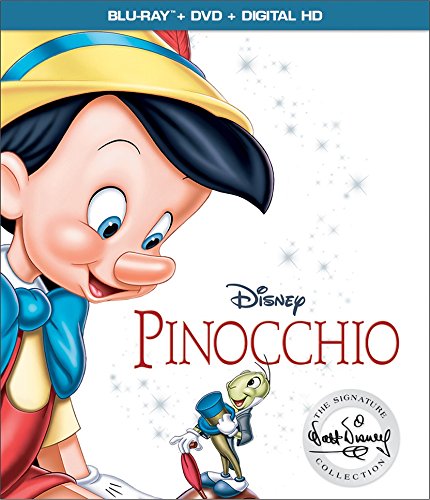
The song has become a standard. Every kid knows it. Walt Disney Studios has made it their theme song. You hear it each time you load up a Disney disc. If you have been fortunate enough to have visited Walt Disney World, you’ve heard it the entire day long. We know the song, but did you know where it originated from? It was back in 1940 and the release of Walt Disney’s, in fact, the world’s, second ever feature-length animated film: Pinocchio. Now Disney brings us this timeless classic on high definition and Blu-ray. What a marvel this release is.

“Greed is Good.”

No other cinematic phrase described the 1980’s better. And no other movie captures the financial corruption of the 80’s better than Oliver Stone’s Wall Street. Bud Fox (Charlie Sheen) is a small-time stockbroker, making cold calls to businessmen who won’t give him the time of day. His father, Carl (Martin Sheen), is a hardworking airline mechanic for a fledgling airline and is worried about the path his son is headed down when big-time investment broker Gordon Gekko (Michael Douglas) takes Bud under his wing. At first, Bud loves the money, the women, and the power that Gekko gives him. But when Bud involves his father in one of his investment schemes, he sees Gekko for the greedy slimeball he really is, and starts to see the error of his previous ways.

Among the more unjustly ignored performances was Jack Nicholson’s turn as union boss Jimmy Hoffa in Hoffa. Fox finally decided to put out the Danny DeVito-directed, David Mamet-written film on DVD. Mamet’s script seems to romanticize Hoffa, portraying him as more of a union man, as one who was forced to make deals that could compromise his integrity, but he overlooks his integrity in order to help benefit the American working man. The story is told in the point of view of Hoffa aide Bobby (DeVito), a fictitious character whose flashbacks are used to help us see how Hoffa perhaps should be viewed, as opposed to the punchline in some jokes we may make now.

As is usually the case with Mamet’s screenplay, the dialog is well-written and engrossing, and Nicholson’s portrayal of Hoffa is both powerful and persuasive. You see him with a prosthetic nose and hairpiece, along with a couple of dental devices that get the look of Hoffa down to a T. In DeVito, a longtime real-life friend, one who knows his ins and outs, Nicholson pulls out all the stops. Recent Nicholson performances seem to glide along on a gentle stride, using the occasional (and very effective) use of his noteworthy eyes. But in Hoffa, he’s a guy who is clearly more animated, as the role dictates, and it’s a much more dynamic performance than you’re used to seeing. Is Hoffa historically accurate? Probably not, and God knows there are more informed people who will tell you so. However, DeVito does manage to use the time period where Jimmy feuded openly with Robert Kennedy to great effect, using the congressional hearings as an interesting start of a plot device that helps provide an interesting hypothetical on Hoffa’s possible Mafia ties. With an outstanding supporting cast including Robert Prosky (Hill Street Blues), the late JT Walsh (Sling Blade), Armand Assante (Q & A) and a very young John C. Reilly (Chicago), the movie’s overall impact is very clearly felt.

“Did you pick your feet in Poughkeepsie?... Have you ever been to Poughkeepsie?... When you were in Poughkeepsie, you sat on the edge of the bed, didn’t you? You put your fingers between your toes and you picked your feet…. If I can’t bust you on this other thing, I’m going to bust you for picking your feet in Poughkeepsie.”

There can be no argument on this point. The 1970’s was a golden age for the cinema. When you think about the iconic characters and films the decade produced, it’s hard to contradict the point. Films like The Exorcist, The Godfather (both parts), Jaws,  Dirty Harry, Star Wars, Superman The Motion Picture, The Sting, Rocky, Deliverance, Apocalypse Now, Alien, One Flew Over The Cuckoo’s Nest, and yes, The French Connection. They redefined film genres. The slasher film was born in the 1970’s. Their influence is felt on nearly every film today, and inspired nearly every new filmmaker to come along in the years since. Yes, there were golden eras before then, but I’m not sure there’s been one since. Of course, there have been truly great movies since, but can you remember a decade with that kind of a run?

Tom Hanks is sometimes called this generation's Jimmy Stewart. In an odd sort of way, that is sort of a compliment to both men. Both are extraordinary actors who have secured a place in film history as the best of their time at playing the everyman. While such a role would doom other actors to being typecast as the all-time greatest supporting actor, both Hanks and Stewart have been able to pull off the role with amazing versatility.

Clearly, this is not the definitive set of Stewart's work as an actor. For t...at, you would have to include his roles in Alfred Hitchcock's Rear Window and one of my all time favorite films, Vertigo. Of course, Frank Capra's It's a Wonderful Life would also have to receive special treatment. The Spirit of St. Louis, which is in this set, would also be there. But what about The Philadelphia Story or Mr. Smith Goes to Washington, you might ask? Yes, those would have to be there too. We are now approaching the problem with putting together a set of Stewart's best movies. If you were to truly include his greatest films, you still might be left with a 20-disc box set. It's best to look at this release for what it is, and not try to play the “but where is...” game. That is a dead end road.

I've said it before, and as long as Warner Brothers keeps putting these classic discs out, I am going to keep on saying it. No studio respects their classic film catalog like Warner's. They have done marvelous things with their special editions of classic films, such as their fantastic 2-disc tin box release of King Kong. They have the largest collection of classic films on the planet, including the entire RKO Pictures catalog, and they are succeeding in introducing an entirely new generation of film fans to the best that cinema has to offer.

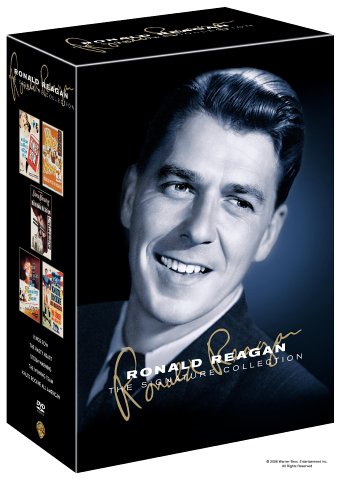
In addition to their wonderful single-title releases, they started releasing “Signature Collection” boxed sets of a couple of years ago. These are sets of films featuring a single actor or director, and they are packaged in beautiful boxes, complete with the original artwork for each film. This time around, they are focusing on five films by Ronald Reagan. Included in this box is the 1942 Best Picture nominee King's Row, 1949 film The Hasty Heart, the surprising (and way ahead of its time) drama Storm Warning, the inspirational baseball film The Winning Team and the beloved film Knute Rockne All American, which reminded the world to “win one for the Gipper”.

Synopsis

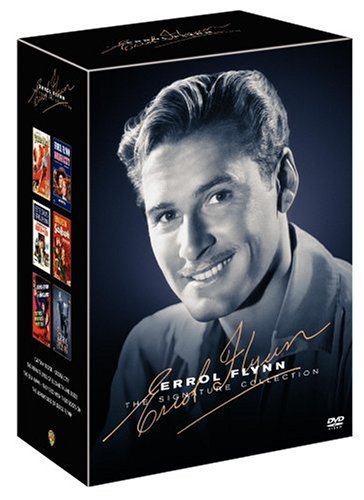
Captain Blood (1935) is the picture that made Errol Flynn a star, and paired him for the first time of many with Olivia De Havilland. There had been pirate movies before (Douglas Fairbanks was the star in them), but this became the new high watermark of the genre. Flynn plays a doctor who is unjustly accused of treason and shipped off to a life of slavery in the colonies. He fights back, eventually becoming the pirate of the title, but always remaining an honourable man, of course. Th...s is a terrific swashbuckler, and its worthy descendant today would not be the entertaining but shallow Pirates of the Carribean, but Master and Commander.