Special Edition

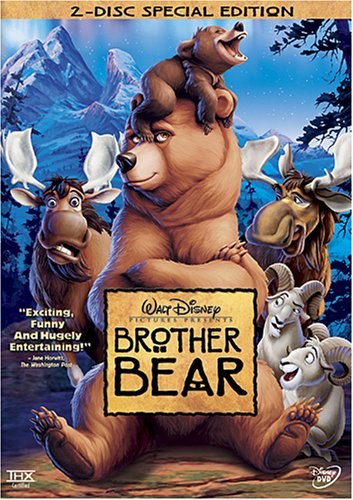
Brother Bear is the story of a boy who becomes a man by becoming a bear. Kenai (Joaquin Phoenix) is a young man set on revenge against a bear he feels is responsible for his brother’s death. Going up against the beast and winning the battle, the great Spirits who guide Kenai transform him into a bear himself. As Kenai tries to undo the spell placed on him by the spirits, he meets Koda (Jeremy Suarez) a young cub who was separated from his mother. As the story unfolds Kenai becomes more find of Koda and “adopts... him, however, his main desire is to once again become human. Kenai’s journey takes himself and Koda to the salmon spawning grounds where they meet a group of other bears led by a huge black bear voiced by Michael Clarke Duncan. It is here that we learn that Koda’s mother was the bear that Kenai did battle with at the beginning of the film – he learns that Koda’s mother was attempting to protect Koda from ‘the hunters’ i.e Kenai and his brothers. Because of Kenai’s anger at the bear he attacked and as a result is the reason for Koda being without his mother. The climax of the movie comes when Kenai faces off against his remaining brother who believes that Kenai, in his bear form, is responsible for the death of Kenai and their older brother. While Kenai tries to avoid harming his brother he is torn when his brother starts going after Koda. Kenai does his best to protect Koda and at this point the spirits intervene and transform Kenai back to his human form. Kenai is finally reunited with his brothers but his joy is overcome with the responsibility that he feels for Koda and in the end makes the decision to remain as a bear and care for his brother bear.

While this sounds very serious, the comedy provided here is some of the best that Disney has offered in a long time. Now I am a huge SCTV fan so keep that in mind. The comedy relief is provided by Rutt and Tuke, a couple of moose voiced by none other than Bob and Doug themselves, Rick Moranis and Dave Thomas. How cool is that? And where else are you going to hear a line like, “How do you total a mammoth (referring to the trip that they all took on the backs of a herd of mammoths that Rutt and Tuke ‘crashed’ offscreen)?”

Not that there was anything wrong with the picture and sound of the previous Superbit release. But now Panic Room returns in a package that truly contains every imaginable extra, and then some.

Synopsis

SynopsisFive films here, making a very coherent package.Persona is probably the most famous of the bunch, and is arguably Bergman’s mosticonic film. The images are among the most famous in cinema, though they are slightly moredifficult to take seriously thanks to SCTV’s parody. The plot concerns Liv Ullmann as an actresswho has suddenly fallen silent, and Bibi Andersson as the nurse hired to look after her. In theface of Ullmann’s silence, Andersson talks and talks ...nd talks, and her identity is graduallystolen by Ullmann. But this is really a meditation on the nature of storytelling and filmmaking, asthe startlingly postmodern imagery constantly disrupts the narrative.If Persona can be considered a psychological thriller, then Hour of the Wolf isBergman’s gothic horror film. As Max Von Sydow succumbs to madness, tormented by spirits thatmay be imaginary (or may not), the film is very much in the spirit of the Italian gothic filmsbeing produced at the same time.Shame is Bergman’s take on the horrors of war. Ullmann and Von Sydow are the couple whose lives are destroyed by a conflict they do not understand. These are all dark films, and thisis one of the most uncompromisingly bleak.The Passion of Anna is more personality disintegration, and is the first of this set(chronologically) in colour. I’ll confess that I prefer the luminous black-and-white of the others,but the effect does humanize the movie somewhat. This time around, secrets from the pastdisrupt and destroy the lives of four people, including Kinski and Ullmann.Odd man out in this collection is The Serpent’s Egg. Shot much later (1977,compared to the late 60s for the others), and on a much bigger budget, this is the story ofUllmann and (wait for it) David Carradine encountering the nightmare of rising Nazism in 1920sBerlin. The genre Bergman is playing with here is film noir. Not as highly regarded as the otherfour (which are widely hailed as masterpieces), its inclusion in this set might lead to its re-evaluation.AudioAll the films are mono. There has been no messing around with stereo remixes, which is agood thing. Such treatment would be very inappropriate with these films, which have a verycarefully constructed aural environment. What is even better is the clarity and cleanliness of thesound. There is no hiss at all, and so we have beautifully rendered soundscapes where the totalsilence is as important is crashing cacophony. (Persona is a particularly good example ofthis principle in action.)VideoExcellent picture quality on all the prints. Sven Nykvist’s gorgeous cinematography isbeautifully rendered, and nowhere better than in the black and white films, where the grey tonesare jaw-dropping. The clarity is excellent, the tones luminous. There is no noticeable edgeenhancement (or not much, anyway), and the contrasts are beyond reproach. Now and again,there is a bit of grain, but very little, especially when the vintage of the movies is taken intoaccount. All the features are in their original aspect ratios, all of them in 1.66:1 (except forPersona in 1.33:1).Special FeaturesAll five films come with a commentary track. David Carradine does the honours on TheSerpent’s Egg, and has many behind-the-scenes anecdotes to recount. Bergmanbiographer/film professor Marc Gervais comments on the other four. Though he does sometimeslapse into unhelpful rhetorical questions about what’s on the screen, he is still an interestingspeaker, and provides a real sense of commentary from film to film, and so the set becomes an-in-depth course on Bergman. Gervais also turns up on all the featurettes (about a half-hour each)for each film, and Liv Ullmann is the other constant presence. Gervais goes solo on TheSerpent’s Egg short extra on the film’s relationship with German expressionism and filmnoir, and his recontextualization of the film is most helpful. The films are also accompanied by aphoto gallery and theatrical trailer, while The Passion of Anna has Bergman’s short story(which his uses instead of a screenplay) read by Elliott Gould.There is a sixth disc, and this one provides more general background to Bergman and hisfilmmaking. There are two (rare) interviews with the director: “Intermezzo” (a 40-minutedocumentary from 2002) and “An Interview with Ingmar Bergman” (from 1970). DP SvenNykvist’s contributions to the films can hardly be overstated, and he is given his due with “SvenNykvist: With One Eye He Cries.” “Fårö Island Mystique” explores the island which served assetting for many of Bergman’s films (and was also his home). A special issue of AmericanCinematographer (from April 1972) is reprinted, providing six articles on Bergman. Andthere’s another photo gallery.” The menus have scored main screens, but are otherwisebasic.Closing ThoughtsSome of the most important films from one of cinema’s most important directors.Essential.Special Features List