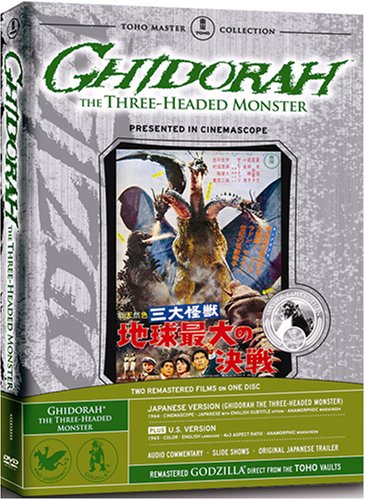
Posted in: Disc Reviews by David Annandale on June 8th, 2007
There's a heat-wave in January, and dozens of meteorites are falling from the sky. The plane carrying a princess explodes, but the princess has somehow survived, though she has no memory of her former self and believes herself to be Venusian, come to warn humanity of impending calamity. In due course, this calamity arrives as one of the meteorites transforms into King Ghidorah. Earth will be destroyed unless Mothra manages to convince Godzilla and Rodan to stop fighting each other and instead take on King Ghidorah.
This follow-up to Mothra vs Godzilla marks the point at which the series definitively took a deliberate turn for the comic, for good or ill. The slapstick had already been present in King Kong vs Godzilla, but now it would be here to stay. The storylines would also become more and more outlandish. The monster battles here are largely in the countryside, thus cutting costs on the expensive destruction of city miniatures. Whatever one's feelings on the direction the series took from this point on until the late 70's, the wrasslin' is still a lot of fun, both exciting and funny. However, it is far too long in coming. The monsters have far too little screen time, taking backseat to the rather uninteresting (but much cheaper to film) human stories.
Posted in: Disc Reviews by David Annandale on June 8th, 2007
A mysterious new planet is discovered, and an expedition there discovers a civilization under threat from King Ghidorah. The inhabitants of Planet X ask to transport Godzilla and Rodan to their home for help. Earth agrees, and at first it seems that all has gone well, as Godzilla sends Ghidorah packing. But then it turns out that the Xians are actually invaders, and plan to use all three monsters to subjugate Earth.
If you thought Godzilla grabbing at his butt after being zapped by Ghidorah in Ghidorah, ...he Three-Headed Monster was silly, just wait for the infamous victory jig here. So yeah, the juvenile nature of the series is pretty much set in concrete by this point. This is also the first time of many that aliens will plot our conquest and using monsters somehow figures into their dastardly scheme. That said, the plot is livelier and more entertaining than the previous entry’s.
Posted in: Disc Reviews by David Annandale on April 2nd, 2007
Godzilla and Anguirus are discovered duking it out on a deserted island by two pilots working for a fishing fleet. Before long, the brawl makes its way to Osaka, devastating the city.
And that, as they say, is just about that, as far as plot goes. There's a fair bit of business about our heroes' friendship, and references to their private lives, but nothing that really has much of an impact on the plot, which remains one of the most basic in the entire Godzilla series. Lacking all of the first film's tragic grandeur and emotional punch, this film stands or falls on the strength of the monster scenes, and these, it must be said, are pretty damn good. The fight in Osaka is especially satisfying, and there is none of the horsing around that would show up in the later movies. The climax is overlong and rather static, a real disappointment after the spectacular second act. Still and all, for too long the film has been available only in the butchered US version, and on an VHS recorded in LP mode, so for Godzilla fans, this is an exciting release.

Posted in: Disc Reviews by David Annandale on April 2nd, 2007
A ferocious typhoon washes up a giant egg on Japan's coast. Unscrupulous entrepreneurs lay claim to it, planning to exploit it as a tourist attraction. The egg in fact belongs to Mothra, now nearing the end of her life cycle, and the twin fairies from Infant Island come to Japan in the hopes of having the egg returned. No such luck, but when Godzilla returns and begins another rampage, this time it is the inhabitants of Infant Island who are turned to for help in the hopes that Mothra will come to Japan's aid.
This was one of the Godzilla films that was least hacked about for its American release (the running times between the two versions here differ by less than 30 seconds), and of the first series of Godzilla films (running from the 1954 original to 1975's Terror of Mechagodzilla, this is arguably the best after the first. Colourful and exciting, with lively monster battles that never undermine the dignity of the creatures, this is Toho at the top of its game.