Posted in: Disc Reviews by Archive Authors on April 24th, 2007
Ahead of the pack with eight nominations, Dreamgirls had a lot of buzz leading up to this year’s Academy Awards. In the midst of it all, there was talk of a surprise standout performance by American Idol alumnus Jennifer Hudson in her first film role, and even more surprisingly, Pluto Nash – I mean, Eddie Murphy was up for best supporting actor.
With that many nominations, Dreamgirls, in yet another surprise, was not up for the coveted best picture Oscar. And after the dust settled, the film had been honored with just two of the golden statues, for Jennifer Hudson as best supporting actress and best achievement in sound mixing. No best picture nod and so few wins seemed to say, ‘yeah, your movie had a lot of good parts, some even great, but they didn’t add up to something more.’

Posted in: Disc Reviews by Michael Durr on April 14th, 2007
Synopsis
Baseball films always hold a place near and dear to me. I would go see them with my dad when I was a kid and enjoy the plight of a team or an individual with a desire to win and overcome the odds. Sometimes it would be funny (Bull Durham), sometimes it would be sad (Eight Men Out), sometimes it would be uplifting (Field of Dreams). However, all of the above movies would have never been as successful without one movie in particular. That movie is The Natural . The Natura... (starring Robert Redford & Glenn Close and so many other great actors & actresses) is the story of a fairy tale; one where Roy Hobbs (Redford) grows up with a great gift. The gift to play baseball better than anybody who has ever played the game. However, fate deals him a cruel hand as he encounters a mysterious woman (played by Barbara Hershey) who guns him down with a silver bullet. This ends his career for the next sixteen years until he battles back to find a spot on the Knights, a last place professional team in search of a hero. From here, this is where the story begins of a man battling his health and his demons to capture the pennant and to have his name remembered for ever.
Posted in: Disc Reviews by Archive Authors on April 13th, 2007
Synopsis
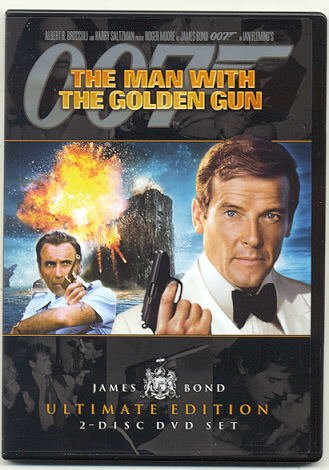
Ian Fleming’s The Man With the Golden Gun was the only posthumous release for the established actor, and the book was such a success that producers Albert Broccoli and Harry Saltzman decided to try and recruit Roger Moore for the role immediately after You Only Live Twice to capitalize on the success of Fleming’s book. However, it wasn’t meant to be, and the film’s production was delayed several years while the George Lazenby era came and went, not to mention the Sean Connery era leav...ng and returning, only to leave again. When Moore came on, Live and Let Die was the first book they adapted, and The Man With the Golden Gun finally came to fruition in 1974.
Posted in: Disc Reviews by Archive Authors on April 4th, 2007
Perhaps in an all too unsubtle move, the MGM/Fox contingent has released The Pebble and the Penguin on the same day as the recently released Happy Feet. The film chronicles the quest of Hubie (Martin Short, Innerspace), a penguin who is trying to win the love of Marina (Annie Golden, Twelve Monkeys) as a mate. But Marina is also eyed by Drake (Tim Curry, Clue), and knows that Hubie must not have her, so he throws Hubie into the ocean. Hubie meets Rocko (Jim Belushi, Return to Me), who helps him stand up to Drake while winning the love of Marina.
Posted in: Disc Reviews by Archive Authors on April 4th, 2007
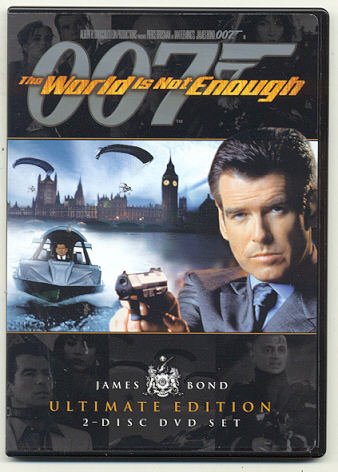
To the credit of James Bond film producers Michael G. Wilson and Barbara Broccoli, they realized that recycling a storyline with Russian antagonists or other satellites of communism, was stale even several years after the Berlin Wall fell. But in its place, the big Bond villain was a Serbian national of sorts named Renard, who was shot in the head, and the bullet, still lodged in his brain, made him magically impervious to pain.
When it comes to The World is Not Enough, the ideas and aspirations (the script was written by Neal Purvis and Robert Wade) were fairly lofty, and the directing choice (Michael Apted of Gorky Park fame) was interesting. In this installment, Pierce Brosnan reprises his role as 007, this time following the death of a wealthy English businessman whose daughter (played by Sophie Marceau, Braveheart) was kidnapped and held for ransom. How does Renard play into it? Well, he's holding the daughter for ransom, part of a larger plot to control the world's oil supply.
Posted in: Disc Reviews by Archive Authors on March 31st, 2007
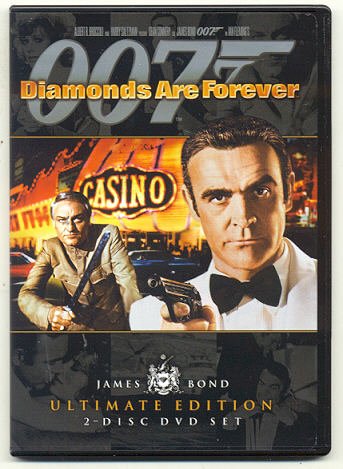
Admittedly after George Lazenby left the James Bond franchise when On Her Majesty's Secret Service was released, producers Harry Saltzman and Albert Broccoli wanted to go with a more American-based Bond in their seventh film, and were pretty serious in their intent. At one time, Adam West (yes, Batman) was even involved in negotiations to play the part. Actor John Gavin (Psycho) was signed and sealed for the role a week before principal photography started. But Sean Connery was pitched for it, a bunch of money was thrown at him, and he went upon his merry way to reprise the role that made him famous.
In this film, which was adapted from Ian Fleming's novel by Richard Maibaum (Goldfinger) and Tom Mankiewicz (Live and Let Die) and directed by Guy Hamilton (The Man with the Golden Gun), James finds himself at the beginning of the film thwarting yet another attempt at world domination, this time by Blofeld (Charles Gray, who ironically played a Bond ally in You Only Live Twice). SPECTRE does make a larger plan though, with the planned kidnapping and impersonation of a mysterious and reclusive Las Vegas-based millionaire, in order to proceed with nuclear testing with the goal of mutually based destruction.
Posted in: Disc Reviews by Archive Authors on March 31st, 2007
Once Roger Moore left the Bond franchise (some would say three or four films too late), quite a few things left with him. When Timothy Dalton, whose most well-known work before this was an excellent supporting turn in The Lion in Winter, was brought in, several things seemed to change. First and perhaps most notably, the return of a James Bond that smoked cigarettes was most startling. Second, supporting characters like Lois Maxwell (who played Miss Moneypenny) and Bernard Lee (M) were replaced with younger, fresher (?) perspectives. Was all this change in the perspective of "modernizing" Bond worth it? Well, Dalton's role in The Living Daylights was the first of two Bond films, so easy come, easy go I guess.
In this installment, based on an Ian Fleming story that was adapted to a screenplay by current Bond producer Michael Wilson and Richard Maibaum (Diamonds are Forever), James helps a Russian general (played by Jeroen Krabbe, The Fugitive) defect to England from Russia, but he is unfortunately reacquired by the KGB and kidnapped. James is dispatched to Russia to kill the Russian general that was presumably behind it (played by John Rhys-Davies, The Lord of the Rings), and along the way encounters a beautiful musician named Kara Milovy (Maryam D'Abo, White Nights), who is also reaching out to the defecting general.
Posted in: Disc Reviews by Archive Authors on March 23rd, 2007
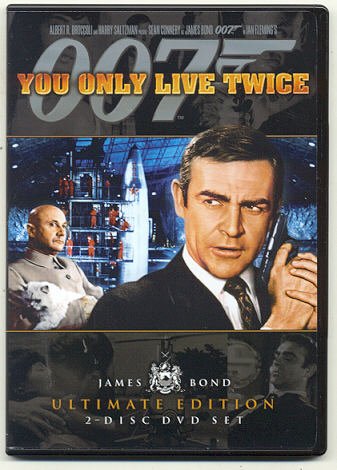
By the time of the fifth James Bond film, producers Harry Saltzman and Albert Broccoli decided to shake things up a bit creatively. Star Sean Connery was probably getting a little antsy inhabiting the suits and drinking the martinis and feared getting pigeonholed (sorry Sean) and announced he was stepping away from the role. However, he still had one more in him, and with You Only Live Twice there was a definite change in style. It may have been based on Ian Fleming's novel, but it was adapted for the screen by Roald Dahl, of Charlie and the Chocolate Factory fame. Lewis Gilbert began the first of his three Bond adventures as director of the Bond films, and in a surprise, Freddie Young took the cinematographer reins, quite a change of pace for the collaborator of such David Lean classics as Lawrence of Arabia.
Moreover, I think You Only Live Twice is probably one o the first Bond films I can recall seeing, growing up back in the day. It's probably because the pre-opening sequence where the spacewalking astronaut gets swallowed by the satellite always stuck with me, who knew? However, the bigger surprise should probably be that there was a pretty good story along with that stunt. In this installment of the film (out of order from the original intent of the producers, who wanted to shoot On Her Majesty's Secret Service), James goes to Japan to continue to thwart the attempts of SPECTRE and Blofeld (Donald Pleasance, Halloween). And because James is in Japan and is as obvious as any tall Englishman can be in Japan, there are some subtle things to make him blend more with the people and the culture.
Posted in: Disc Reviews by Archive Authors on March 21st, 2007
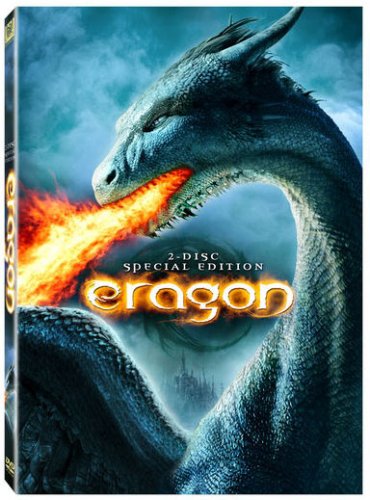
Eragon is based upon the best selling book, which was written by then nineteen-year-old Christopher Paolini. This film was met with much hype, but initially to me seemed to be another generic Lord of the Rings type rip-off, with the addition of a dragon. Not usually my type of movie, but The Lord of the Rings trilogy did more that just amaze me maybe Eragon has a trick or two up its sleeve.
Right from the beginning Eragon starts off shaky, a storyline that seems too have been done a hundred times before; a mesh of Star Wars and The Lord of the Rings. Eragon is a seventeen-year-old farm boy living in the village of Carvahall in the fictional world of Alagaesia. One night, while out hunting, he stumbles upon a dragon�s egg. At first unsure of what�s really going on, Eragon becomes enlightened that he is the chosen one to save his kingdom. It turns out that before the dark ages of Alagaesia�s dark ruler the land was ruled by Dragon Riders, who are just as they�re called, people who ride dragons. The evil king Galbatroix (John Malkovich) sends his evil minion and sorcerer Durza (Robert Carlyle) to kill Eragon and his dragon as they pose a threat to his dark rule of the kingdom. While trying to unite with the remaining rebels, Eragon is trained by Brom (Jeremy Irons) in the arts of magic, combat, and dragon riding.
Posted in: Disc Reviews by David Annandale on March 15th, 2007
Long the bad boy of French novelists, Jean Genet directed this 25-minute short in 1950. Borderline pornographic, it is a silent portrayal of (literally) imprisoned desire. Two prisoners convey their longing for one another through the prison walls, while a voyeuristic guard watches, becoming aroused and frustrated to the point of violence. Poetic, fetishistic, and intensely personal, it is a startling and historic piece of underground cinema.Audio
Consider the rating a place-holder, because we don't have a star equivalent for "Not Applicable." This is a completely silent film. Not even a score. As for the extras, they are clear enough.