Special Category

This is another of Cult Epics’ entries in their new Rene Daalder Collection. His most recent film, it’s a documentary about conceptual artist Bas Jan Ader. The brief body of work he left behind is best known for using gravity as a medium (so, for instance, he did a number of filmed pieces of himself or objects falling). He was lost at sea in1975 while attempting to cross the Atlantic in a minuscule boat as part of a piece to called “In Search of the Miraculous.” Daalder’s 68-minute film retraces Ader’s life, but does so in part through the filter of Daalder’s own parallel experiences as an expatriate Dutch artist. The film is very interesting, though I would have like a bit more analysis of Ader’s work, in order to have a better understanding of exactly what it was doing, and Daalder’s speculations about what Ader’s final thoughts might have been are a little too definitive. Still, a strong documentary.

Audio

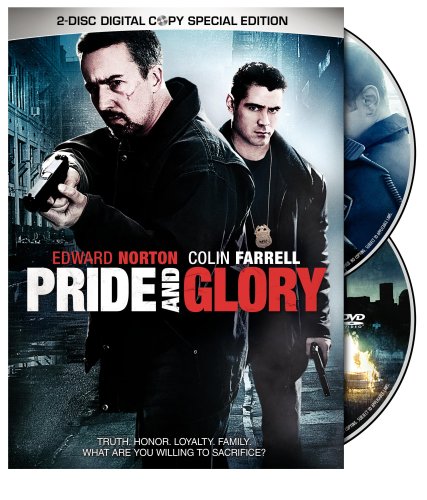
“Four cops down: two dead, two likely. An NYPD drug bust has gone horribly wrong.”

That’s how this gripping drama opens. Not since the likes of Al Pacino in Serpico has there been a movie anything at all like Pride And Glory. This film doesn’t pull punches, and it looks about as real as any police drama I’ve seen anywhere before. Filmed entirely on location in the seedy streets of New York City’s Washington Heights district, there is enough gritty realism to go around. Director Gavin O’Connor not only used these very dank and atmospheric streets, but he also employed his extras and some of the key cast members from the community. If nothing else, you can’t criticize this film for not taking us into the street and watching the action from street level.

If ever there was a release whose title told you everything you need to know, this is it. Yup, the second part of season 5. There you go. Which is in no way a condemnation. Well over four hours of prime silliness is reason enough to pick this up. Unless, of course, you have picked up any of the other recent SpongeBob releases, in which case the curse of double-dipping will likely befall you. Many of these episodes have already been released on the shorter compilation discs. If you held off until now, though, this is a wonderful fix for nautical nonsense junkies.

Audio

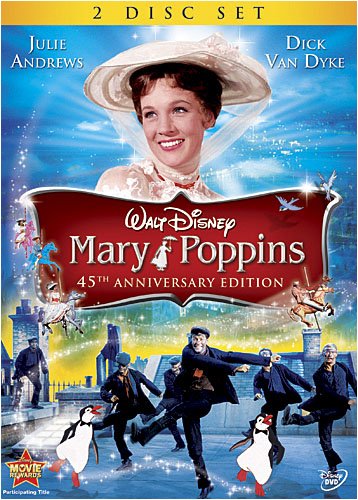
Mary Poppins was the subject of a series of books by P.L. Travers. Long before Harry Potter came on the scene, Mary was delighting children all over the world with her spectacular magical abilities. At the time Walt Disney was making a name for himself and his studio by bringing many of the children’s classics to the big screen. From fairy tales to Winnie The Pooh, the studio was providing the look and the soundtrack to the imaginative worlds already known and beloved by millions. It was a magnificent strategy, and it would pay off huge for the company. The problem with Mary Poppins was that it needed to be a live action film. Mary and her pals needed to appear as real people. The worlds themselves could be animated, of course, but Mary and Bert and the children had to be real. Walt insisted upon it. And so a painstaking effort was begun to bring the story to life on screen in a way no film had yet done before. The results were as magical as Mary herself and have captivated children of all ages ever since.

In the 1960’s Walt Disney was the center of some of the most groundbreaking f/x technology in Hollywood. Disney was that era’s Industrial Light & Magic. Even films not produced by the Mouse Factory went to their f/x wizards for their high end work. Films like Forbidden Planet made use of the Disney magic for a few of their trickier sequences. Mary Poppins is a wonderful example of the magic that Disney was capable of at the time. The film is a wonderful blend of live action and hand drawn animation work. The two worlds interface seamlessly even by today’s standards.

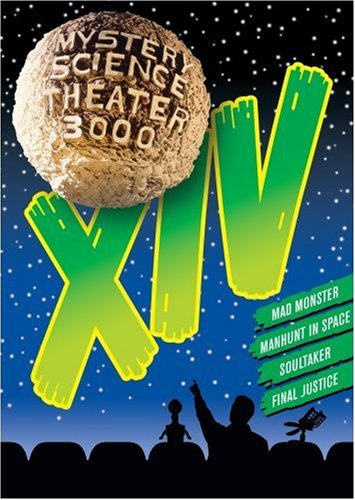
Here we go with four more cruel experiments inflicted on Joel, Mike, Tom Servo and Crow T. Robot on the Satellite of Love. The Mad Monster is a 1942 proverty row epic with George Zucco as a mad scientist giving future Frankenstein Monster Glenn Strange transfusions of wolf blood, with predictable results. Manhunt in Space is a Rocky Jones, Space Ranger adventure – multiple TV episodes pasted together into one dreadful piece of SF idiocy. Soultaker has the unfortunate Joe Estevez, under the orders from Angel of Death Robert Z’Dar, tracking down four teens who are supposed to have died in a car crash. Finally, Final Justice sees Joe Don Baker as a Texas Ranger confronting the mob in Malta. But of course.

Naturally, the real interest of these releases is not in the films themselves (which are, with the partial, nostalgic exception of The Mad Monster, utterly unwatchable), but in what Joel or Mike (depending on the episode) and the ‘bots do with the films. Two hits here, and two misses. The comments aimed at The Mad Monster and Final Justice are disappointingly unimaginative. The failure of the latter is a special sore point, since MST3K’s previous shot at Joe Don Baker, Mitchell, is one of the series’ masterpieces. This time around, the boys don’t have much to say other than to comment on the man’s eating and digestive habits. On the other hand, inspiration was at hand for both Soultaker and for a good chunk of Manhunt in Space (i.e. the first half, and with the accompanying episode of General Hospital).

So there's this group of flight attendants, and we follow their swinging adventures and affairs on and off planes. One, for instance, hopes to be an actress, and hooks up with an advertising executive. And if you care what the plot of “the first 3D sex film” is, you need your head examined. Much of the what goes on  is mind-numbingly banal (SEE  Wine being poured  SEE  Drinks being mixed  HEAR  Dull conversations ), though the acid trip that leads one woman to make out with a lamp in the form of a greco-roman head is something you don't see every day.

The film is an object lesson on how far mere novelty can take a film – it was a huge success at the time, and 3D was, in 1969, a rarity again after its initial craze in the 50s. So there are numerous shots of legs and pool cues (and feet) jabbing at the camera, enough, presumably, to have kept audiences entertained while everything else remained mundane beyond words. Or, so the situation is for most of the running time. But the last act takes a sudden turn into the starkly dramatic, and becomes very dark indeed. It is also rather more imaginatively shot than most of the rest of the film. The ending is a vicious sucker punch that must be seen to be believed, and suggests that the filmmakers were storing all of their creative juices for the cruel finale. In fact, as the accompanying featurettes reveal, the dramatic plot was added to the film after the rest of it was completed, and indeed, after it had already been released in some markets. In the final analysis, this is a vital piece of low culture.

On July 20th, 1973; Bruce Lee left our world. The world he left was never the same, but somehow his fans and directors carried on in their own way. The fans he left behind were hoping for a great martial artist that could be just as good as the late Bruce Lee. The directors he left behind were hoping to capitalize on the look of Bruce Lee and find one who not only looked like Lee but performed like him. What happened as a result of all this? A whole lot of bad kung-fu films known as Bruceploitation films. These films ranged from the normal to the obscene including one where Bruce Lee fights James Bond & Dracula in Hell. Unfortunately for the Dragon Immortal set, that one did not make it. But this collection brings together ten that did.

This boxset of 10 movies on three discs brings together the best and worst of the films in the Bruceploitation era. Who am I kidding? These are all pretty bad. But let us analyze the wreckage and see if anything is salvageable. There is one movie called Fist of Death (Jackie & Bruce to the Rescue) where the old kung-fu master of the village gets killed by a gang simply known as the YMCA. The YMCA? Are they lead by an Indian and a cowboy who sing about a “Macho Man”? Incidentally the gang's logo says YMGA but every actor in the movie calls them the YMCA. This all leads to some rickshaw driver who plays the Bruce Lee role and beats the gang and saves the day.

“This motion picture is principally based upon the book “Wallace” by Marshall Frady and other historical sources. Certain events, characters, and dialog have, nonetheless, been created or altered for dramatic purposes”.

In other words, this should not be taken as an historical record of the controversial George Wallace. If anything, the film attempts to soften his personality some. One of those created characters is Archie, a trustee attending to the needs of the residents at Alabama’s Governor’s Mansion. We are meant to see Wallace and the events of the tumultuous era through his eyes. It’s not told from his perspective, mind you, but we are intended to share his reactions and emotions along the way.

“When one starts to perceive one’s own reflection as a completely separate being, one is suddenly confronted with two entirely separate egos, two entirely separate worlds that can surface at any given moment. A feeling of self hatred usually triggered by a psychological shock can split the personality in two, hence creating two or more personalities with distinct memories and distinct behavior patterns within the same individual. The patient has the false perception of the existence of two distinct worlds, the real world and the world inside the mirror.”

Or maybe not so false, at least according to the 20th Century Fox thriller, Mirrors.

Paramount has decided to standardize their DVD releases. This goes from everything to the DVD disc art, which is now just a two tone silver on all releases, to the cases. The new cases are a mixed deal. You get 6 discs inside of a single DVD space. That’s the good news. The bad news is that the disc holders are quite brittle and end up chipping and breaking. You save space but ultimately endanger the discs themselves. I hope someone at Paramount takes a look at the packaging and comes up with something a little better. There will also be some inconsistancy with your older sets, and because the final season was already released out of order your middle sets will look out of place. If you’re even a little OCD, you are not going to like the changes.

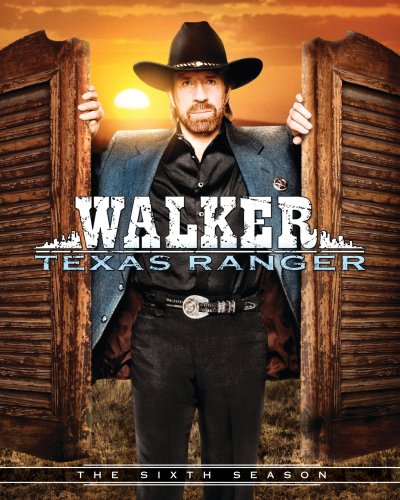
There was a new Cowboy in Dallas, and he wasn’t throwing touchdown passes. But Walker was almost gone before he could really get started. After just four episodes the show’s production company suffered financial collapse, and the show was rescued at the last minute by CBS Productions, who would continue to run the show for its nearly decade-long run. For nine years Norris brought us the ultimate Texas Ranger in a formula cops and robbers show. The show often became a parody of itself, but maintained a solid viewer ship throughout. Hell, Norris even sings the theme song. Truthfully, what started as a one man show (it was originally called Chuck Norris Is Walker, Texas Ranger) became a good working ensemble that probably kept the train going for so long. Walker (Norris) is a tough guy Texas Ranger. He is partnered with Sydney Cooke (Peebles) and Jimmy Trivetti (Gilyard) who’s an ex-jock with a brain. Walker had a love interest and eventual wife in the local assistant district attorney Alex Cahill (later Walker). Together they fight the evils that come to the high plains of Texas armed with their fists, six-shooters, and Stetsons. After starting with the final season, CBS is finally halfway through the series back from the beginning.