Special Category

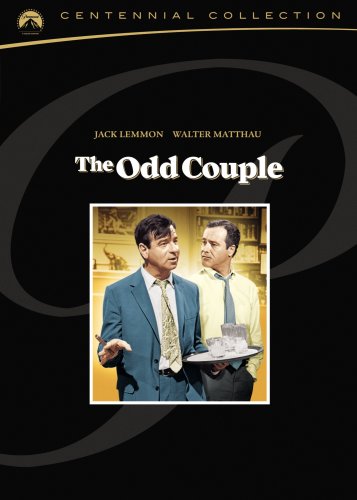
The Odd Couple began as a concept when playwright Neil Simon observed his recently divorced brother share an apartment with another divorced guy. He developed it into a very successful play. In the original play Walter Matthau played Oscar, but it was The Honeymooners star Art Carney who played Felix. Both actors were offered the parts for the film. Carney declined. It was because of the onscreen chemistry between Matthau and Jack Lemon on the film The Fortune Cookie that led to Lemmon being cast as Felix. The decision was a stroke of genius. If you look at it on its surface, there really isn’t much of a story here at all. It is the connection and relationship between these characters, and subsequently these actors, that made this film the classic that it is. Also returning from the play to reprise their roles were Monica Evans and Carole Shelley as the amusing Pigeon Sisters, roles they would actually repeat for the television series two years later.

When I watch this film, I will admit that it’s often a little hard to get the images of Jack Klugman and Tony Randall out of my mind. Most folks have had far more exposure to that 5 year television series than they have with the original film. To me, they will always be those characters. In fact Klugman replaced Matthau on the stage as Oscar before he took the role on television. Still, even with that bias, it is awfully hard not to get drawn into this film. For me characters and performances can be everything. That’s what makes this film have the lasting power it has enjoyed. Most of the film, as the play, takes place inside the apartment. There is a very limited cast, often just Felix and Oscar on the screen. Certainly there are some great moments with the poker buddies and the Pigeon Sisters, but most of the film takes place in a limited environment with just two actors. If you can make that work at all, let alone create a classic experience from it, that’s saying something. There were a few outside locations utilized in the film that were not part of the original play. These were placed there just to give the viewers a change of scenery but were totally unnecessary.

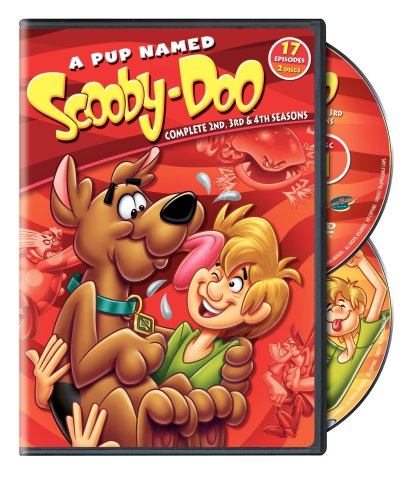
“Scooby-Dooby, Scooby-Dooby-Doo! There's a mystery in town, So call the coolest pup around, Call Scooby, A pup named Scooby-Doo! Join Shaggy, and the crew, Daphne, Freddie, Velma too! And Scooby! A pup named Scooby-Doo! When the ghostly ghoul attacks, Scooby eats a Scooby Snack! Scooby-Dooby-Doo! So come on, it's mystery time, You can help us solve the crime, With Scooby, a pup named Scooby, Scooby, a pup named Scooby-Doo!”

First there was Muppet Babies. Then there were Tiny Toons. It seems that every famous children’s cartoon series eventually turns back the clock to offer up pintsized versions of the same formula. That’s what you get in A Pup Named Scooby Doo. The show aired 1988 through 1991. It was on somewhat erratically so that, while the box claims this 2 disc set contains the complete 2,3, & 4 seasons, that really only adds up to 17 half hour episodes in all.

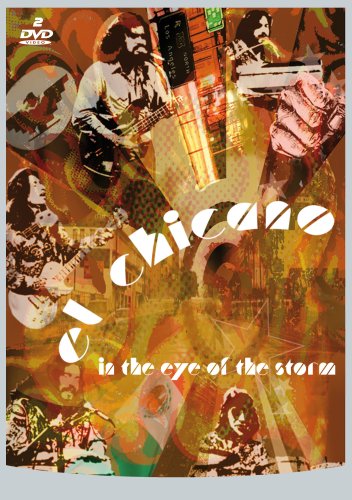
"Chicano" is a term for a Mexican American (US born with Mexican ancestry).

El Chicano was and is a band that started in the late 60s as club players called The V.I.Ps (playing after hours at a Japanese restaurant in East Los Angeles) who became popular because of their jazzy approach to Latin rock. This musical approach was really defined by this band, as well as by Santana who started about the same time, and their songs became the anthems for the "Chicano Movement" around the late sixties and early seventies.

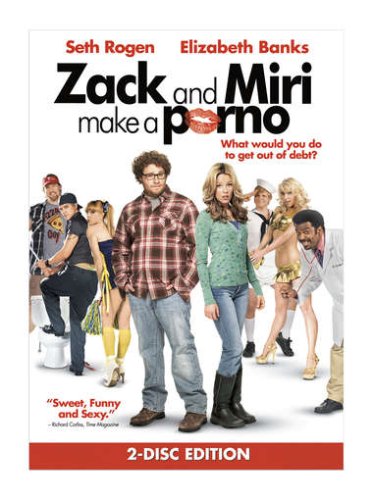
Zack (Seth Rogen) and Miri (Elizabeth Banks) have been friends since school, and are now terminally broke roommates. As their utilities are turned off one by one, and they face the prospect of eviction, Zack hits on the idea of shooting a porn flick to get out of debt. They gather together a motley collection of actors and crew, and, letting no setback stand in their way, start making their movie. But the real question is not whether they will succeed, but whether they will come to terms with their feeling for each other.

In his review of the film Roger Ebert writes, “'I don't know bleep about directing,' Smith once confided to me. 'But I'm a bleeping good writer.'” Smith is half-right. The direction here is very meat-and-potatoes, every shot serving little more than to get the actors decently framed. But I can't agree with his self-estimation as a writer. There are some funny lines here, but many of the laughs are due to Smith's stellar cast. Rogen does his usual shtick, but it's still funny, thanks to his appealing naive/cynic vibe and befuddled stoner delivery. Justin Long shows up for a single scene, and walks off with the movie. None of his lines are particularly stellar, but his cameo is hysterical, all of it due to voice and body language. The man could make the yellow pages side-splitting. This is not to say that Smith's script is that dry, but it veers between clumsy earnestness (I kept waiting for the punchline during the final emotional speeches, the clue that I wasn't really supposed to take this hackneyed dialogue seriously, and it never came) and a potty mouth approach that clearly finds naughty words to be funny in and of themselves. You know, like we all did in grade five. David Mamet this is not. But when all is said and done, there's the cast. Determined to save Smith from himself, they make the film a bizarrely endearing and sweet experience.

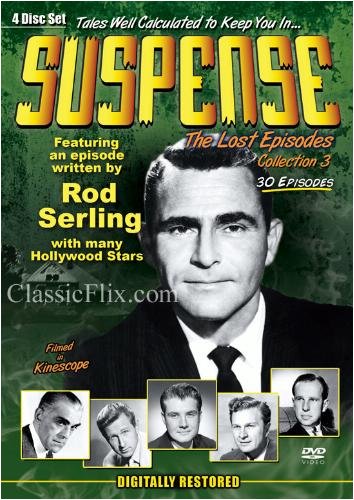
Suspense began life as a very successful radio show on the CBS Radio Network. It premiered in 1942 and lasted just over 20 years on the nation’s airwaves. When television began to make its own waves on the air in the late 1940’s, naturally many of those first shows would be programs that had already shown strong appeal to the radio audiences. Shows like Gunsmoke had been staples on the radio for years and would be a nice way to entice the first television crowds to the new medium. Suspense was one of those shows. It first broadcast in 1949 and was broadcast live from a studio playhouse in New York City. The anthology series presented stories that featured some kind of a horror or thriller theme. Public domain stories were great fodder for the series, and it certainly brought together some of the big names of that genre to the broadcasts. Names like Boris Karloff, Bela Lugosi, Peter Lorre, Nina Foch, and John Carradine would give the show instant credibility. But, the episodes were not limited to the horror field. Crime dramas that involved murders under mysterious circumstances were another favorite staple of the series. Because it was aired live there were no taped copies to be used as reruns, so that each episode was intended as a single broadcast event. For reference purposes a kinescope recording was made, but not very well preserved. These were the days when the networks were just starting, and they didn’t reach a majority of the nation yet. These simple recordings were intended so that the episodes could air in the towns and cities where the networks had not yet penetrated, a whopping 67% of the nation in 1949. It would go on to become one of television’s first hit shows and lasted 15 years. Surprisingly, the radio version would continue for almost another decade after the television series left the airwaves.

These kinescope recordings were uncovered in 2007. Since then they have been released in various sets and collections. 90 episodes in all have been found and somewhat restored. This collection 3 offers the last 30 of those 90 episodes. They feature the likes of Boris Karloff, Eddie Albert, Walter Matthau, Pat Hingle, Lloyd Bridges, Arlene Francis, Jack Warden, Jackie Cooper, James Whitmore, Vic Morrow, George Reeves, and Richard Coogan. The episodes span the entire run from 1949 – 1954, although one episode lists an airdate of 1958. I could find no record of that episode airing at all.

“When you wish upon a star. Makes no difference who you are. Anything your heart desires will come to you. If your heart is in your dream, no request is too extreme.
When you wish upon a star, as dreamers do… Like a bolt out of the blue, fate steps in and sees you through. When you wish upon a star, your dreams come true.”

The song has become a standard. Every kid knows it. Walt Disney Studios has made it their theme song. You hear it each time you load up a Disney disc. If you have been fortunate enough to have visited Walt Disney World, you’ve heard it the entire day long. We know the song, but did you know where it originated from? It was back in 1940 and the release of Walt Disney’s, in fact, the world’s, second ever feature length animated film: Pinocchio. Now Disney brings us this timeless classic on high definition and Blu-ray. What a marvel this release is.

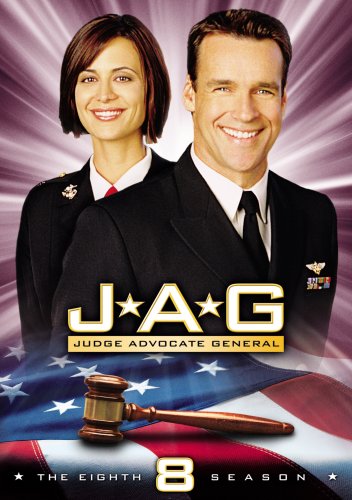
Finally, this show has really gotten to me. I don’t know what it is about this 8th season, but I was far more interested in the show than I had ever been. Maybe I’ve spent so long with these characters that they started to come alive for me. Maybe I was resistant to a slightly different way of telling stories. Maybe it was that the stories became less about who was with who that I was finally able to enjoy the great courtroom drama and investigation elements of the series. Whatever it was, I am finally a fan.

Most of each episode is dedicated to the investigation of the particular case. For action junkies, this often means flying some sweet high tech aircraft. The show’s primary character, Commander Harmon “Harm” Rabb (Elliott) does a lot of the high flying investigations. He was once an ace pilot who developed night blindness, which essentially grounded him.

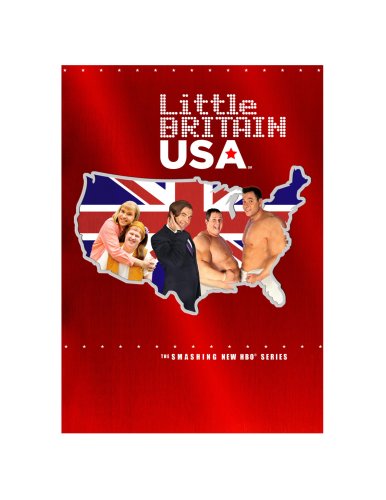
"There are more fat people in American than there are people." That's the dry wit of Tom Baker, Little Britain USA's narrator, introducing a sketch about "Fat Fighter" Marjorie Dawes. If the series stuck with that brand of humor, I'd have enjoyed it thoroughly. Instead, it goes places so crude I was continually startled by its outrageous comedy. I'm of the opinion that blue humor is a love-it-or-hate-it genre. If you enjoy the nasty stuff, Little Britain USA : the complete first season is definitely up your alley. Mine? Not so much.

The series is yet another British invasion, having begun as a program in the U.K. before crossing over the Atlantic to reach American audiences, like The Office, Life on Mars and many others. Of course, this time it's still helmed and starred in by its original creators, which should alleviate the concerns of fans of the British version. And in this case, I wasn't familiar with the original series, so Little Britain USA was my introduction to the talents of show creators and stars Matt Lucas and David Walliams. They play most, but not all, of the regular sketch characters, which include the above-mentioned Fat Fighter, horny prime minister Sebastian Love, grossly obese seductress Bubbles Devere, over-muscled homoerotic gym buddies Mark and Tom, eighth man on the moon Bing Gordyn and many others. They're joined in the six episodes of this first season by guest stars like Rosie O'Donnell, Paul Rudd, Sting and Vivica A. Fox.