Special Category

The relationship between Richard Burton and Elizabeth Taylor appeared to blossom when they were both on the set of Cleopatra. The epic film was famous, not for the success of the film but more for the near bankruptcy of the studio and for the romance that blossomed between the two. Warner Brothers has recently been releasing groups of films surrounding various film icons, and this set of four titles focuses on the two acting giants.

The V.I.P.s was the first film after Cleopatra for both performers, and ironically enough they play a married couple on the downside of a marriage. Taylor plays Frances and Burton plays Paul, a wealthy businessman who treats Frances as more of a business chore than anything else, until one day Frances decides to leave Paul and for the waiting arms of Marc (Louis Jourdan, Octopussy). Marc is a gigolo but seems to have reformed for Frances. Frances and Marc are about to fly to New York until fog keeps them in, along with a few other notable individuals. Les (Rod Taylor, The Birds) is a rather convincing Australian businessman who is desperate to get to America to change a business deal that will save him financially, and his secretary Miss Mead (Maggie Smith, Clash of the Titans) will help him try to accomplish that. Max (Orson Welles, Touch of Evil) is trying to get out of England for tax purposes, and will even resort to marriage to try and do it. Margaret Rutherford (Blithe Spirit) won an Oscar in her role as the elderly Duchess.

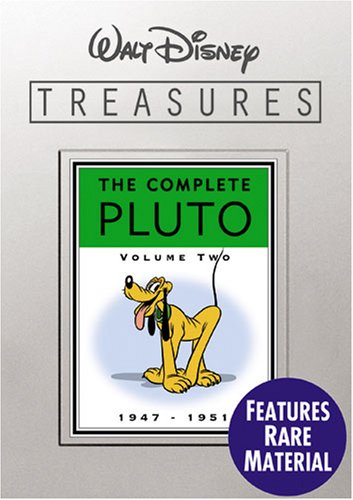
This is the second volume of Pluto cartoons, here going from 1947 to the end of the series in 1951. The neat thing about these themed collections in the Wald Disney Treasures series is that they highlight particular strengths in Disney’s animation. Thus, if the Silly Symphonies sets focus on the marriage of movement with music, the Pluto cartoons are wonders of pantomime, since the central character doesn’t speak. Pluto is not a jot less communicative for not using words, however, and the sight gags involved in some of his facial expressions (such as when wearing the unwanted “Pluto’s Sweater”) are priceless. Pluto’s frequent sidekick Figaro the cat has the spotlight to himself in three bonus cartoons.

Audio

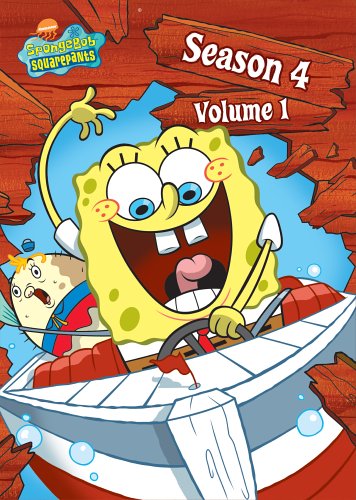
The zaniness continues in Bikini Bottom, and the series shows no sign of losing its appeal or its lunatic creativity. Wonderful little example: “Whale of a Birthday” is about Mr. Krabbs’ daughter’s sixteenth birthday. The highlight: a performance by “Boys Who Cry” singing “It’s All About You.” Perfect. There are twenty episodes here to keep your funny and whimsy bones tickled. (What, you don’t think you have a whimsy bone? Of course you do.)

Audio

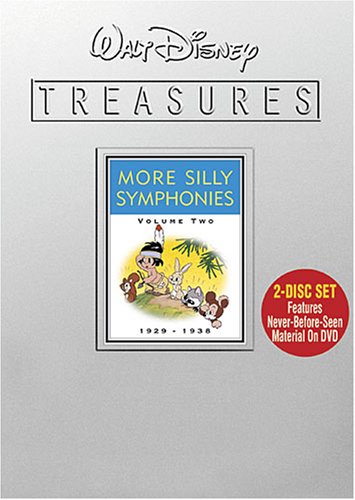
Warner Bros. had the Looney Tunes and Merrie Melodies, Disney had the Silly Symphonies. This is the second volume collecting those shorts, covering the years 1929 to 1938. The shorts are selected on a menu that can be presented in alphabetical or chronological order, and it is the latter approach that is the most enlightening, as we can see the cartoons evolve. There is no dialogue in these shorts – the point was to fuse animation and music. And while that is an end in itself in the earlier cartoons (and quite the technological feat at that), more and more narrative content develops over the years. The culmination of this form of animation would, of course, be Fantasia, and in such early pieces as “Hell’s Bells,” one can see in embryonic form the ideas that would become, for instance, the “Night on Bald Mountain” segment.

Audio

Adapted from the hit stage musical, Norman Jewison's film version of Fiddler on the Roof has established itself as a classic over and over again since its release in 1971.

"He loves her. Love, it's a new style... On the other hand, our old ways were once new, weren't they?" I'll hardly be the first to write it, but the reason Fiddler on the Roof, a story about Jewish people and their culture, is so popular, is that its themes have universal appeal. In fact, in a way it hardly matters th...t the characters are Jewish. As we learn from a famous anecdote, when the first Japanese production of the stage musical opened, the show's creators traveled to Japan to meet the producer. He said to them, "I don't understand, I don't know how this piece can work so well in New York. It's so Japanese!"

After seeing Casino Royale it's hard to look at a Bond film the same way, and when Roger Moore inhabited the guy who likes martinis, fast cars and dangerous situations, it may have been a little cheesy. Granted, Moore did appear in a couple of notable Bond misses, but in the tenth release of the James Bond franchise, The Spy Who Loved Me stands as one of his best, if not the best Moore film.

From a screenplay by Richard Maibaum (his 7th Bond film) and Christopher Wood (his first) and directed by Lewis Gilbert (his 2nd Bond film), this new situation finds James at first in Austria, being chased by assassins, with everyone on skis. The end of the chase, whether you like it or not, is one of the better (maybe the best) in Bond film history. Once he gets settled, he is sent to find out why nuclear submarines are going missing. Complicating things is that James has to work with a Russian agent, a striking female named Major Anya Amasova (Barbara Bach, Caveman). Together, they find out the cause of the disappearances, a reclusive businessman named Stromberg (Curt Jurgens, The Longest Day, The Enemy Below) and his henchman, the ginormous guy with metal teeth, lovingly nicknamed Jaws (Richard Kiel, The Longest Yard).

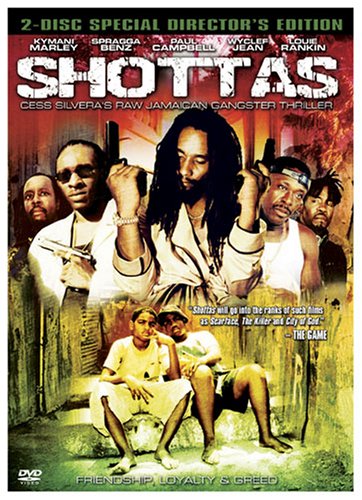
Here we go, with another rise and fall story in the underworld. Two young friends in Jamaica, Biggs and Wayne, grow up separately to become powerful gangsters (the “shottas” of the title). After a prolonged separation, they reunite in Kingston, and the story takes them back and forth between that city and Miami as they climb the drug totem pole, heading for the inevitable fall shown pre-credits.

All the characters speak Jamaican patois, making subtitle necessary. This and the vision of the grinding poverty of Kingston give a certain freshness to the film, but the storyline is utterly hackneyed, and we know nothing about the characters we are following, let alone have any reason to sympathize with them. Attitudes toward women are, as one might expect, antediluvian. Imagine a Grand Theft Auto storyline presented with all the humour and satire removed, and this is what you’d get.

Comments on the supplemental material on this edition have been ported over from Ryan Erb's excellent (and recent) review of the HD DVD, which also can be enjoyed on this site.  Now onto this review...

Remember when it was announced that far-left conspiracy theorist (and resident Castro admirer) Oliver Stone would be making a film about the September 11 attacks? Of course you do. In fact, the collective pucker of the nation tightened in horror and trepidation when the notion was first thrown around, and later grew in suspicion as the film's realization became closer and closer.

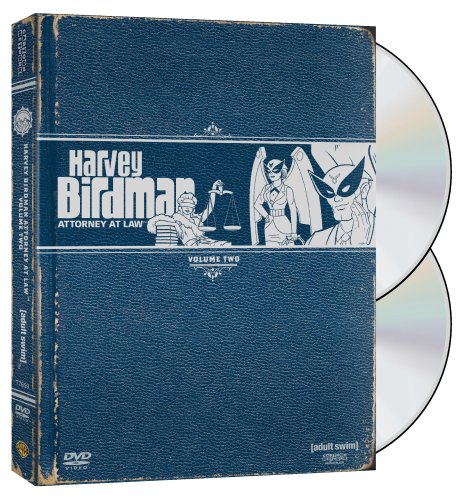
I'd never seen, nor heard of, Harvey Birdman, Attorney at Law before I received my review copy of this second volume of the series, which aired as part of Adult Swim. What a bizarre show! Not since Ren and Stimpy have I seen such a strange, adult-oriented cartoon.

Harvey Birdman was a shoddy superhero who has become a substandard Attorney. His firm handles cases for well-known animated Hanna-Barbara characters like The Jetsons, with each of the 13 episodes in this second volume presenting a new case. The episodes run about 11 minutes each, and they're all very odd and pretty darn funny. Since the episodes are so short, I'm not going to spoil any of the storylines here. If you're not familiar with the show or the adult-oriented cartoon genre, I suggest renting a disc from Harvey Birdman volume one to get a taste. If you enjoy that, you'll eat up this volume two release.

Everyone in the world knows about the September 11 terrorist attacks on the United States. With films hitting the big screen in 2006, I guess the studios thought time enough had gone by to start making movies on the tragedy. World Trade Center is based on the attacks on the World Trade Center, as obvious by its name, but makes mention of the other attacks of the day. I can�t comment on the realism of the movie pertaining to the individuals depicted in the film (John McLoughlin and Will Jimeno) but they were involved with the production of the film, and since film is based on their accounts of the day I could imagine it�s very realistic. There are a few factual inaccuracies regarding some of the events of the day, but nothing major.

World Trade Center opens on the morning of September 11, 2001 when everyone was going about his or her life without any idea of the tragedy that was about to strike. You get a glimpse into the lives of John McLoughlin (Nicolas Cage) and Will Jimeno (Michael Pena) two Port Authority police officers and family men as they leave for work. The two begin their day as usual patrolling Lower Manhattan until there is a loud thump similar to that of an earthquake. The officers rally back at their police station and together head to the site of the World Trade Center to help evacuate people. Along the way they get news of the second tower being hit, and debate whether or not that could have even happened. When they arrive they are asked to volunteer to enter 5 World Trade Center (a building part of the 7 buildings that made up the World Trade Center) and help people escape.