Lionsgate / Maple Pictures

"Dear Screenwriter,

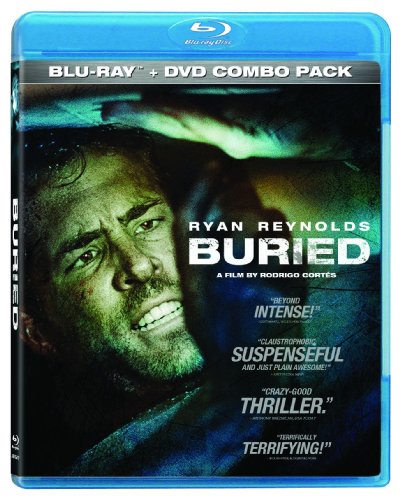
"Here’s your writing prompt: You are to write a feature-length screenplay with only one on-screen character. This character is to remain in only one location for the entire duration of the film, and that one location must be a 2' x 7' wooden box. You cannot use flashbacks, cut-aways, or any other narrative device that would take the action outside that box. Sound impossible? It’s not. In fact, all this exactly describes the film BURIED."

"You have conquered and I yield. Yet, henceforward art though also dead - dead to the world, to Heaven, and to hope. In me did thou exist - and, in my death, see by this image, which is thy own, how utterly thou hast murdered thyself." - Edgar Allan Poe

The last of the Lionsgate / AfterDark double features covers the middle of the road. The films both deal more in science fiction or alternate realities than they do in any form of horror, one with the idea of a menacing world of doppelgangers and the other with changing the past through time travel. Both of these themes have been played to death before. Do they offer anything more here? Let's examine the evidence, shall we?

"Between 1954 and 1976 nearly 600 children were voluntarily submitted for participation in a number of behavioral studies. These experimental facilities were privately funded and tucked away in secluded regions of the South. Families were paid a fee for their involvement and were told the studies were harmless. Most of the children were never heard from again."

What we have heard from again are these little independent films from Lionsgate and After Dark. You might remember them as the 8 Films To Die For. They were usually around Halloween on DVD. Now, for the first time, a wave of these films is being re-released on high-definition Blu-ray. It's kind of a nice Halloween treat, and it isn't even Halloween.

"O joyful. O delightful. O fortunate one. Weep no more, this departed son. Read these words. Sound thy voice. Revel and sing. Rejoice! Rejoice! Life's for the living, not for the dead. Forget tomorrow. Live now instead. This night you breathe, while they cannot. So dance ye soul on their resting spot."

It's another double feature from Lionsgate and AfterDark. This one offers one of the best of the series with a rather flat companion. Of course, it's that two-for-one thing that makes it so attractive anyway. Consider Gravedancers the main feature and Wicked Little Things that budget extra feature you used to get when you went to the old drive-in shows.

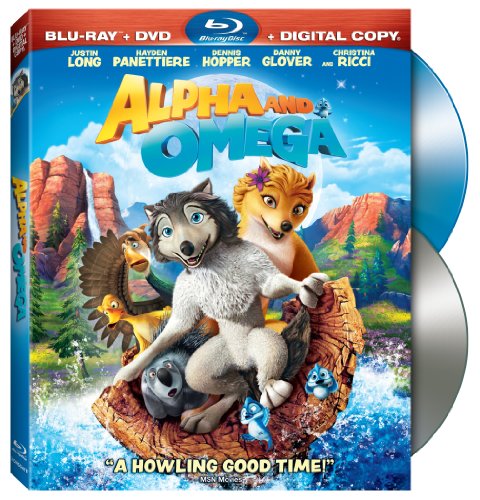
Baby here. Yeah, I'm the German shepherd/chow mix that runs security here at Upcomingdiscs. I also get called upon to help out with the dog movie reviews from time to time. Now, somebody needs to get themselves a good book on proper mammal identification around here. You see, Alpha And Omega is about wolves. I'm a dog. That spells D O G. Look at it this way. That's God spelled backwards, and that's no coincidence. If you doubt me, just let me get a couple of seconds with one of the delivery guys. Now wolves are a whole different animal. I know there are nut jobs out there who say that dogs did something called evolving from wolves, but those same guys call you humans a bunch of monkeys. Get my point? And that spells F A N G. Dogs are these nice furry buddies who sleep in your bed on cold nights and eat tissues on your nightstand when you're not lookin'. Okay, so I get in a little trouble for that last thing. Wolves are wild animals who don't really do any of those cute snuggly things. If you spell wolf backwards you just get flow, which reminds me of something else I get into trouble for. And that spells B A D. Now Gino says I have to pull my weight around here and write a wolf movie review. Well, I'll show him who's boss. I won't do it, and that's final.

(ed. note: We've had a long talk with Baby and after threatening to take her ball away, I think we've come to an understanding.)

Most people who have read my reviews before know that I don’t particularly care for prison movies. They hardly ever have a complicated story and instead focus their time solely on fights and homosexuality. But there are examples out there that go against the grain. One such movie stars a very young Sean Penn who is a young thug on the wrong side of the law. He ends up in a juvenile detention center which is made in ever way to appear like a prison. It is simply called: Bad Boys.

Mick O’Brien (played by Sean Penn) is a troubled teen living in Chicago. He steals purses from ladies; he knocks out men and takes their wallet. During the day, he goes to school. He has a best friend named Carl (played by Alan Ruck) and a girlfriend named J.C. (played by Ally Sheedy) who he cares for very much. Life is hard for young Mick and things aren’t looking to get better any time soon.

The Graves:

When you first look at the title for this entry in After Dark’s 4th annual 8 Films To Die For, you probably have summoned up images of a dank and foreboding cemetery where unspeakable horrors rise from their resting places to torment the, albeit temporarily, living. This is definitely a little bit of a case of false advertising and the misleading use of a title. These Graves are sisters, Megan (Grant) and Abby (Murray), to be exact. They’re the kind of sisters who do everything together. You know the type. They almost speak in a secret language and appear to be soul mates. But Megan is a bit more outgoing and has gotten herself a job in New York, far away from the sisters’ home in Arizona. Abby is a bit more introverted and is having a hard time dealing with the inevitable loss of her sister. So the two decide to have one more blast together. It’s time for a road trip to visit the world’s largest thermometer. Oh boy. Any horror fan worth his remote knows that the girls are likely not going to make it to see the big thermometer, and they’d be correct. They get sidetracked in a small town called Unity where they are encouraged to visit the abandoned gold mine called Skull City Mine.

"September 19th. Dear Diary, as I sit here thinking about picking up the pieces of what used to be my life, I realized something. Every room in this house holds a painful memory for me. Even though he's suffering, something somewhere in me wants him to suffer more. A few months and a divorce can take you through just as many emotions as 18 years in a marriage. And I'm starting to feel all of them at once. But the one that is clear is rage. Signed, a Mad Black Woman."

Lately I've had an opportunity to watch a ton of Madea on Blu-ray. Lionsgate is bringing out all of the Tyler Perry collection on high-definition Blu-ray of late. It makes sense that this wave of releases would also include Diary Of A Mad Black Woman. This is where Madea's cinematic life began. Watching these films has been a bit of a blessing and a curse. The blessing part comes from some of the pure hilarity that can be Madea. The curse comes in the form of Perry's Jekyll and Hyde style of presenting these absolutely classic comedy moments with tales of faith and redemption. Again, both styles are admirable and good on their own. I just have trouble with the mix. However, Diary Of A Mad Black Woman is better than most of his efforts in that department. Because Madea relates more integrally with the other story, it doesn't come across near as awkward as some of the others. This was probably the best of this recent wave of Tyler Perry movies. And so it seems I saved the best for last.

Truth is I don’t do very well with Christmas movies. Most of them reek of bad acting and a whole mess of clichés. One of my least favorite movies of all time is A Christmas Story, a masterpiece of absolutely awful movie making. So, needless to say when I received Thomas Kinkade’s Christmas Cottage, I wasn’t exactly abundant with anticipation. Let’s just hope that we don’t want to shoot our eye out over it or anything.

The year is 1977. Thomas Kinkade (played by Jared Padalecki) is busy at working drawing his girlfriend, Hope (played by Gina Holden) as she models (don’t worry, this is a Christmas movie, so all we get is some bare shoulder action). However, he has to stop what he’s doing and go home for Christmas. Where is home you might ask? Why, that’s Placerville, California. The little town also happens to be known as the Christmas Tree capital of the World.

"Well when you gettin' "got" and somebody done "got" you and you go "get" them, when you get 'em everybody's gon' get got."

When Tyler Perry started writing his small plays, he probably never had a clue just how far it might all go from there. The plays had a solid audience, but there was always concern that the appeal would be too narrow. That didn't stop Perry from putting together a few relatively low-budget films located in his adopted film hometown of Atlanta. For the most part the studio got pretty much what it expected. The payoffs weren't huge, but they more than covered the costs. Perry's creativity attracted some big-name actors and cameos, and that wasn't bad for business either. The mainstay of his moderate success was his cross-dressed character, Madea. Mabel Simmons was a wildcat old lady. She didn't take no "stuff" and she spoke her mind. The racial profiling here was a bit rough, but nothing more than the blacksploitation films of the 1970's. Anyway, it was all harmless fun, and no one seemed to be all that upset over the characterizations. There was talk of sending Madea to that big old folks’ home in the sky when the numbers for Madea Goes To Jail came in. They weren't good. They were extraordinary. The film pulled in over $90 million at the domestic box office with very little money spent. Tyler Perry, that one-man writer/director/producer/ and three-character actor, had a bona fide hit on his hands. And we’ve continued to deal with loud-mouth Madea ever since.