Posted in: Disc Reviews by Michael Durr on November 2nd, 2011
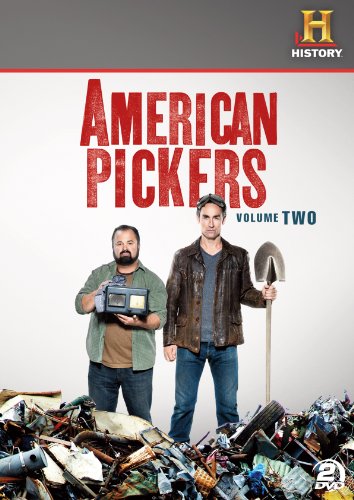
Personally, I do not watch much reality television. Most “realities” they present is quite boring or scripted. However, as of late I have started to watch reality shows that I have dubbed, “One Man’s Junk is another Man’s Treasure.” My two favorites are Storage Wars and Pawn Stars. The idea that just because one person might think it is a piece of crap, the next might think it is worth a ton of money. Today’s review is the second volume of American Pickers. Will it be another diamond in the rough?
So, as I asked myself when I unwrapped this sucker, what exactly is American Pickers about? Well, there are these two guys, Mike Wolfe and Frank Fritz who roam the United States in search of knick knacks, car parts, collectibles, anything that will bring them money. A picker. Their method is somewhat unorthodox as they actually visit people’s homes, storage sheds, and any other place where somebody have stored their collection.
Posted in: Disc Reviews by William O'Donnell on November 2nd, 2011
Bubokan is one of those venues that has become a goal for any major band. Dream Theater had toured Japan numerous times over the course of 12 years but never yet rocked this venue. Japan is, and has been, one of those markets that tends to embrace things differently than North America or Europe; and Progressive Metal is not exactly rocking the Top 40 stations (at least, not since RUSH were in their prime...and even then...). It was only a matter of time that the most relevant “Prog” band playing today would make it to Budokan, and they celebrated by making it into a concert film.
Each member of this group is a virtuoso at their instrument. Taking time for instrumentals or solos are rather commonplace for arena concerts. Instead of the standard guitar or drum solo, all but the lead singer of the group would flex their progressive metal playing muscles while putting on a clinic of just how flashy a musical education can be when the most technically impressive of scales and rhythms are played at breakneck paces and mixed with very strange time signature changes.
Posted in: Disc Reviews by Gino Sassani on November 2nd, 2011
"You lose. You die."
In 2005 Russian-born writer director Gela Babluani had a bit of an Eastern Europe success with his film 13 Tzameti. The film took the Grand Prize Jury at Sundance and a few other film festivals, winning also in places like Venice and Transylvania. The film made quite a splash, and it wasn't long before it attracted the attention of American distributors. An English-language version was inevitable at this point. Thankfully Babluani was able to work out a deal where he got to direct his own remake. Babluani has received more than a little heat for essentially remaking the exact same film with only a few changes to cater to the American audience. I never saw the original film, but now I have seen his remake. It would become his first American film and what a film it has turned out to be.
Posted in: Disc Reviews by M. W. Phillips on November 2nd, 2011
“I might be wrong, but I'm guessing you know something that I don't.”
First off, this is not the 2011 Sucker Punch directed by Zack Snyder. This was shot in 2008, but released in 2011 under the name Sucker Punch just months after Snyder’s action fantasy. I can only imagine this was done to capitalize on confused DVD renters and buyers.
Posted in: Disc Reviews by Michael Durr on November 2nd, 2011
Everybody needs a little help in their life but many are afraid to ask for it. Perhaps they need to know how to ask for a raise, or perhaps help with their geometry homework. One does not exactly gain knowledge of how to ask out a beautiful redhead supermodel unless they get a little help from somewhere. But I digress. Today, we explore the life of Laura who apparently needs a little help when her cheating husband dies right in front of her. Things are not as easy as they seem.
Laura (played by Jenna Fischer) is a dental assistant. Behind is a very noisy macaw outside the window who constantly repeats “Rinse Please”. He is supposed to be soothing. She talks to the patient and tells him about her husband and how he flosses with the extra waxy floss and how that is not good for him. Laura obsesses a bit about the fact that her husband ignores her and the patient soon wonders where the exit sign is at.
Posted in: Disc Reviews by David Annandale on November 1st, 2011
His troops defeated and massacred, General Pang (Jet Li) staggers away from the battlefield, more dead than alive. After a brief by intense overnight encounter with a mysterious Lian (Xu Jinglei), he falls in with bandits headed up by Er Hu (Andy Lau) and Wu Yang (Takeshi Kaneshiro). He finds a renewed purpose in life with this group, and forges the band into a formidable fighting force, one that will play an ever greater role in shaping the conflicts that are dividing China. But the fellowship he forms with his blood brothers has a fatal flaw: as fate would have it, Lian is promised to Er Hu. Betrayal and tragedy lurk in the wings.
First, the positives: this is a very handsome production, with a visual sweep that is appropriately epic. The battle scenes are expertly staged, whether these be small-scale skirmishes or grand campaigns. These are spectacular, exciting moments in the film. The characters and their story, however, are far less interesting. The love between Pang and Lian is difficult to empathize with – we don't really understand why these two are obsessed with each other, and must take it on faith that they are. All of which makes it difficult to care about the relationship, and thus its consequences are more irritating than tragic. And while Pang's internal conflicts are sometimes compelling, Lian's characterization is so perfunctory that she comes across as little more than venal, misogynist caricature. In the end, then, the film seems to drag on longer than its 113 minutes, as one finds one's eyes glazing over between the battle scenes. This is a beautiful movie, but an uninvolving one.
Posted in: Disc Reviews by M. W. Phillips on October 31st, 2011
“In a blaze of blood, bones, and body parts, the vivacious young girl was instantly reduced to a tossed human salad... a salad that police are still trying to gather up... a salad that was once named Elizabeth.”
Ah, there is nothing that can bring an exploitation movie alive like the unhinged imagination of Frank Henenlotter. Frankenhooker is another love letter to the seedy side of a New York City from a long-gone era. It is a cult film extraordinaire.
Posted in: Disc Reviews by David Annandale on October 30th, 2011
The Reverend Cotton Marcus (Patrick Fabian) has made a tidy living preaching the Gospel and working his specialty: exorcisms. But he has lost his faith and, along with it, his willingness to fleece the gullible. He does, however, acknowledge that an exorcism can prove psychologically beneficial if the recipient believes in the ceremony. All that said, Marcus wants out of the business, but he takes on One Last Case, and a film crew tags along with him to the backwoods (where else?), where the devout Louis Sweetzer (Louis Herthum) is convinced that his daughter Nell (Ashley Bell) is possessed. Marcus slips into his routine, but soon discovers that there is is much more afoot here than he could have imagined.
The first half or so of The Last Exorcism is not without interest. It does, in some ways, handle the faith-vs-reason question more interestingly than The Exorcism of Emily Rose, and it does a credible job of gradually building suspense. But as we approach the climax, the cracks in the found-footage conceit begin to show, and the resolution blasts straight past “frightening” and into “ridiculous” and makes nonsense of the entire mockumentary premise. Maybe it’s time to retire what is rapidly becoming a tiresome cliché. In the end, then, the film is a misfire, but kudos to Ashley Bell for her disturbing physical performance – she does all the back-breaking double-jointed shenanigans without the benefit of special effects.
Posted in: Disc Reviews by David Annandale on October 29th, 2011
Season 2 of the Tyler Perry-created series continues misadventures of Leroy Brown (David Mann), who, last season, opened up a seniors’ residence. This season has all the characters firmly in place, and the stage is set for no end of misguided schemes and misunderstandings, all of which conclude with lessons learned and heartstrings tugged.
If the above sounds a little generic, that’s because so is the series, and furthermore, I’m referring to an archaic quality to this series’ generic nature. Put another way, this is an unapologetic (though it should be deeply ashamed) throwback to situation comedy’s dismal era of the 1980s. The performances broad, unfunny caricatures, all squealing yelps and bugging eyes. The laugh track comes in on every other line, underscoring just how desperately unfunny the dialogue is. As for the plots, I cry mercy. Brown hopes to get rich marketing his family’s barbecue sauce, Brown becomes an over-demanding patient after being grazed by a bullet, Brown wins twenty bucks in a lottery and becomes a gambling fiend, and so on and so on and so forth. Storylines that would creak even if the main character were named Ralph Kramden, overlaid with thudding sanctimony and Real Social Issues.
Posted in: Disc Reviews by Archive Authors on October 28th, 2011
Ken Burns has achieved a rare feat in the world of filmmaking: he makes clean, concise, uncontroversial documentaries and yet has somehow become a household name, or as close as any documentarian can get in this society. It also depends, I suppose, on the ratio your household's television is tuned in to PBS compared to, say, Spike TV. Burns has made his name making huge, sweeping films that take in gigantic aspects of American history and culture, like The Civil War, Jazz, and my personal favourite, Baseball. His latest documentary, which he co-directed with Lynn Novick, ranks right up there with his best work. Prohibition is vast, covering a huge time period in American history, contains tons of detail, and still manages to be focussed, concise, and tremendously entertaining.
The first part, A Nation of Drunkards, starts its story before the Civil War. It sets the scene by painting a picture of a nation obsessed with alcohol. Saloons are such an integral part of the landscape that huge numbers of the working class and immigrant labourers were giving up most of their pay buying liquor. Spousal and child abuse was rampant, and Temperance Unions grew out of the need to protect and shelter women and children from abuse and neglect as much (or more) than they did out of religious zealotry.