Studio

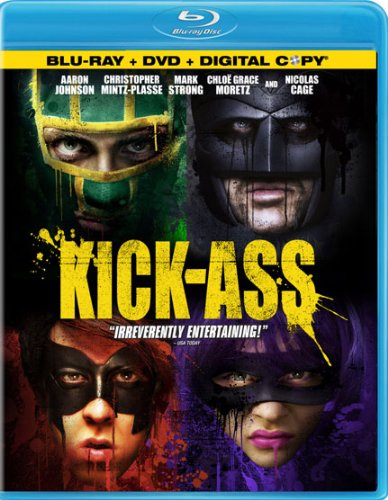
"I always wondered why nobody did it before me. I mean, all those comic books, movies, and TV shows. You'd think that one eccentric loner would have made himself a costume. I mean, is everyday life really so exciting? Are schools and offices so thrilling that I'm the only one who ever fantasized about this? Come on. Be honest with yourself. At some point in our lives, we all wanted to be a superhero. Who am I? I'm Kick Ass."

You have to give the folks at Lionsgate some serious credit for the way they promoted Kick Ass. The film was generating a lot of buzz almost a year before it actually came out. It was a huge topic of conversation at last year's ComicCon, and I must have gotten promo alerts from the studio once a week for several months. But even with all of that hype, the film just refused to interest audiences enough to show up in any great numbers for the quirky superhero spoof. We're talking under $50 million for a film that got so much pre-release attention. And so it was with that history in mind that I rather cautiously approached the film when the Blu-ray arrived here from the studio. Most of what I had heard wasn't so good. I figured, at best, it'll be a nice diversion.

For ten years we watched Jack O'Neil, Samantha Carter, Dr. Daniel Jackson, and the Jaff'a Tealc' enter the Stargate. Others would join the team over the years. Each week we would follow their adventures, first on Showtime and finally on the Sci-Fi (now Sy Fy) Channel. We watched with awe as they stepped through a portal that was in reality a wormhole transporting them instantly to another world, brought online by dialing the device like an old fashioned telephone. For another five years we traveled not only to another planet, but to the Pegasus Galaxy itself to the Atlantis Base, a bright floating city left behind by the ancients, the people who created the Stargate system millions of years before. On this show we met new friends, new bad guys, and had new adventures. The location might have changed. The faces might have, at first, been unfamiliar, but the missions and the entertainment value didn't let us down. For 15 seasons we enjoyed a spectacular tale to rival the myths of the Greeks and Romans themselves.

I'm told that all good things must come to an end. When Atlantis was finally cancelled, I was made almost immediately aware of the plans to continue the franchise. First reports started coming out that the show was going to be called Stargate Universe. Soon my inside contacts started giving me tidbits about the story. Details began to emerge about the Destiny, an ancient ship abandoned in another universe far away. The ship was on some kind of predetermined course and would sport an unsuspecting crew of humans that would be left stranded on the ship for an indeterminate amount of time. It was starting to sound a lot like Star Trek: Voyager to me. Of course, this is Stargate, so there has to be some gate travel, one would assume. The ship would come with a gate, and the vessel would come out of faster-than-light travel from time to time and dial up a local planet for exploration. The ship was ancient not only in its origin but in its duration in space. There were going to be a lot of system failures, as the equipment was long past its expiration date. The ship itself would know what resources it needed to continue to operate. Searching its vast planetary database, the ship would locate planets with the essential resources, allowing away teams to get such vital raw materials. Unfortunately, the ship didn't always give a good indication of what to find or where on the planet it might happen to be. Oh, and did I mention the countdown? The ship would decide how much time it would allot for each mission, instituting a countdown. When the clock reached zero, the ship goes back to FTL, and whoever's not back in time gets left behind.

One of the most difficult types of films to pull off is the black comedy. By its very nature the film has to be somewhat morbid and exist in a world of the absurd. As much as I am often drawn to this kind of movie, I haven't found more than a handful that were able to pull it off. The black comedy usually involves someone's death, often by some bizarre means, and almost always in a world of moral ambiguity, where such things fail to affect the emotions or consciences of those involved. The death has to appear almost matter-of-fact. Probably the best example of a good black comedy is Michael Caine's A Shock To The System. Bad examples include the Weekend At Bernie's films. Now you can add The Job to one of the better examples of the genre.

Meet Bubba (Flueger). He's a typical down-on-his-luck kind of guy. He can't hold a job and has been in these dire straits for over a decade. He spends most of his time hanging out at the diner where his girlfriend Joy (Manning) works the counter. Usually all he can afford is a cup of coffee. He whiles away the time listening to Joy talk about her acting career. As a child she was in a popular show, but hasn't found a part since that time. It doesn't help that she possesses an exaggerated limp, dragging one of her legs as she walks. Apparently, it's a lifetime disability. When we see footage of her as a child on her series, the kid is dragging the same leg. Enter Jim (Perlman). He's dressed in an urban cowboy outfit and sits next to Bubba and asks what's good. Bubba recommends the trucker's special, which Jim quickly orders. But suddenly Jim doesn't feel so hungry and offers the food to the obviously very hungry Bubba. The two talk a spell, and eventually Bubba offers to let Jim park his car to sleep in at his spot next to his apartment. Feeling obliged for the favor, Jim offers him a sheet of paper given to him by a man he helped in Baltimore. The slip is for a job interview at someplace called Be Your Own Boss. Bubba figures “why not”, and goes to the office.

The rock gods must have been smiling when Keith Emerson, Greg Lake, and Carl Palmer journeyed from their perspective corners of the music world and combined to form the band Emerson, Lake & Palmer, or merely ELP to the fans. Keith Emerson had made quite a name for himself with his manic organ riffs in working in the band The Nice. Greg Lake was busy with the band King Crimson where he worked with long-time ELP collaborator Peter Sinfield. Carl Palmer was the youngest member of the group and had played for several bands before meeting up with his eventual ELP bandmates. Together they would help to define an entire genre of music. This new progressive rock era would be recognized not by hit singles and AM radio play; instead this music would be enjoyed for its virtuosity and complexity. In all of the years the band enjoyed success, they've released less than a handful of what the industry defines as a single. Yet, anyone who has ever seriously picked up an instrument in the last 40 years knows exactly who they are.

The band formed in 1970, and by the end of that year they were already doing some quite ambitious things. One of the most ambitious and most memorable was their modernization of Mussorky's wonderful Pictures At An Exhibition. The piece was actually originally written by the classical composer as just a piano piece. It was one of the first classical works I had ever fallen in love with. Unfortunately, that original arrangement is rare. I find that most people are unaware of the composer's original intent.  It strikes me as odd that there are people who call themselves purists who have ranted about the reinvention of this music by ELP. It's a bit hypocritical when you consider that the version that they likely enjoy was also tampered with and not what the composer intended for the work. When Emerson Lake & Palmer took on the collection of works, they added a modern spin that included MOOG synthesizer solos and even lyrics written and performed by Greg Lake. The beauty is that these new elements were quite faithful to the subject and fit as if they had always belonged. It's no less sacrilegious than the orchestrated version you've likely heard, which is enjoyed by the elitists.

Since I get to review a lot of sitcoms, I tend to see the gambit of shows designed for only purpose. That purpose is for me to laugh. But there is another word in sitcom which can restrict how funny the comedy will be to a given person. Situational. The situation I present here involves a female sports columnist and her male friends. One can only wonder if this formula created by Betsy Thomas will be what I'm looking for.

P.J. Franklin (played by Jordana Spiro is a sports-writer for the Chicago Sun-Times and she works and lives with a whole lot of males. She rooms with a radio DJ named Brendan Dorff (played by Reid Scott). They have two close friends named Mike Callahan and Kenny Moritorri (played by Jamie Kaler and Michael Bunin) who run a sports memorabilia store. Mike and Kenny are also single and spend their times trying to get the ladies.

Extraordinary Measures is a moving story about family and a father’s perseverance to find a cure for his children.  John Crowley (Brendan Fraser) seeks out the help of an irritable medical researcher (Harrison Ford) whose theory cannot be fully developed without extensive funding. As the time ticks away, so does the probability of finding a cure.  This film requires an emotional investment and audiences will be surprised at how invested they become. 

Coming from emotionally charged source material, the filmmaker (Tom Vaughn) was given the difficult task of conveying personal emotion to a mass audience. Too often stories similar to this are made into low budget made for TV films which are downtrodden for their ineptitude. It is difficult for audiences to shed that stigma from the marketing of this film. However, on a positive note, Extraordinary Measures is executed quite well.  The momentum of the film is driven from the story and less on aesthetics.  The shot selection, editing and score of the film are all pedestrian at best.  However, there is something to be said for a film that has an arbitrary execution and still manages to maintain the audience’s attention.  

The second (and final) season of this erotic horror anthology series follows the pattern set down by the first. David Bowie replaces Terence Stamp as host, and takes up the job of briefly uttering portentous statements before each story rolls. These stories star such luminaries as Giovanni Ribisi, Eric Roberts, Jennifer Beals and Lori Petty, and are based on tales by a pretty impressive line-up of line-up of writers: Poppy Z. Brite, Kim Newman, David J. Schow, Gemma Files and Ramsey Campbell, to name but a few.

As before, the erotic fixations give the series a clear identity, but also narrow its focus so that a marathon viewing of episodes would be a bit tiresome. But again, as before, the talent involved means horror fans would be remiss to pass the series up without giving it a serious look.

In 1983, director Tony Scott wasn't quite as prone to self-caricature as he is today, but he was already enamored of glossy, pretty surfaces, and if nothing else, his vampire movie The Hunger was glossy and pretty. The film arguably remains the most high-profile mixture of eroticism and horror, its place in libidinal history cemented by the love scene between Susan Sarandon, Catherine Deneuve, and Deneuve's body double. The film's lasting cult appeal resulted in a short-lived TV horror anthology series, presented by brothers Tony and Ridley Scott, and running two seasons (1997-8 and 1999-2000). Here we have Season 1, hosted by Terence Stamp.

The series' mandate was to present glossy sex-and-horror tales in a half-hour format. In this respect, it follows in the footsteps of The Hitchhiker (1983-91), but the intervening years mean generally better production values for The Hunger. An annoyingly long opening credit sequence leads to an enigmatic 30-second intro from Stamp (everything set to the sort of flashy cutting and visual excess that sure feels like it was directed by Tony Scott, even if it wasn't). The actual stories are notable for their talent on both sides of the camera – directors such as Russell Mulcahy, Patricia Rozema, and Tony Scott; actors like Daniel Craig, Karen Black, and Jason Flemyng. Even more interesting is the fact that just about every story is either adapted from a short story by a notable writer (Robert Aickman, F. Paul Wilson, Brian Lumley, Edgar Allen Poe) or scripted by one (Harlan Ellison, David Schow). The limitations of TV and budget are still present (beware some extremely ill-advised CGI), and the centrality of sex to the narratives mean that things can feel repetitious if you watch many episodes back to back. On the other hand, there is also some genuinely disturbing imagery here (check out the climax to “Necros”). In small doses, then, worth watching.

Wilson Yip and Donnie Yen have done a lot of movies together in the last five years including Dragon Tiger Gate, Kill Zone, and Flashpoint. This duo has had a knack of combining strong stories with fantastic martial arts. In 2008, they decided to take on the story if Ip Man, the grandmaster of the martial art Wing Chun. Ip Man also had a few famous students including the legendary Bruce Lee. Can Wilson Yip and Donnie Yen produce another quality martial arts flic?

In the 1930’s, Foshan was the center of Chinese martial arts and had plenty of masters willing to teach anybody who was willing to learn. But the most skilled man of martial arts in all of Foshan is not on the front lines teaching students. He’s back in his mansion with his wife and child and goes by the name of Ip Man (played by Donnie Yen). Ip spends his days training and studying his art of Wing Chun much to his wife, Cheung Wing-sing’s (played by Lynn Xiong) dislike.

Timer is an innovative concept.  In the film, people can choose to be fitted with a timer which counts down until that person meets their soul mate.  The timer will tell you precisely how long you will have to wait to find true love.  Oona (Emma Caulfield) is in the rare situation of having a blank timer.  Her soul mate has not had one implanted yet and the suspense is getting to her.  Oona decides to go out of her comfort zone and begin dating a considerably younger man named Mikey (John Patrick Amedori).  The only problem is that Mikey is not slated to meet his soul mate for another four months. 

This film has a strong and imaginative concept. The writer/director Jac Schaeffer takes an ambitious approach at the romantic comedy genre and the result is a muddled film. The performances are mediocre and the characters are not fleshed out enough. I found myself struggling to identify with any of the characters.  The concept needed to be further examined with more confrontation and a grittier approach. When attempting to make profound statements about our culture in the happy-go-lucky genre of romantic comedy it becomes difficult.  By viewing this film as a critique of the popularization of internet matchmaking and dating, it asks the audience to enjoy more of the present and worry less of the future.  The statement is sound, but the vision is never fully realized.