Studio

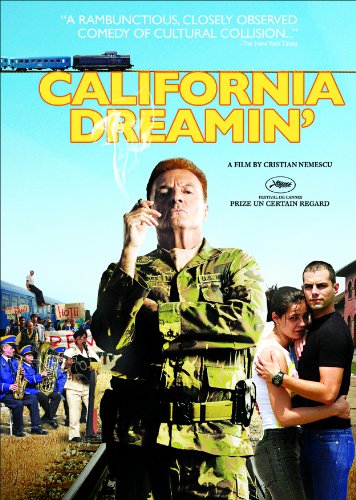
In 1999, a troupe of US marines must transport some equipment across Romania. Leading them is Captain Doug Jones (Armand Assante), a man so committed to his duty that he does a pretty convincing job of appearing passionate and proud about what is, on the face of it, a rather dull, two-bit assignment. As matters develop, the mission is far from dull, though it is not interesting in the way Jones might have hoped. The train is waylaid in the small town of Capalnita by the corrupt stationmaster, and a comical clash of cultures ensues.

Director (and co-writer) Cristian Nemescu was killed in a car accident before he had finished editing the film, and it is likely that his final version would have run less than the current 154 minutes, which is long for a comedy. Nonetheless, there has been no second-guessing of his artistic intent, and the film is presented as he left it, and if it isn't as tight as it probably would have been, had Nemescu been able to complete it, it's still a remarkable piece of work, with wonderful, finely observed (and performed) characters, and a sharp, wry sense of humour.

My relationship with romantic comedies has not been one of wedded bliss. More often than not, it is something I get forced into. Once you are forced into something, then you automatically have a pre-disposed attitude against the movie. Hence, I haven’t liked too many of these things. Thankfully in the last few years, if I see a romantic comedy it’s been mostly because it ends up in my review queue. This in turn has given me a softer approach to these movies but don’t think I’m going all sentimental just yet.

Beth (played by Kristen Bell) is a successful art curator for the Guggenheim. After a great art show, she is talking to her friends and mentions how she hates her ex-boyfriend: Brady Sacks’ guts (played by Lee Pace). Of course, he’s standing right behind her. They talk for a while and it appears that Brady is bitter over the fact that he got dumped at Applebees (he probably wasn’t allowed to get the Riblets, I hear they are divine). Brady then mentions he is engaged.

One thing I’ve learned about family sitcoms is that it usually defined by one principle character. For example, Different Strokes had Arnold Jackson (played by Gary Coleman, may he rest in peace), the Simpsons had Bart Simpson and Unhappily Ever After had Mr. Floppy (I love Bobcat Goldthwait). Family Matters is no different. The show was a very successful sitcom and had one of the best breakout characters of all, Mr. Steve Urkel.

The Winslow family is your typical family that lives in the city of Chicago. The head of the family, Carl Winslow (played by Reginald VelJohnson) is a city cop and knows how to put away a doughnut. His wife, Harriette Winslow (played by Jo Marie Payton) works for the Chicago Chronicle, a local newspaper. Harriette has a sister named Rachel (played by Telma Hopkins), a widow with a baby named Richie (played by Joseph and Julius Wright ).

"At the top of the world, there's a job only a few would dare. Last season the dash for the cash was fought on the smooth playing field of Canada's Arctic ice. This season, two old pros join four of America's bravest truckers to tackle the continent's deadliest ice passage. Just when you thought extreme trucking couldn't get more dangerous, Ice Road Truckers takes on Alaska."

It was the peak of the 1970's and CW McCall was teaching ordinary people like us about Cabover Petes with reefers on and getting by those smokeys. The man practically started a new genre of music with the hit song Convoy. The song was so popular that the back-up band used their cut to start a little project of their own. They became Manheim Steamroller and used the cash to cut their own music. The movies started giving us things like Smokey And The Bandit. Truckin' was in fashion, and a good time was had by all.

It's a story we have seen many times before. A man is down on his luck with love, largely due to his irresponsible ways, until he finds redemption by coaching a little league team. Sound familiar? Got a good idea of how this movie will progress? Good, that will save me some time.

A man dies during what appears to be a botched robbery, and his heart winds up in the needful chest of Josh Lucas, single father to a young daughter with a rare bone disorder. This is obviously a man with more than his share of troubles, but things appear to be turning around. He has a new heart, and his daughter's beautiful doctor (Lena Headey) really likes him. But then, when he crosses the path of a certain paramedic, his heart begins to beat furiously, deafening him. Before long, Lucas realizes that his donor was murdered, and the vengeful heart is leading him to the killers.

Produced by the Scott brothers, Ridley and Tony, this is, as one would expect, a handsome-looking piece, but has none of the editing frenzy that characterizes Tony's work, and for that matter is more of a moody tone poem than is typical of the work of either brother. So director Micheal Cuesta is forging his own identity here, and is aided by genuinely moving performances, especially from Lucas, an actor who seems to be able to move effortlessly between hero and villain roles. Also on hand is Brian Cox, as the detective who realizes what is going on, and for reasons of his own encourages the heart's vendetta. He's always fun to watch, though his hard-boiled character here isn't much of a stretch.

"You may think this silly, but ever since I can remember I had this urge to be a knight. Not in armor or anything like that. Just in spirit. You know, to help the helpless. To find a wrong and right it. Then somewhere around 13 or 14 it sort of all became an urge to save beautiful damsels in distress. I just wish that somewhere in all of those books I read about knights and dragons they'd have warned me about damsels wearing little straw hats."

In the previous film, the Rapture (from the Bible) has occurred and two FBI agents were investigating. By the end, each was left in less than desirable situations and we start off with both of them getting into further trouble as the world has become a dystopia run by some sort of “Global Alliance.” One is busted from jail and finds a group of Christians in hiding, and the other is blackmailed into seeking out that same group and revealing their camping location to Alliance bad-guys.

A spin-off from Diff'rent Strokes, The Facts of Life centered around four residents of the Eastland Academy for Girls and their headmistress, Mrs. Garrett (Charlotte Rae). The four girls were characterized in strokes as broad as they way their physical types were presented: Blair (Lisa Welchel), rich, spoiled and blonde; Jo (Nancy McKeon), tomboy and brunette; Tootie, nosy and African-American; Natalie (Mindy Cohn), fun-loving and overweight.

The actual humour in the series is pretty pitiful – in other words, standard sitcom quips that might pass for wit if you're about five. However, like its parent show, it would consistently tackle difficult subjects. In this season, that means the likes of abortion, drunk driving, and hearing loss. Nothing subtle, and much that is painfully earnest here, but at least there is also a little bit of ambition in the stories, so credit where credit is due. The lead-in to the season was the TV movie, The Facts of Life Goes to Paris. While the dire nature of the humour is even more apparent here, now that the laugh track has been stripped away, the shooting was actually done on location, which is, frankly, more than I was expecting.

"I try to believe in as many as six impossible things before breakfast. Count them, Alice. One, there are drinks that make you shrink. Two, there are foods that make you grow. Three, animals can talk. Four, cats can disappear. Five, there is a place called Underland. Six, I can slay the Jabberwocky."

To be perfectly honest with you, I have never read either of the two Lewis Carroll books on which this film has been based. Under ordinary circumstances, that would put me at a decided disadvantage in both watching the film and certainly in providing an insightful review of the movie. But these are not ordinary circumstances. The characters and their stories, originally told in both Alice's Adventures In Wonderland and Through The Looking Glass And What Alice Found There, have become an indelible part of our culture. One need not have read a word to be intimately familiar with Alice and her fanciful friends and rivals from Underland, which Alice herself interprets for us as Wonderland. There have been animated features as well as other live action attempts. The characters have become iconic and have appeared in advertising campaigns and even an episode of Star Trek. The surprise isn't that I feel like I know this story without having read the source material. The real surprise would be if there was anyone out in the civilized world who wasn't familiar with these characters.