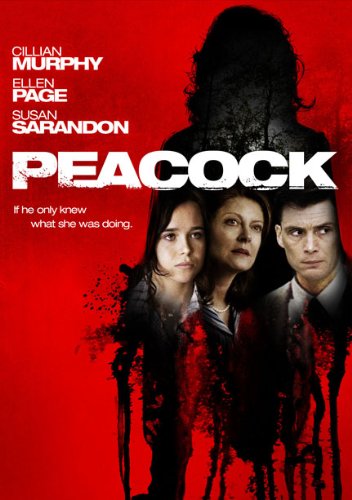
Studio

John Skillpa (Cillian Murphy) has been hopelessly damaged by the monstrous abuse his mother inflicted on him. As a result, he now has two separate personalities: John and Emma. John is a terminally shy bank clerk who exists as of 8:15 in the morning and for the duration of the work day. Emma takes care of the domestic chores and leave notes and meals for John. But one day, while Emma is doing the laundry, a derailed caboose blasts through the fence, revealing her existence to the town of Peacock. Everyone assumes she is John's wife. Coaxed out of her shell by Susan Sarandon, Emma gradually blossoms, much to the distress of John. When Ellen Page shows up with a young child and a dark revelation from John's past, the two personalities find themselves moving closer and closer towards a violent confrontation.

It is a testament to the work of director/co-writer Michael Lander and of Cillian Murphy (not for the first time making effective use of his androgynous looks) that one finds oneself increasingly viewing Skillpa as two entirely separate people as, bit by by, drop by drop, the suspense builds. Sympathy shifts back and forth between Emma and John, and by the end one can no more imagine Skillpa as a unified whole than one can decide which of the two halves is the “real” person. Touching and tense, this is a bizarre cross between Psycho and Our Town, and it somehow works very well indeed.

"Two years ago my son was taken from me. Since then I've lost everything: my job, my marriage, even my life. But I came back, and the dead came with me."

Despite its rather crass and offensive material, Drawn Together lasted three seasons and thirty six episodes before Comedy Central pulled the plug in March 2008. The show featured parodies of popular cartoon characters or archetypes and brought that together in a very funny style that delighted fans who were partial to shows such as Family Guy or Robot Chicken. So it was only natural that when the episodes ended, they would look to other production avenues, like direct to dvd.

*Warning. This review does have a little bit of salty language or describes risque situations. If you are a child, please do the right thing. Clear your browser history and cookies after you read this review. You have been warned, thank you.*

"Nothing worse than an old hippie, man."

When I think of Cheech & Chong, I am brought back to the 1970’s. It was then that the pair had their first success with an iconic brand of “stoner” comedy. Their LPs sold millions across the country. You didn’t have to be a stoner to appreciate the jokes. I was about as straight as they come, but I really loved listening to Cheech & Chong. The material was about more than just getting high. It was timely, at least it was then. It mirrored the culture that we could see from our own windows, and like all inspired comedy, it was relevant.

“Man lives in the sunlit world of what he believes to be reality. But there is, unseen by most, an underworld, a place that is just as real, but not so brightly lit, a darkside.”

Not since the likes of Rod Serling’s Twilight Zone or The Outer Limits has there been a really good sci-fi/horror anthology until 1984’s Tales. Not to say that each episode was a winner. In fact, most were pretty weak and relatively lame, but when this show was good, it was very good. These tales weren’t any ordinary specter spectaculars, but were told by spectacular story writers, directors, and producers. Look at just this first season, and you’ll find some of the top names in the field involved in one way or another. You’ll see the likes of Stephen King, Tom Savini, George Romero, Robert Bloch, Frank De Palma, and Harlan Ellison. The tales often came with a twist, or at least a big finale in the end. Much like a train’s headlight in a long tunnel, you might have seen it coming from a mile away, but it’s hard to avoid the impact.

Erle Stanley Gardner wrote crime fiction, and while many of his 100 or so works are unknown to most of us, he created a character that has become as identified with criminal lawyers as any other in fiction. It was in these crime novels that Perry Mason first faced a courtroom. He developed a style where he would investigate these terrible crimes his clients were on trial for. He would find the real killer, and in what has become a Hollywood cliché, reveal his findings in a crucial moment during the trial. While we may not remember the novels, we all remember the man in the persona of Raymond Burr.  Burr had a commanding presence on our screens and enjoyed a well deserved 11-year run as the clever lawyer. What makes this run so amazing is that the show followed pretty much the same pattern the entire time. We always know what’s going to happen, but we wait eagerly for that gotcha moment when Perry faces the witness on the stand. We know when he’s got the guy squarely in his sights, and we can’t sit still waiting for him to pull the trigger. OK, so maybe that’s a little over the top, but so was Perry Mason. From the moment you heard that distinctive theme, the stage was set. To say that Perry Mason defined the lawyer show for decades would be an understatement. Folks like Matlock and shows like The Practice are strikingly similar to Perry Mason. If you haven’t checked this show out, this is your chance. See where it all began.

At this rate, it’s going to be quite some time before you complete your collection. I’m not even sure that DVD will still be a viable format before the end of the series on DVD. It’s another half season, and the episodes continue to fly at us at a snail’s pace. But slow and steady wins the race, and as long as the quality episodes continue to deliver that classic Mason charm and style, I guess folks like us will continue to come back for more.

Flight Of The Intruder is one of those films that appears and disappears off of the film world radar about as quickly as a stealth bomber. It has had its share of accolades but often passes swiftly into that entertainment night of obscurity. While it is at its core a Vietnam War film, the movie never really appears to be about the war at all. It attempts to capture some of the sartorial wit of Catch 22 while still trying to pass itself off as a serious enough movie. Make no mistake. This film leaves no war cliché unused, particularly in the stilted, sometimes gung-ho dialog of its characters.

Jake "Cool Hand" (Johnson) is a bomber pilot during the Vietnam War. He's stationed on an aircraft carrier. He's growing a bit bored with the missions he's being ordered to fly. Instead of taking out the important military installations he's assigned to, the locations end up being just empty jungle, or worse. Some of them are simply civilian farms and villages. His morale is already pretty rock-bottom when one of these useless missions catches his plane some serious fire and kills his navigator. Now Jake wants to do something worthwhile, not to mention get a little payback on the enemy. Commander Camparelli (Glover) is growing concerned with the emotional state of his pilot. He tries to keep him reined in as best he can. Enter Jake's new navigator Lieutenant Commander Cole (Dafoe). This guy loves combat. He's just volunteered for his third tour of duty. Like Jake, he wants to make some kind of a real difference. Jake convinces him that they should fly an unauthorized mission straight to downtown Hanoi where it is believed there is a stockpile of SAMs (Surface to Air Missiles) that are responsible for bringing down a lot of American planes. They know it's likely a suicide mission and that even if they should survive, a court martial is about the best they can hope for from the service.

You've seen me talk with a certain element of affection for the remarkable work that the Walt Disney Studios have done in the way of feature animation. Who can really argue with me when I state categorically that the studio invented that particular medium? The long line of classics could certainly fill a lot of space in this review, but these are things you already know. Left out of the list of classics, and deservedly so, is this 1980's Disney feature. the studio's take on Sherlock Holmes, The Great Mouse Detective.

Now, the first thing that pops into your mind when you connect Walt Disney with a mouse is that studio icon image himself, Mickey. That image is so ingrained in my skull that I at first thought I remembered Mickey being in this film. Obviously I was mistaken and am thinking of some similar role the royal rodent likely performed in another title. The mouse in question here is more your standard-looking mouse without the trademark three circle head and ears. The characters are no less endearing here. Still, this was a transition time for the studio, and they were not putting out their best work in the 80's.

One of the first books I read about the restaurant business was a title called Kitchen Confidential by Anthony Bourdain. He describes the people who work at restaurants to be a band of misfits, those who are probably only there because of an irrational dedication to cooking. That would certainly describe the people who work at the Slammin Salmon, the latest comedy from Broken Lizard group.

Rich Ferente (played by Kevin Heffernan) is a down on his luck waiter. After a bout with some very disrespectful customers, he comes to the back with a tuna patty forcefully stuck in his mouth. He gets yelled at by the floor manager Carl (played by Nat Faxon) which causes Rich to quit on the spot. However Rich has to tell the Champ that he has quit and you know what happened to the last guy who did that? Ultimately Rich chickens out and runs away. Fast forward a year.

Remakes are a fact of life. It might seem now more than ever that we are plagued with this reality, but it's been true for a very long time. It's not so new, as you might expect. Even the lauded Cecil B. Demille The Ten Commandments was a remake of his own silent 1923 film. They've existed almost as long as the movies themselves and will continue to exist for the foreseeable future. So, the question should be: Why should a particular film be remade? Often technology catches up with the content in a film. The ability to create on the screen something that was simply impossible originally is a legitimate reason to tackle an older film. Sometimes the movie is so powerful that it bears retelling for a new generation.

But then there are the reasons why a film should not be remade. There are some classics that simply should be off limits forever. Would anyone even dare attempt to remake The Godfather? There are those films that are just not worth being remade. How many versions of Piranha do we really need? Then there are the films that are remade in title only, like the 1999 version of The Thomas Crown Affair.