Studio

Most people don't know or remember that Andy Griffith had a career before his television classic reached the airwaves. He had a pretty distinctive stand-up routine going for many years that included recordings like most stand-ups of the day. He had quite a famous bit about a country farm boy seeing his very first football game. It was called “I Think They Call It Football”, and it's a priceless classic. Andy also found his way into a couple of movies in the days before he became Sheriff Andy Taylor. One of those movies was No Time For Sergeants. It wasn't a stretch for this country boy, and fans of the rural years of Andy Griffith will find about everything they're looking for here.

Will Stockdale (Griffith) is down on the farm with his Pop enjoying the slow life when they are visited by an officer from the draft board. It appears that Will has been getting draft letters, but his Pop keeps throwing them away. Now Will is considered a draft dodger and is taken away in cuffs to be inducted into the Air Force. Along the way he befriends Ben Whitledge (Adams) who comes from six generations of infantry. His mother has sent a letter asking that the military honor the tradition by giving Ben a transfer to the infantry in the Army. Will, a naive rural boy, just wants to help. So he goes directly to the company leader, Sergeant King (McCormick) and tries to help out his new pal. What he ends up with is the assignment as PLO, Permanent Latrine Orderly, a post Will thinks is intended as an honor. But when the Captain discovers the "honor", he puts King in charge of Will's classification. If Will isn't classified in one week, King will be the next PLO. The film follows the antics of getting Will classified before the three (King, Will, and Ben) are assigned to gunnery training. With Ben and Will on a training flight, their plane ends up in the middle of Yucca Flats during a nuclear test. Presumed dead, the "heroes" are to receive posthumous medals at a gathering in their honor. It's all a nice fitting tribute until the boys show up at their own memorial service.

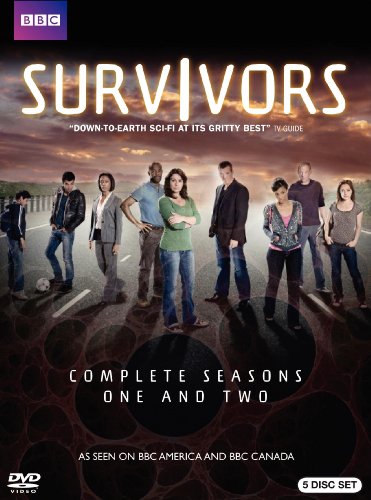
"Most of the world's population has been wiped out by a virus. Civilization, as we know it, has come to an end. For the few survivors, every day is a fight for life. But sinister forces threaten their future."

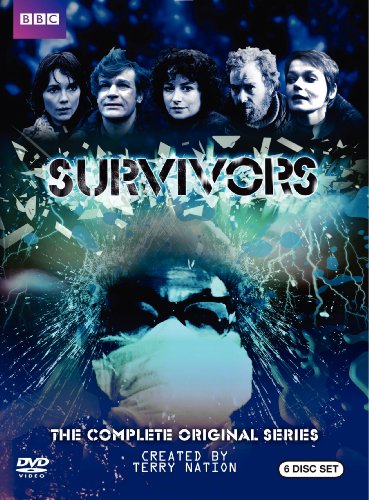
Right from the opening credits, you can see that a lot has changed since 1975 and the original series. I'm guessing that my watching them back to back allows for even more dramatic notice of the changes. Everything is cleaner here. The production values are light-years away from what they were. Even the disc menus reflect the higher-tech edge of the 21st century production values. The credits claim that this series is not really based on the original show, but more on Terry Nation's novel. I never read the novel, but it appears there is some truth to that statement. The episode titles no longer have individual titles. They are merely listed as Episode One, Two... and so on. Once you begin to watch the show, you will find that you recognize many of the characters by name and, at times, circumstance, but these are not the same people at all. More on that later.

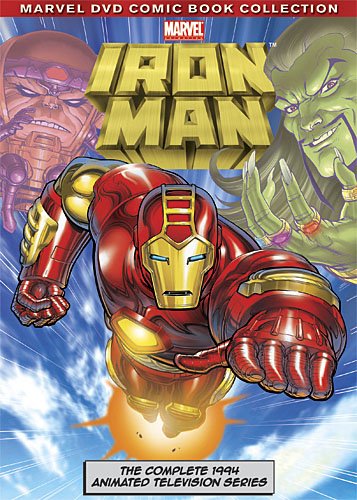
Iron Man 2 comes out this week and is set to do fantastic business. Usually I’m a person who waits for movies to hit dvd and blu-ray and I’m already planning to when I can go see this movie. But one of the things I’ve come to appreciate over the years is when a big movie such as Iron Man 2 comes out, there are disc releases that dip into yesteryear and help to get you in the mood. Imagine my surprise when I was asked to review Iron Man: The Complete 1994 Animated Series.

To do this correctly, I really have to break up this synopsis into two parts. There is the first season and the second season. Trust me, they are so different from each other, I’m surprised they were released together. Everything from drawing style to the characters to the way they craft stories is different. It’s a fun ride either way but you’ll certainly prefer one over the other.

"You know, I never thought what happens to a city ... well ... if it breaks down, all at the same time. There's no power. There's no lighting, or cooking. And food, even if you can get it into the city, you can't distribute it. Then there's water and sewage, things like that. You know, it just never occurred to me when I lived in London. The city's like a great big pampered baby, with thousands of people feeding it and cleaning it, making sure it's all right."

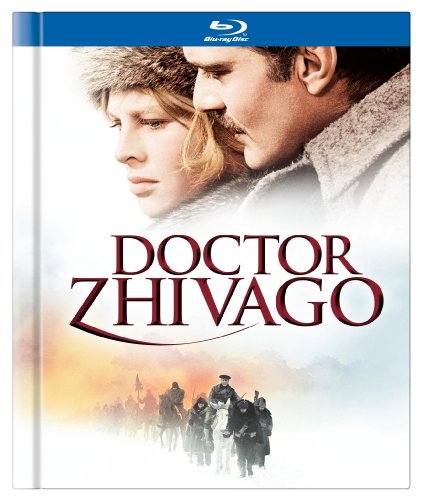
In many ways the epic story and film Doctor Zhivago echoes the real-life story of Boris Pasternak, who penned the original novel. Pasternak was a firsthand witness to the events that led to and became the Russian Revolution. He collected 50 years of memories that began with the early days before the revolution and ended with his own confrontations with the USSR government. Like Zhivago in the story, Pasternak's work was banned in his own country. The manuscript had to be smuggled out of Russia and found its way first to Italy, where it was finally published for the first time. But it didn't stop there. The book quickly found its way to countries all over the globe. It was translated into several languages in a very short time. In 1957 Pasternak was honored with the Nobel Peace Prize for literature. Alas, that was not meant to be. He was confronted with the Party Government and warned he would not be permitted to return home should he go to Sweden to accept the prestigious award. And while that might not have appeared to have been much of a threat when you consider Pasternak's harsh observations, this was his homeland, and he did have family there who would have most assuredly paid a price for his actions. He declined the award, begging the committee to not "judge him too harshly". It would be Pasternak's last stand. He would never see the complete success of the novel or the impact it made on the world stage. He died just three years after turning down the award. He was never to see David Lean's epic interpretation of his work. He never saw the film Doctor Zhivago.

I must confess that I too had never seen the movie. I had certainly seen many clips of the film. It was impossible to follow films, in general and not be aware of the film and its impact. Of course, I had heard much of the music. The Love Theme, also called Lara's Theme, has become one of the most recognizable movie themes in the history of the industry. The movie was quite popular, but circumstances just never presented themselves for me to have the opportunity to see this movie, at least in a manner worthy of its reputation. Certainly, there were television showings, but I could never bring myself to experience such an iconic film in a cut-up fashion with likely an inferior print. Even DVD kept me at a distance. Did I really want to watch this movie with a 3-4 mbps bit rate? Certainly not. I suspect there is perhaps an entire generation of film fans out there that found themselves in the same situation. We've been asking ourselves: will there ever be any chance of seeing the movie in a format that preserves its splendor? I guess I was holding out for a nostalgic screening at a local at house theatre. And then came Blu-ray, with its limitless possibilities, and finally a copy of Doctor Zhivago would arrive on my doorstop. My dog barked ceaselessly at the UPS man who delivers these goodies on an almost daily basis. This time there was an extra snarl in that growl, I was sure of it. Could she have known that this particular delivery was going to find me and my wife locked away for nearly 4 hours (in my case more like 6) in our, closed to dogs, little theater? She knew. She knew.

These last couple of years have seen a resurgence of a particular kind of character study. For me I think it started with The Wrestler. For Mickey Rourke, it was a powerful comeback and led to an example of grand theft at that year's Oscar celebration. Now, I wouldn't exactly say that Jeff Bridges was in any particular need of a comeback. He's had some pretty steady work over the years. Still, you just can't watch Crazy Heart and not be reminded of The Wrestler. These characters could not be more different in a lot of ways. But they are also cut from the same cloth. Both have already seen their glory days behind them. They've each indulged in some pretty self-destructive behavior. In The Wrestler, it could be argued that the abuse he put on his body was a necessary part of the life he chose. With Crazy Heart, we're talking alcoholism, pure and simple. Still, any of those old cowboys might make the argument that booze is as much a part of the life they choose as the drugs and physical punishment are for a wrestler. It's a pretty good point. Both characters are looking for some kind of redemption with a past child. In this case it's a son. Both are attempting to find healthy relationships, perhaps for the first time in their lives, with single moms who have had some bad luck in the romance department. Finally, both characters are looking for a comeback. Here is where the stories truly diverge. For Mickey Rourke's Ram, he returns because it's the only thing he knows. His job defined him. His comeback will likely mean the end of his life. For Bad Blake, the new career in music could well be his salvation and a chance at a longer life. Whatever the comparisons, both are strong character-driven pieces.

Bad Blake (Bridges) was once on the top of the country charts. But that was a long time ago. Today, he's driving around in his Suburban from gig to gig with about 10 bucks to his name. He's gone from great arenas to bowling allies and small-town dives. He still has a small core group of fans that make even this life possible. The trouble is that Bad chain smokes and drinks his health away. He can barely stand for one gig. His old guitar player Tommy Sweet (Farrell) has offered him the chance to open for his act. More important, Sweet wants him to write some new songs for him, and is willing to pay well for them.

Most of my growing up and living occurred in the 1980’s. From ages five to fifteen, I grew up in an era that was famous to many different types of cartoons. It helped to shape my personality, from bad jokes to that unmistakable sarcasm. So, it was easy to attract me to a cartoon set that showcased odds and ends from that familiar era. Join me as we take a step back in history, a history that hits very close to home.

The first toon we find is one called Goldie Gold & Action Jack. They fight by air, by sea and by the seat of their pants. They aren’t kidding. Goldie is a certified lunatic: she rides a helicopter indoors, jumps out windows and talks to hobos. Doesn’t she know that she is blonde and rich? Jack really isn’t all that Action, he’s just good at being lucky. The show is very gadget heavy and has a little Scooby Doo sleuthing thrown in.

It's the Bronx in the early 60s and a psychotic man named Heinz (John Turturro) is released from jail and immediately starts stalking the girl he tried to rape (Jodie Foster), which landed him in prison in the first place. Upon hearing about his release, the son of a cop turned pacifist/activist is enlisted as protection despite his hesitancy and desire to move to Mississippi to support the Black communities' struggles there.

The review you are about to read is true. Nothing has been changed. These are the actual people who performed in this great movie and this is exactly the way it really happened. I truly believe this. Signed, Michael Durr also known as Kedrix. Trust me on this one, I couldn’t make up what I’m about to write for this review. If I were to brainstorm for the next twenty years, there would be absolutely nothing to lead me to this movie. (well except for the boobs).

(*warning* The following review might contain salty language, bad jokes and gushing about the female naked anatomy. The writer of this review bares no responsibility for this work and the director, Fred Olen Ray would have wanted it that way.)

Tenure revolves around Charlie Thurber (Luke Wilson) an insecure college professor who is up for a tenure position in his English department. Charlie has an ongoing problem getting his work published and to add a further complication, the university decides to hire another applicant, Elaine Grasso (Gretchen Mol) for the position.  Through the competing for the job, Charlie begins to have feelings for Elaine.  As their relationship emerges, Charlie needs to make a decision about what his passions are.  

The film blends comedy and drama fairly efficiently.  The comedy is hammered home with Charlie’s friend Jay (David Koechner).  Whether its herbal enhancements or a fruitless pursuit of Bigfoot, no comedic stone is left unturned. The drama is left for the dark and charming Charlie Thurber.  Luke Wilson’s performance is bland.  He doesn’t showcase much of a range.  Even after his deciding moment in the film, audiences are left feeling shortchanged.  However, his comedic moments in the film are timed well and his chemistry with Koechner is undeniable.