Posted in: Disc Reviews by Archive Authors on May 12th, 2006
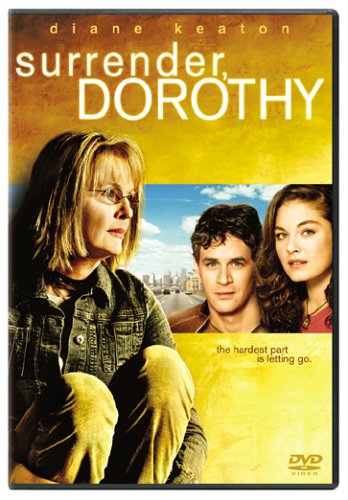
Diane Keaton and Tom Everett Scott star in Surrender, Dorothy, a predictable, over-the-top melodrama plagued with unsympathetic characters, clichés, and unbelievable plot developments. The plot centers on Keaton as she copes with a car accident, which claims the life of her daughter. There is a lot of venom and hostility inside her, as the rest of the world takes a back seat to her own grief. As someone, who has lost a loved one prematurely, I take offense to the behavior of this central character. She’s a sel...ish, loathsome wretch, who feels like she can walk all over her daughter’s friends, simply because she’s the grieving parent. It’s an aggravating picture of grief, and it dims the possibilities of ever feeling for your protagonist. They should have toned her down several notches, because, by the time she does start to behave like a human being, you’re already sick of her. Also, the daughter’s tragic death is made a lot less tragic, when viewers actually get to know the kind of person she was. Her greatest offense is to engage in adulterous sex with her best friend’s husband, who gets her pregnant. Then, in a glowing act of heroism, she aborts the child out of convenience as if she’s having a wart removed. This portrayal does a real disservice to the women out there, who have made this decision out of duress, and then carry it with them all the days of their life. It does a disservice to the women, who wanted to have children, but couldn’t, because doing so would endanger their lives. Within the context of the film, it’s a selfish, loathsome act, from a selfish, loathsome daughter, who was raised by her selfish, loathsome mother.
Needless to say, I hated this film, but not because it was poorly made – or even poorly acted. Keaton is competent enough. Tom Everett Scott, as the token gay best friend – and he really is a token character, in this case – does the best he can with the material and, in fact, elicits more sympathy from viewers than any other character in the film, combined. No, my disdain hinges entirely on the lack of respectability of the characters. Each one – with the exception of Scott and the wife of the adulterous husband – tramples all over the others’ feelings, and uses them to get what they want, until a nice, neat little ending, where we are supposed to believe all is right with the world. It just wasn’t a great idea making a film, which tries to sympathize with the unsympathetic – a film where the only likeable characters are the ones, who take the proverbial back seat. If this is Keaton’s idea of a “good role for female actors of a certain age,” I’d hate to see her idea of a bad one.
Posted in: Disc Reviews by Archive Authors on May 11th, 2006
From reading the back of the box, one would think that this film was one of the true Disney animated classics. Phrases like “digitally remastered for the first time on DVD†and “the original Disney classic†would certainly lead one to believe such a thing. The fact of the matter is, however, that this “classic Disney film†was just originally released in 1997. Sure, it's remastered, but we're talking about remastering a print that is less than a decade old. Improvements were undoubtedly made, but this re...ease is not the towering accomplishment that one might be led to believe.
The plot revolves around Pooh and the gang setting out on a cross-country trip to find Christopher Robin, who has mysteriously gone missing. As the gang travels on their search, they find opportunities to conquer their fears and accomplish great things. The viewers, however, know that Christopher was just at school the whole time.
Posted in: Disc Reviews by Archive Authors on May 11th, 2006
Whisper of the Heart follows Shizuku, a young girl on the cusp of womanhood as she learns to realize her talents and follow her dreams. She harbors deep admiration for Seiji, a mysterious young man, who shares a strange kinship with her that soon blossoms into love. From the start, Shizuku isn’t sure who she is. She indulges in songwriting and reading. It’s the latter hobby that first links her to Seiji. She starts to notice his name in the histories for every library book she checks out. It seems he’s always ...ne step ahead of her, and this observation soon turns to fascination. Once she meets Seiji, her fascination becomes something more. Through their ensuing relationship, Shizuku takes her interests and turns them into dreams. She learns those that never try are the only true failures, and she decides to become what she loves, rather than one, who takes part in hobbies of no consequence.
While Whisper of the Heart is an animated film, it has a head on its shoulders that far surpasses most mainstream films today. It’s likely the narrative will draw in adults more than the little ones – despite the G rating – but there is still something here for children… just not all children. It’s safe to say kids will have to be more advanced to enjoy and understand the depth and layers of this film. Shorter on fantasy than Spirited Away, Whisper carries with it a lot more intelligence than that earlier feature from the same creators. This film, instead of being strictly for kids, is instead for those on the verge of determining their interests and realizing those attributes and preferences can be cultivated into a way of life. Those are the children this film really speaks to. And if you’re an adult like me – the kind that didn’t know what he wanted to do with his life, even as he stood up to accept his college diploma – then Whisper of the Heart will speak to you, too.
Posted in: Disc Reviews by Archive Authors on May 11th, 2006
Synopsis
Felicity Huffman plays Bree, formerly Stanley, who, after years of therapy, surgery and hormone replacement, is one week away from undergoing the operation that will finally and definitively make her a woman. Out of the blue, a phone call comes revealing that Stanley fathered a son seventeen years ago. Bree’s therapist won’t let the surgery go ahead until Bree comes to terms with her past and her responsibilities. She travels to New York City to bail out Toby (Kevin Zegers), a street hustler... but keeps the true nature of their relationship a secret as they begin a cross-country journey back to LA.
Posted in: Disc Reviews by Archive Authors on May 11th, 2006
Training Day stars Academy Award Winning Actor Denzel Washington in the role of Alonzo Harris. Harris, who is one of the meanest, baddest cops in the city of LA, is a person who cruises the streets in his customized Caddy. Harris, in one of the film's opening scenes, meets Jake Hoyt (Ethan Hawke), a young cop whose dream is to be promoted to the elite narc squad. Naturally, this is Jake's first day of training and he is thrown into the arms of Harris. Alonzo tries to show him the streets so he can understand e...erything. He has Jake smoke pot just because he can. In one interesting scene, possibly Alonzo being a tough ass to Jake, doesn't arrest two rapists like Jake wants to, but, instead, proceeds to beat the living crap out of them.
For Alonzo, acting the way he does is simply because this is the way Alonzo feels he should act. As he tells Jake in one scene "If you turn down gifts on the street, you'll be dead." Jake, who has just learned his pot has been laced with PCP, has just awoken to find out that he is now involved with a raid on a drug dealer's house. Alonzo continues to take Jake on these various trips, which all seem to be teaching Jake more and more about the type of cop Alonzo truly is. It makes me wonder if all LA cops are truly this evil, not necessarily as a poke at LA and the crime, but possibly a look into the corruption of the cop field in itself.
Posted in: Disc Reviews by Archive Authors on May 10th, 2006
Sam: Hey, I recognize you.
Andrew: Oh, did you go to Columbia High?
Posted in: Disc Reviews by Archive Authors on May 10th, 2006
If Only is a romantic drama, which too often goes for the cheapest emotional reaction out of its viewers, without incorporating logic or common sense into such decisions. Jennifer Love-Hewitt and Paul Nicholls star as a couple of young lovers, who represent the prototypical female and male, with very little surprises in their characterizations. In the beginning, we see Nicholls is a bit invested in his work, and, while adoring his singer-songwriter girlfriend, he instinctively keeps her and the rest of the wor...d at arm’s length. This distancing is due to a somber childhood, which involved a relationship with his alcoholic father that was filled with both admiration and disappointment. His father was his hero, but is now the case study Nicholls’ character uses for how NOT to live his life… due to the alcohol, of course. But as a result, Nicholls’ character tends to run from love, when it’s staring him in the face (and I mean that both figuratively and literally). Then, something huge happens that forces him to approach life from another perspective… his girlfriend dies in a car accident. The accident makes him realize just how much she meant to him… but it all comes too late.
Or does it?
Posted in: Disc Reviews by Archive Authors on May 9th, 2006
Fran Drescher, the nasally, whiny-voiced beauty we all either love or hate, returns in The Nanny – The Complete Second Season, and the show hits its stride, if you’re of the belief it ever had one. With mileage out of the mutually aloof Fran Fine-Maxwell Sheffield (played by Charles Shaughnessy) relationship, The Nanny does manage a few chuckles, even from someone such as myself. Let’s make things clear right out of the gate: I’m not a Nanny fan. If I had free reign to decide on everything that w...uld, and would not, be watched on my television, this hit show from the nineties would never make the cut. Never mind that its star is an absolute knockout. (You know she must be gorgeous if you still find her attractive in spite of that voice.) But alas, I don’t have that autonomy, for I am married. That, along with the frequent airings on Lifetime, spells out whom the show’s demographic really is – women… in particular, women, who wish to escape in the form of a fairy tale with real-world context. I can’t fault them for liking it; and the show really does succeed in reaching that demographic. I’m just not of the multitude.
Sony’s package includes all 26 of the second season episodes completely uncut. Most of the laughs are hokey and telegraphed, but a few will occasionally take you off-guard, especially during Niles the Butler (hard to believe this guy’s from my home state of Arkansas, as his British accent easily bests Shaugnessy’s – who’s actually from England!) and C.C. Babcock’s banter. Also of value is the aforementioned relationship between boss and employee, as the show, from its very first episode (“Fran Lite”), plays up the continual “they’re perfect for each other, but don’t know it” angle. I don’t hate this series, and some may really feel it’s blasphemous to make this comparison, but I honestly look at it as an I Love Lucy for the nineties. I get the same escapist feeling from both programs, and neither one invokes much laughter in accordance with my personal tastes. But neither show is fly-by-night either, and I’ve got a feeling each will hang around for some time to come.
Posted in: Disc Reviews by Archive Authors on May 9th, 2006
Harrison Ford stars as Jack Stanfield, an online security chief for a mid-sized baking chain. One day, he is introduced to a new possible candidate in Bill Cox (Paul Bettany). We learn this turns out to be a setup. Cox and his men are holding Stanfield's wife (Virginia Madsen) and their two children hostage. In return, Cox demands that Stanfield hack into his bank's computers to transfer a fortune into Cox's offshore accounts.
Firewall, in whole, contains a smart plot, one that makes you think. The ...asic plot, however, is nothing new. The plot has been updated with newer technology, such as an iPod containing everything Stanfield needs to get into his bank. It seems a bit odd that a small little device like an iPod could hold this much data. The bigger question is if a film like this needs events that are plausible in order to make a shred of sense. Fortunately though, mostly due to how entertaining Ford is to watch, the film holds its own and doesn't necessarily conclude in an odd manner.
Posted in: Disc Reviews by Archive Authors on May 9th, 2006
Synopsis
Spanning 1966 through 1995, these are six short features covering David Lynch’s career from is very beginning to his current position as one of the most important voices in American cinema. The shorts are, in order: “Six Men Getting Sick,” “The Alphabet,” “The Grandmother,” “The Amputee” (two versions), “The Cowboy & The Frenchman” and “Lumière.” As one might expect from Lynch, there is a pretty heavy nightmare quotient here. The first three films have a lot of animation, and the result is n...t unlike the hallucinatory collaboration between Monty Python’s Terry Gilliam and Norman MacLaren. The most substantial piece here is “The Grandmother,” a half-hour journey through a little boy’s hell and the grandmother he grows to protect him from his horrible parents. Lynch introduces each film, contextualizing it in his life and career, and there are shots of her first camera, the receipt for it, and the like. For Lynch fans, this is essential viewing. For film historians, ditto.