Paramount

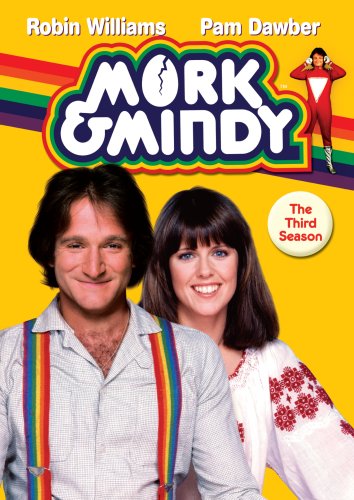
Have you ever watched a recent Robin Williams film and yearned for the days when the actor wasn’t so full of himself and stealing every scene he was in? Well, you’re out of luck, because there was never such a time for Williams; however, you can journey to a time when at least he was hungry and wasn’t so over the top. OK. Even in the days of Mork and Mindy Williams was never capable of reining himself in. Still, I thought I would look back on these episodes with that warm nostalgic feeling I tend to get and just remember the good times. And yes, there were good times. But the more I watched this third year of Mork and Mindy I was becoming all too aware that in 35 years nothing has changed except that the routine has gotten old. Watching Williams prance around with his silly voices and wide eyed faces might have been fresh in the 1970’s, but honestly, haven’t we all had just a little too much of it by now? A television film about the show didn’t present either of the stars in a very positive light, and perhaps it is that image that has tainted the show for me. Whatever the reason, I just didn’t find this stuff nearly as funny as I did 30 plus years ago. Somebody’s matured, and it wasn’t Robin Williams.


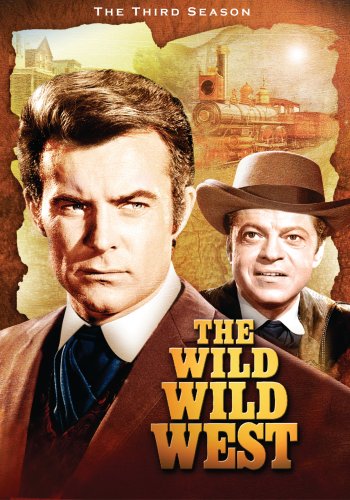
James West (Conrad) was a Union Army vet. He’s the kind of act first think about it later kind of guy. Artemus Gordon (Ross) was a typical con man. He could create the most convincing disguises and was also a master of sleight of hand. Together they worked for the Secret Service in the days of the western frontier. The two of them were the prototype of the future spy. They would use incredible inventions and Bond-like gadgets along with their own skills at trickery to investigate major Federal crimes, often plots against the United States. Think of James Bond in the Wild West.


This collection of SpongeBob cartoons has a distinct musical theme, underlined by the main offering, “Atlantis SquarePantis,” a 2-part episode that just aired. SpongeBob and friends travel to Atlantis on a song-powered bus (but of course!) and witness the many marvels of the lost city. Their tour guide is Lord Royal Highness (voiced by David Bowie). The action is cheerfully episodic, and many of the song sequences are very funny (one highlight being Sandy’s ditty which occurs with the cast transported into a 1991 video game). The other shorts are pretty fun, too, with the highlight being “Sing a Song of Patrick,” wherein the starfish writes his own pop tune, with hilariously catastrophic results.


Audio

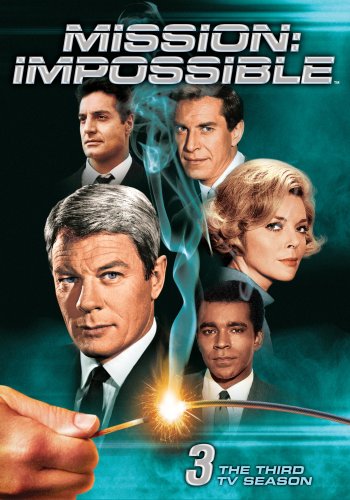
It was in the second year that the format of Mission:Impossible became what we all remember today. By this third year the show was running on all cylinders and full speed ahead. By now the formula was tight, so the audience knew exactly what to expect. They weren’t disappointed. The third year was also a very successful year in the ratings as the show began to come into its own. Mission:Impossible was a companion show to Star Trek. Both were produced at the Desilu Studios and often shared guest stars. If anything changed, it could be said there was a little more action in the third season. A few more fights and gunfights were added without compromising on the style or traditions of the series. A lot of time is still given to show the team performing some elaborate setup, often without any dialog for rather extended periods at a time. The scams were entertaining enough that somehow the audience stuck around for what many broadcast professionals would have called dead air.


You would think that after seven years, CSI would begin to show a little wear and tear around the edges. When you factor in the dilution of the two other versions of the franchise with a combined 8 years of episodes, you end up with 15 years and over 250 episodes of CSI total. Certainly even the best of shows with the most imaginative writers can’t stay fresh for that long. Still, somehow, the gang at CSI continues to crank out compelling drama, rarely repeating itself. Every year I go into a new season of CSI expecting to find it starting to show its age a bit, and every year I continue to be amazed. The fact is that season 7 just might be the best year of CSI to date. Each episode begins with The Who asking the question: Who are you? I have to say that after seven years the answer is, still a fan.


Erle Stanley Gardner wrote crime fiction, and while many of his 100 or so works are unknown to most of us, he created a character that has become as identified with criminal lawyers as any other in fiction. It was in these crime novels that Perry Mason first faced a courtroom. He developed a style where he would investigate these terrible crimes his clients were on trial for. He would find the real killer, and in what has become a Hollywood cliché, reveal his findings in a crucial moment during the trial. While we may not remember the novels, we all remember the man in the persona of Raymond Burr.  Burr had a commanding presence on our screens and enjoyed a well deserved 11 year run as the clever lawyer. What makes this run so amazing is that the show followed pretty much the same pattern the entire time. We always know what’s going to happen, but we wait eagerly for that gotcha moment when Perry faces the witness on the stand. We know when he’s got the guy squarely in his sights, and we can’t sit still waiting for him to pull the trigger. OK. So, maybe that’s a little over the top, but so was Perry Mason. From the moment you heard that distinctive theme, the stage was set. To say that Perry Mason defined the lawyer show for decades would be an understatement. Folks like Matlock and shows like The Practice are strikingly similar to Perry Mason. If you haven’t checked this show out, this is your chance. See where it all began.


Wings was one of those unusual sitcoms that depended more on the characters than the situations they were in. While the setting was a small Nantucket airline owned by two brothers, most of the episodes had very little to do with flying. Rather, the writers populated this small airline with very distinctive personalities and let these interactions be fodder for the funny. The characters were played by more than competent actors, many who have proven themselves beyond this quaint sitcom. Timothy Daly played Joe Hackett, the older, more responsible brother who was often the show’s straight man. His rather adolescent sibling Brian was played by Steven Weber. I wouldn’t exactly say this was Oscar Madison and Felix Unger, but their conflicts over maturity fueled the characters. The airline’s love interest was Helen Chappel played by Crystal Bernard. She was an aspiring symphony cellist who worked the airport’s lunch counter. For much of the show’s run she had an on again off again romance with Joe. By far the most animated character was mechanic Lowell Mather played by Thomas Haden Church. It’s still amazing to me that this rather unintelligent character was played by the same guy who brought us Sandman in the latest Spider-Man film. Finally there was cabbie Antonio Scarpacci, played by the current Adrian Monk, Tony Shalhoub. Antonio is an Italian immigrant who has trouble understanding things most of the time, leading to some of the better moments in the series. Fay, played by Rebecca Shull, is the mothering member of the cast. And Roy Biggins (Schram) runs the rival airline and is often engaged in one underhanded scheme or another.


I wanted to watch these movies back to back to try and get a feel for how they work together. The box art tells us: “Much has changed since we last saw Jake.” No truer words were ever spoken. Jack Nicholson is now a household name and a fixture at the Lakers games. Many a classic character has worn Jack’s sardonic smile since Chinatown. Perhaps it was the timing that was bad. Nicholson decided to resurrect Jake Gittes as his first role following his awesome turn as The Joker in Tim Burton’s Batman. Perhaps it was the absence of Roman Polanski. Or maybe the time for Chinatown had come and gone.


Jack Nicholson’s career has been decades of a man who is constantly redefining himself. Few actors have created as many memorable roles; among them has to be Jake Gittes. This Raymond Chandler styled character first appeared here in the Roman Polanski Film Noir Chinatown. The feel of Chinatown was far more effective in 1974 than it is today. Unfortunately the style has been done to death and often with disastrously horrid results. Still, in 1974, Polanski was able to create an effective atmosphere and use it not just for style but as a place to tell an engaging story. Chinatown takes you to a Los Angeles that simply no longer exists. He utilized many locations that were even in 1974 on the verge of disappearing forever. Perhaps one of the reasons that the style has never been reproduced quite so successfully since is that Chinatown was made at just the right time. The last dying embers of the Los Angeles between the wars are caught on film, making Chinatown a somewhat historical event in itself.


Back around the time I was born, and Tom Cruise had an ounce of sanity, a little movie called Top Gun swept across the globe raking in over $350,000,000 worldwide, as well as sparking an interest in the US Navy and everything Tomcat, Skyhawk, and MiG related. Ever since its original release Top Gun has kept a hold on its audience, being played almost weekly, and now it makes its way into the world of high definition with its release on HD DVD.

For the few of you out there who don't know, Tom Cruise (Mission Impossible) plays Pete Mitchell better known to the rest of us as Maverick. He's young, cocky, and he pilots an F-14 Tomcat. His wingman Goose (Anthony Edwards, Zodiac) keeps him in check with a cool head, and is the more cautious of the two. After another pilot turns in his wings the two are given the opportunity to join the Top Gun fighter pilot school in which only the top 1% of fighter pilots are invited. Upon getting into the school Maverick believes himself to be the best there and borders on the line of being reckless, creating an enemy of fellow pilot Iceman (Val Kilmer, Heat). As the movie plays out Maverick falls in love, contemplates his lifestyle, looses people close to him, and faces death well trying to make it through the training. The movie pretty much wraps up in typical Hollywood style with a bow on it, but still manages to be a good watch.