Posted in: Disc Reviews by David Annandale on June 24th, 2010
Bill Williamson (Brendan Fletcher) is an angry young man. His boss treats him badly, he can't get good service at the local coffee shop, and his parents are trying, none too subtly or smartly, to get him to move out. He hangs out with a friend who talks a big talk about changing the world, but does nothing. Bill, by contrast, is about to do something: gearing up with so much body armor he becomes a walking tank, he begins a gigantic massacre in town, beginning by blowing up a police station, and going on to gun down anyone who crosses his path. There is, however, rather more method to his madness than might appear.

The indefatigable Uwe Boll here brings us a film that echoes the likes of Falling Down, Targets and Elephant. (And in typically modest fashion, on the commentary track he feels he has improved on Falling Down.) This is one of Boll's better films, blessed by an excellent lead performance by Fletcher, convincing improvised dialogue (which does produce a couple of grammatical howlers, but hey, so does real-life dialogue), and intense hand-held camerawork. There are some genuinely witty moments, too, such as the scene where Bill enters a bingo hall, and is completely ignored by its denizens. Even at a brisk 85 minutes, however, the film doesn't have quite enough plot, and thus the rampage itself feels a bit too long. There is also too much reliance on flash-forwards, which ultimately telegraph the resolution too far ahead. As for that resolution, it isn't without a certain cleverness, but it does tend to muddy the film's social commentary. But social commentary there is, and there is quite a bit to admire about this effort.
Some of the reds are bit too strong, but otherwise the colors are excellent, as are the contrasts, blacks and flesh tones. There are moments where the film shifts to webcam footage, and the difference is clear and convincing. The overall look of the film is rich without venturing too far outside of a realist aesthetic (the exception being a gigantic explosion early on, but as far as the transfer goes, everything still looks very nice). The aspect ratio is the original 2.35:1 anamorphic widescreen.
Posted in: Disc Reviews by William O'Donnell on June 12th, 2010
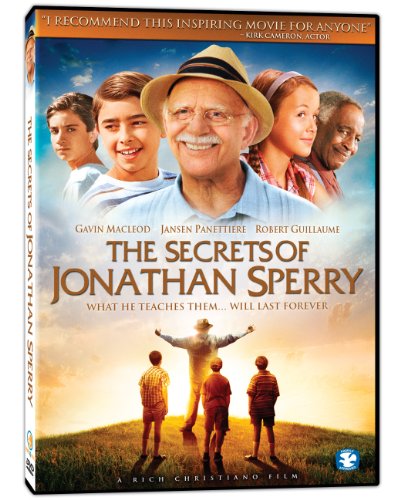
This film takes you back to the realm of Leave it to Beaver and from there tells the story of a young boy who has a crush on a girl who works at the local pizza parlour, and befriends an elderly neighbour who inspires him and all his friends (and enemies) to become devout Christianity. This film does not hide the fact that it is geared towards those who are faithful and are seeking a family friendly story to witness.
Posted in: Disc Reviews by William O'Donnell on June 8th, 2010
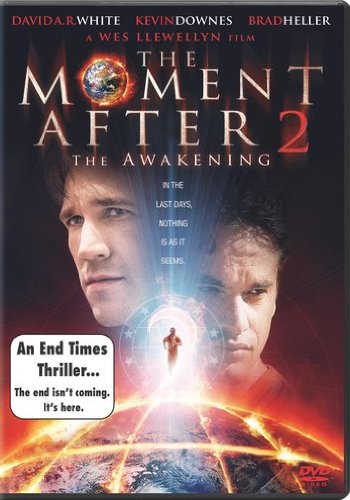
In the previous film, the Rapture (from the Bible) has occurred and two FBI agents were investigating. By the end, each was left in less than desirable situations and we start off with both of them getting into further trouble as the world has become a dystopia run by some sort of “Global Alliance.” One is busted from jail and finds a group of Christians in hiding, and the other is blackmailed into seeking out that same group and revealing their camping location to Alliance bad-guys.
Posted in: Disc Reviews by Gino Sassani on May 12th, 2010
"Step 1: Reconnaissance. First you need to identify your target."
If you are a regular reader here, you likely know that I have a fondness for Andy Griffith. I recently watched and reviewed in these pages one of his earlier comedy films, and rather enjoyed the old simple rural comedy. That's what makes this one so painful to write about. I think that Andy Griffith missed the boat when he was targeting the audience for his latest comedy, the sexually charged Play The Game. I'm going to just admit up front that this movie made me feel very uncomfortable. I think that many of Griffith’s fans might have the same problem. There are just some actors, particularly ones in their 80's, that I don't want to hear talking about their sexual function, let alone watch having sex. Andy Griffith would be at the top of that list, and I suspect I'm not alone there. But, that's exactly what you're getting into if you decide to pop this one into your DVD player. This will not be like anything else you've ever seen this particular actor do before, and hopefully I never will again. This is strictly for the adults. I'd say the over 95 crowd.
Posted in: Disc Reviews by Gino Sassani on May 11th, 2010
"When I was young, about eight or so, I tried making friends with God by inviting Him to my house to watch the World Series. He never showed."
Jim Carroll was a promising young high school athlete. He was seduced into the dark nature of New York City's underbelly of drugs and violence. During his youth he was also an aspiring poet, who kept a poetic journal of his thoughts before, during, and after his slide into addiction. When he finally did manage to climb out of the hole and gain his sobriety, the entries became a popular piece of literature. Carroll ended up going on reading tours and doing various things to try and help others who might have fallen into the same trap. Director Scott Kalvert attempts to bring these "Basketball Diaries" to life with Leonardo DiCaprio in the role of Jim Carroll.
Posted in: Disc Reviews by Gino Sassani on May 10th, 2010
A short time ago I had the unexpected pleasure of watching and then reviewing Tyler Perry's I Can Do Bad All By Myself. I say unexpected, because I was looking for the typical Madea antics and ended up drawn into a compelling gospel musical that was inspirational and entertaining without ever feeling like I was sitting in mass listening to a long homily. Now I've just had the opportunity to see Stan Foster's The Preacher's Kid. There's no doubt that Foster has been inspired by the Black Theater productions of guys like Perry. There appear to be a couple of inside swipes at Perry in the film. I call them swipes, but it's more likely they are loving jabs. I get the impression that Foster is a fan of Perry's and, unfortunately, has tried hard to imitate his style. The result is certainly not a terrible film at all. It's just not a very good one, either.
The plot is based on the biblical parable of The Prodigal Son. In this case it's the Prodigal Daughter. Bishop King (Williams) is a hard taskmaster for the Lord. He has a thriving community congregation that features one of the nation's best gospel choirs. Of course, the choir stars his own daughter Angie (Luckett) as the soloist. They are on their way to a huge competition in New York City, and everyone expects that Angie's going to lead them to the promised land, so to speak. But Angie is getting restless. She has dreams of a recording contract and fame and fortune. She's tired of giving up so much for the Lord and longs for a little Angie time. Her rigorous schedule doesn't even allow time to catch a movie from time to time. She and close friend Marcia (Kelly) sneak away to a club where a has-been recording artist Devlin (Tank) is partying. The girls make his acquaintance, and he is taken with Angie. He invites them to attend a performance of his gospel play called Daddy, Can I Come Home. Angie loves the production and is invited to a diner to eat with the cast and crew, where she loudly declares that she absolutely must be a part of the production. An impromptu audition wins her the part of understudy to the lead. It's her father, the Bishop, who she can't convince. She leaves even after he warns her that he wants nothing to do with her, should she go. Not very Christian, for a Bishop that constantly asks everyone around him: What would Jesus do? Certainly, he wouldn't disown his kin. So Angie goes on the road with the production. She is seduced by player Devlin and quickly falls into the temptations of the road. Before very long, she's drinking, taking drugs, and sleeping with the abusive star. Meanwhile, her church must prepare for the competition without their star singer. Angie soon discovers that the life she coveted isn't all that she hoped it would be. She must endure betrayal and abuse from Devlin while finding her dream of one day singing the lead doesn't look very promising at all. And, like The Prodigal Son of the Bible, Angie wants to go back home.
Posted in: Disc Reviews by Gino Sassani on April 24th, 2010
"Two years ago my son was taken from me. Since then I've lost everything: my job, my marriage, even my life. But I came back, and the dead came with me."
Posted in: Disc Reviews by Michael Durr on March 22nd, 2010
If you know me, you probably know that I don’t exactly exhibit small town values. I grew up in the suburbs, went to a state college and have worked in major cities such as Dallas & Houston. However, for the last ten years, I have lived somewhere in Brazoria County (small town haven) and I currently reside in West Columbia, Tx which has a population of around 4,000 people. Would Good Intentions be an accurate portrayal of small town southern life or more stereotypical mayhem?
Etta Milford (played by Elaine Hendrix) lives in the small town of Myra, Georgia. She has two young boys and a husband named Chester (played by Luke Perry). Chester runs one of the local convenience stores while Etta stays at home and tends to the children. Money is very tight for the family, so naturally one would think that they would be a little more careful with their income.
Posted in: Disc Reviews by William O'Donnell on January 30th, 2010
This is the story of two young twins who are living completely different lives, one in a boarding school who is caught up in a child smuggling ring and the other is living with his struggling artist father, but are able to share their physical pain and emotions as if telepathically. Thomas, who is with his father, knows of Tom, the boarding school “orphan,” but everyone believes Tom is just his imaginary friend. Through a chance encounter the two are reunited and both must find a way to escape the smugglers who wish to take them sell them outside of England.
Posted in: Disc Reviews by Archive Authors on January 11th, 2010
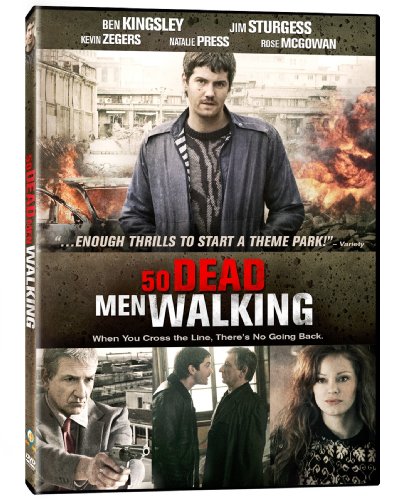
When an inside operation movie is done properly, the plot is ripe with suspense and suspicion. Who can the informer/plant trust? Have they jeopardized their family? What are they willing to do to stay undercover? Audiences have seen this play out many times before in films like Donnie Brasco and The Departed, but in 50 Dead Men Walking the setting is Northern Ireland in the late ‘80s during the Troubles—a period of violent ethno-political conflict between members of the primarily Roman Catholic nationalist community and the Protestant unionist community. The film is based on events depicted by Martin McGartland, and Nicholas Davies in the book Fifty Dead Men Walking: The Terrifying True Story of a Secret Agent Inside the IRA. This depth of history brings an edge to the film that goes far beyond typical mobster fare.
Jim Sturgess made it big in Julie Taymor’s Beatle tribute Across the Universe, but in 50 he shows a side of his acting that really surprised me. He effortlessly steps into the shoes of Martin McGartland—a young swindler who goes door to door selling stolen goods just to get by. Unable to afford a car, let alone the gas to fill it with, he has to bum rides from his friend Sean, played by Kevin Zegers. But his fortune changes one day when British police eager to infiltrate the Irish Republican Army attempt to woo him into their services with a steady job and a car. He reluctantly accepts, and that’s when things start to spiral out of control for Martin.