Posted in: Disc Reviews by David Annandale on December 14th, 2007
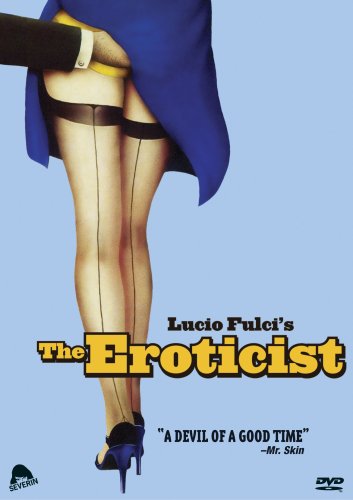
Lando Buzzanca plays Senator Puppis, a telegenic young politician on track to become Italy’s next president. He’s been groomed for the part practically from birth by the Vatican, which plans to re-exert social control over the country through its presidential puppet. But plans go badly awry as Puppis suddenly develops an uncontrollable urge to fondle women’s buttocks (Stephen Thrower has aptly described the character as a “repressed heterosexual”). Even as he seeks help for his condition, various parties around him begin to panic, as the police think Puppis is planning a coup without telling them, the military think they are being left out of the loop by the police, and the Vatican, along with its Mafia catspaws, starts whacking everyone in sight in a desperate attempt to keep everything from completely unravelling.

How’s that for a sex comedy plot? Not exactly of the been-there-done-that variety, is it now? Behind the nonsensical UK release title is one of the most interesting Lucio Fulci films to reach these shores. Fans wanting the Fulci gore will have to look elsewhere, but those open to something new will encounter a level of filmmaking absent in too much of his later work. The sex gags are rather dated (though the moment of the Puppi’s first goose is a bit of wonderful deftness I’ve never seen in Fulci), but the black political satire, which makes up the bulk of the film, while being very tied to the specific Italian context, has lost none of its bite. This is an angry film, one that builds to an utterly appalling resolution, all the more sour for its comic framing. Without going so far as to compare Fulci’s filmmaking skills to Kubrick’s, one might think of this film as Fulci’s Dr. Strangelove – a bitter, hopeless indictment that can only fully express its venom in the form of farce.
Posted in: Disc Reviews by David Annandale on December 11th, 2007
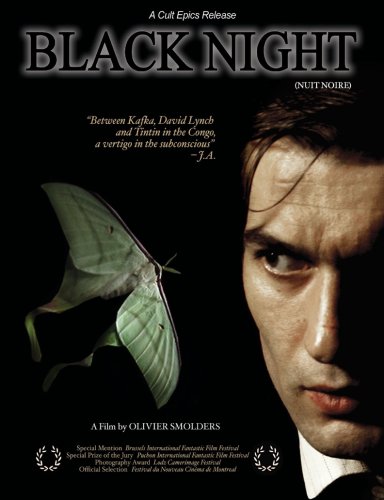
Belgian filmmaker Olivier Smolders, after a successful run of gorgeous and disturbing shorts, here makes a feature debut that is just as gorgeous and disturbing. Strongly reminiscent of the works of David Lynch, but far darker overall, the film is set at a time when the world is shrouded in the night of a perpetual eclipse. Day only comes for 15 seconds at 12:23 pm each day. Oscar (Fabrice Rodriguez) is a museum entomologist haunted by traumatic dreams involving the death of a sister who might or might not have every existed. He returns home one night to find a dying and pregnant African woman in his bed, a woman who is somehow linked to his father’s colonial past.
Trying to summarize the film’s plot is like trying to describe a dream: either case involves imposing linearity where none exists. Don’t try to figure out exactly what is going on here. Think of it as fevered nightmare inflected by guilt of Belgium’s gruesome colonial history, served up as a stunningly beautiful meditation on death, sex and insects.
Posted in: Disc Reviews by Archive Authors on December 10th, 2007
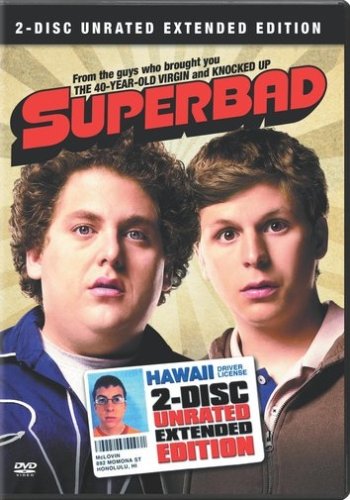
So in a summer where a film directed by Judd Apatow and starring Seth Rogen made a truckload of money, another film released a couple months later where Apatow produced and Rogen co-wrote made almost the same truckload of money, yet both films were funny for different reasons.
In Superbad, Rogen and Evan Goldberg (Da Ali G Show) wrote the script that Greg Mottola (Undeclared) directed, and the film’s premise is simple enough. Seth (Jonah Hill, Knocked Up) and Evan (Michael Cera, Arrested Development) are high school seniors who are attending one last party, with the help of their friend Fogell (Christopher Mintz-Plasse) and his fake ID and subsequent new name ‘McLovin’. The trio’s night takes a dramatic turn, as Fogell is assaulted at the liquor store and Seth and Evan presume that he’s been taken to jail for the fake ID. So Seth and Evan try to get liquor for a party that Seth’s friend Jules (Emma Stone, Drive) is throwing, and Evan wants to get some vodka for Becca (Martha MacIssac, Ice Princess), and the boys desperately want to get with the girls before the boys go to their respective colleges. In the meantime, Fogell isn’t taken to jail, but is taken on a wild ride and a wild night by Officers Slater (Bill Hader, You, Me and Dupree) and Michaels (Rogen), who take him through various twists and turns in the city.
Posted in: Disc Reviews by Archive Authors on December 10th, 2007
Will Ferrell, arguably the last funny member of Saturday Night Live has picked some strange movies to be in since leaving the sketch comedy show. Appearing first as a co-star in Old School and then later in the kid-friendly (but cute) Elf, Ferrell took his time in getting to what fans wanted, a good PG-13 or better comedy for him to stretch his comedic talent.
By and large, Anchorman delivers on that, though occasionally Ferrell himself isn’t the one causing the laughs. As 1970s San Diego newsman Ron Burgundy, Ferrell is the one everyone in town trusts, along with his newsteam. The chemistry is broken when female newscaster Veronica Corningstone (Christina Applegate, Married With Children) is hired. Ron has to resolve the conflicts between himself, his team and his new interest in Veronica…
Posted in: Disc Reviews by Michael Durr on December 5th, 2007
The movie of Hudson Hawk was often panned by critics who thought the movie was the worst thing since George Bush Sr moved into office. Look where that has got us! Remember kids, bad presidents only birth worse presidents. Anyhow, Hudson Hawk which was billed as an action comedy and was thought of by many as sloppy, over-inflated movie making that took the cream of bad movie making. Was it a turd that sank like the Titanic?(both the movie and the ship) Was it a lemon like XXX? (both the movie and the scent of Vin Diesel's Mr. Clean head) Actually no. *gasps and shufflings* I know, you expect me to blast it for the steaming pile it is. But when in fact, I enjoyed myself for a solid one hundred minutes. I didn't even need lotion either.
The story starts off with a song. Actually Eddie "Hudson Hawk" Hawkins (played by Bruce Willis) just did a song or term over in Sing-Sing for cat burglary. Now he wants to go straight. However, others in the business have different ideas. Seems there is a plot to steal various items that were in possession of the great Leonardo Da Vinci. The only one they feel that is suited for this job is Hudson Hawk. So, they make an effort to push him in that direction. He does the deed enlisting the help of Tommy Five-Tone (played by Danny Aiello), his old thieving buddy. The first item is a gold horse from Leonardo that is to be put on auction and certified authentic by the Vatican. They make the theft the night before and think they have finished the adventure. But in reality, it's only started. The plot takes off from there until we get to a rising climax where a nun, a CIA group that goes by the name of famous candybars and a recreation of a machine that turns lead into gold all take part.
Posted in: Disc Reviews by Archive Authors on December 3rd, 2007
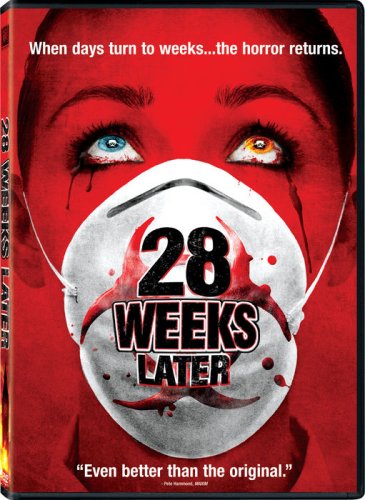
A friend that I work with said that if Hollywood ever ran out of creative and original ideas, and that if a studio managed to make a sequel about pirate zombies that lasted three hours long, it would clean up at the box office. But the fact of the matter is that if we survived a nuclear winter, we would be well prepared about what to do when zombies took over the land, because of the prep we had from guys like George Romero. So even though Danny Boyle’s 28 Days Later might have presumably sealed the deal when it came to this particular interpretation, someone decided to dredge it up for whatever reason.
The sequel, appropriately titled 28 Weeks Later was written by several Spaniards, including Enrique Lavigne (Sex and Lucia), who also produced the film, and Juan Carlos Fresnadillo (Intact), who directed. After the viral epidemic and the subsequent pronouncement that “all was well” in England, the U.S. led NATO troops helped to clean and repopulate the London area. That is slightly down the line of the film’s opening, which has Don (Robert Carlyle, The Full Monty) and his wife Alice (Catherine McCormack, Braveheart) separated when some of the infected invade their countryside cottage, and he manages to get away. Flash forward to the period that shares the film’s title, and Don is a key part of the repopulation effort when his children come back to England. But you know how sequels go, through divine effort or circumstance, London becomes infected again and everything goes straight to hell.
Posted in: Disc Reviews by David Annandale on November 22nd, 2007
Severin unleashes three more entries from Italy’s long-running sexploitation saga, and the result is another fascinating collection. The quality of the movies themselves up and down, but the good stuff is very good, and the collective result is something that is completely fascinating. Exploitation fans should be over the moon.
I’ve already gone on at length about Black Emmanuelle/White Emmanuelle (1976) elsewhere, so I won’t rehash everything again. Briefly, though, the set-up has Laura Gemser as Emanuelle (let’s stick to the single “m” version to avoid confusion with Sylvia Kristel), here a model instead of a journalist, arriving with SOB photographer boyfriend at the palatial home of some friends in Egypt. Much aristocratic ennui ensues, until Laure (Annie Belle) arrives to tear down everyone’s comfortable illusions. The most nicely shot and intelligently scripted of the films, there is something absolutely mesmerizing about the display of decadent self-loathing proposed here. Writer/director Brunello Rondi’s effort is emphatically a high point of the series, and invites repeated viewings.
Posted in: Disc Reviews by Gino Sassani on November 21st, 2007
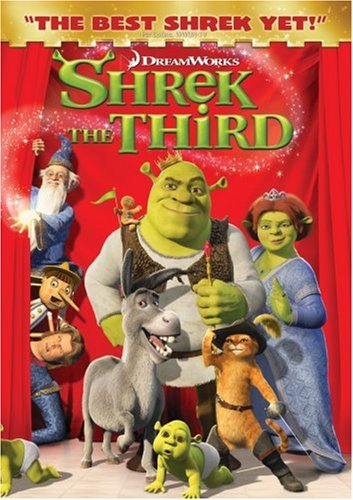
Back in 2001 shortly after the release of the first Shrek I happened to be at a convention with Anne Francis of Forbidden Planet and Honey West fame. She had just taken a young one, I believe it was her nephew, to see the animated blockbuster. To say she was unhappy is an understatement. She was incredibly offended by the toilet humor and had some rather unflattering things to say about pretty much every aspect of the film. Here we are two films later, and I’d have to tell Anne that not much has changed. By my count the film never runs more than 9 minutes without a joke based on feces, farts, or butts. And the truth is it really is a shame, because Shrek is a property too full of talent and startling good CG animation to require that sort of pedestrian humor. I love almost everything about this franchise except the humor.
Posted in: Disc Reviews by Gino Sassani on November 21st, 2007
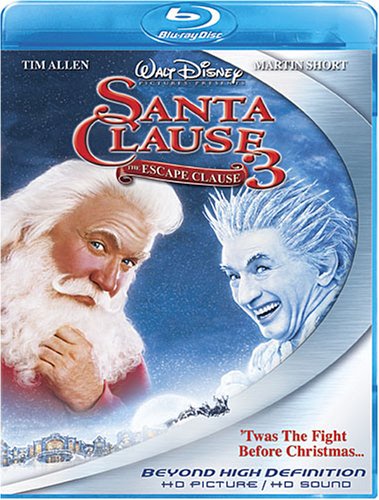
Fans of classic Christmas films need not worry that their perennial favorites are about to be displaced by this third entry into the Santa Clause franchise. In fact, throughout most of the 92 minute running time of The Santa Clause 3: The Escape Clause I was looking for my own escape clause out of watching the film. However, in the true spirit of Christmas and with a feeling of total dedication to duty, I remained firmly affixed to my easy chair and watched every second of the film. It was all for you, my gentle reader, because I know how crunched your time can get around the holidays. I have made this sacrifice to save you an additional hour and a half to commit to your shopping or preparing cookies for the family. You don’t have to thank me. Just send a few cookies my way or raise a glass of eggnog to me this season. There are far too many truly great holiday films to waste on this tripe.
Posted in: Disc Reviews by David Annandale on November 14th, 2007
As a woman commits suicide by leaping to her death on the English seacoast, her daughter in Italy has a vision of her fall. Years later, the now-grown Virginia (Jennifer O’Neill) is married to a wealthy businessman, and is suddenly plagued by visions again. Following the evidence, she discovers the skeleton of a young woman who has been walled up in her husband’s ancestral home for years. He is immediately arrested. Virginia works to prove his innocence by investigating the other mysteries of her visions, but she is letting herself in for more than she bargained for.
Having made quite a name for itself as a purveyor of lovely editions of classic European sexploitation, Severin branches out in spectacular fashion with this 1977 effort by Lucio Fulci. Fans of the director who know him exclusively for films such as Zombie and The Beyond will no doubt be disappointed by the lack of extreme gore. (Exception: the opening suicide, which delivers a nasty jolt as we see the woman’s face smash against the rocks as she falls. Unfortunately, Fulci has to show us the effect more than once, and it loses its effectiveness as its artificiality becomes clear.) But, as clearly derivative as it is of both Nicholas Roeg’s Don’t Look Now and Dario Argento’s Deep Red, this is still evidence that Fulci was more than capable of assembling a film that is gripping at the level of narrative and suspense. Unlike Don’t Look Now, where we are kept as much in the dark as its protagonist as to what the visions mean, here Fulci makes sure we are a few steps ahead of Virginia. We realize quite early that what she saw was a vision of the future, not the past, and watch helplessly as the strands of fate wind inexorably around her. There may not be much to her character, but her plight is so clearly articulated and so unstoppable that we cannot help but feel a soul-deep dread. A excellent slice of Eurohorror.