Video

"What is source code?"

That's a good question. Unfortunately, there really isn't a good answer, not without spoiling some of the finer elements of this science fiction thriller from Moon director Duncan Jones. At the heart of this code you'll a bit of the familiar. From Groundhog Day to Déjà Vu you'll leave this movie with a sense that you've seen much of this before, and that's not entirely a bad thing. These elements aren't necessarily merely retread material. Let's just say they share a large amount of DNA in this film's basic source code.

"Obviously, I miscalculated a few things. Why is it that the moment your life exceeds your wildest dreams the knife appears at your back?"

You've heard the myth that we only use about 10% of our brains so often that most people actually believe it's true. It's one of those old wives' tails that has been around long enough to become an axiom. We actually do use considerably more than 10% of our brains, or should I say, most of us do. But it is true that we don't utilize anywhere near all of it. So what might happen if we could? How might that improve our lives? After spending almost a couple of hours watching Limitless, I might have to become a tad more content with whatever percentage I'm using right now. In fact, maybe it might be a good idea to lower it a little.

“Zippedy Doo-Dah. Zippedy Yay. My, oh my, I got a wonderful slave.”

I’ve never really been a big fan of director Gary Marshall’s films. I prefer his work as a producer of classic sitcoms, like The Odd Couple and Happy Days. Marshall’s most popular film, Pretty Woman, plays off the Cinderella cliché a little too much for my taste, with a man ultimately finding and saving a woman by redefining her. Three years before Pretty Woman, Marshall explored these same themes in Overboard, but instead of slick fantasy salvation at the hands of a wealthy Richard Gere, the redemption comes from a misogynistic and cruel Kurt Russell.

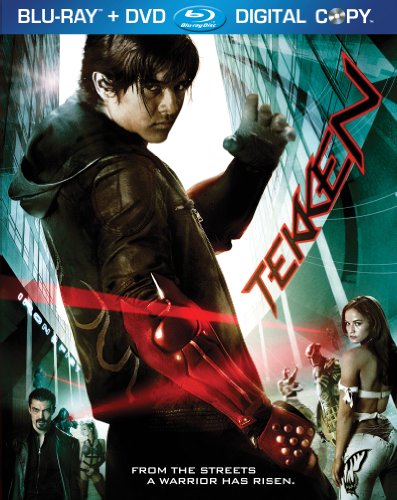
Two of my favorite films of all time are Bloodsport and Mortal Kombat. Before you start groaning, let me explain why. They both act as the total testosterone injection for all of the macho men out there. These movies have tournament style martial arts and MMA mayhem where the only code is to beat your opponent until he/she is defeated. Then they move on to the next fight. Usually, there are theatrics thrown in there too, like to save the world or restore honor. Enter my next review movie: Tekken.

Sometime in the future, the world is plunged into chaos. Eight different corporations take over the world and divide the countries between them. They establish a yearly tournament called Iron Fst which is supposed to determine the greatest fighter of the world. The US territory is controlled by Tekken and headed by one, Heihachi Mishima (played by Cary-Hiroyuki Tagawa) with his son, Kazuya (played by Ian Anthony Dale) in charge of security.

Warner's Japan unit had decided that it wanted to turn one of its shows into an anime production for the Japanese audience. I guess it shouldn't come as too much of a surprise that Supernatural would be the perfect fit. Let's face it. While the production values on the live-action series have always been high, there are certain limitations that exist. With animation you have the ability to go far beyond what you can do with characters played ultimately by human actors. The highly stylized format of anime blends well with the horror aspects of the original show. You don't have to be particularly fond of anime to enjoy this. Honestly, I'm not into the style at all. But as a fan of Supernatural, I found this to be quite fun to watch.

If you are a fan of the original Kolchak: The Night Stalker, you were more than likely disappointed in the remake a couple of years ago on ABC. Your hope is now once again restored. Supernatural is the closest thing I’ve ever seen to The Night Stalker. Like Kolchak, the Winchester brothers are faced with weekly incarnations of evil. They’re forced to research these legends and figure out a way to stop them. As Kolchak discovered, it’s a thankless job. Sure, Supernatural is populated with all sorts of beasties and nasties, but it also manages to hold on to a sense of humor that rounds out these adventures to make this one of the most entertaining shows around.

Back in 1981 we all got a little lost between the moon and New York City as Dudley Moore played the spoiled and perpetually drunk title character in the surprise hit Arthur. He was in love with Liza Minnelli, but his rich family had plans for the socialite played by Jill Eikenberry. Arthur's only real friend was the guy who was paid to be there for him, but nevertheless had a soft spot for him. That was butler Hobson, played by Sir John Gielgud. It was a quirky little romantic comedy that turned out to have legs. Moore would reprise the role in the sequel Arthur 2: On The Rocks which was as much a flop as the original was a success. Moore died nearly a decade ago, and most of us had pretty much forgotten the classic and moved on to other things.

Now along comes Russell Brand, who knows more than a little bit about being an out-of-control drunk. His successful attempt to turn his own life around before it careened off a cliff might have made him the perfect fit to play the character in this 2011 remake. Of course, that's not really what makes him such a wonderful choice. Brand infused enough of his wit and clever improvisation to make this a far funnier version. Moore might have certainly been a more believable and charming drunk. But Brand is a much more entertaining one. And that wasn't the only clever casting to be found here. More on that later.

Three children are born at the moment of a total solar eclipse. On the even of their tenth birthday party, we discover that these kids, for astrological reasons, are complete sociopaths, and are having a merry time offing anyone in the community who even vaguely annoys them. The only ones who even gradually suspect that something is going on are high school senior Joyce (Lori Lethen) and her little brother Timmy (K. C. Martel). They soon become the target of the psycho kids’ wrath.

As slasher films flooded the screens in the early eighties, every conceivable minor variation was tried, while the rigid narrative formula was religiously observed. So if the variation wasn’t in the date (Halloween, Friday the 13th, New Year’s Evil, My Bloody Valentine, etc., etc., etc.), the change-up was in the the killer. And so here we have kids, though the elements remain otherwise familiar: prologue opening, young couples get naked and die, the Good Girl is the Final Girl, and so on. Though there is a bit of a nasty little punch in having the kids be murderous, this was hardly new in 1981 (The Bad Seed anyone?). The world of the film is a very difficult one to buy: the rash of murders has very little effect on the community, the junkyard features gassed-up and fully functional cars, astrology is apparently a for-credit subject at the high school, and everyone is very, very, very stupid. And while there is a certain demented pleasure in seeing tiny, WTF turns by the likes of Jose Ferrer (on-screen for maybe 30 seconds) and Susan Strasberg, this is a film that, in the final analysis, is nowhere as sick as it should be, unable to follow through on its own premise, as demonstrated by the singularly anti-climactic finale. Had this been an Italian or Spanish movie from the same era, I venture to think things would be a bit different.

Ann Gentry (Anjanette Comer) is a social worker with a new case, one that she specifically sought. She has been assigned to the Wadsworth family. It consists of a terrifying matriarch (Ruth Roman), sexpot daughters Germaine (Marianna Hill) and Alba (Suzanne Zenor), and Baby (David Mooney, credited as David Manzy), a grown man with, apparently, the mental development of an infant. But Ann suspects Baby is capable of more, and that there is something fundamentally wrong going on at the Wadsworth residence. The Wadsworths, meanwhile, do not take kindly to Ann’s prying, and will stop at nothing to preserve their way of life.

Viewers lured by the promise of the film’s poster (Baby in crib, hatchet in hand) will no doubt be disappointed. This is not a body-count film, and there is very little that is overtly horrific for most of the movie. But make no mistake: this is a horror film. The horror is primarily conceptual, and the more we see of Baby’s life, the more we squirm. The performances are universally strong, and we buy into the characters, no matter how grotesque they are, and believe me, they are grotesque. The climax is exquisitely sick, as only the denouement of a movie made in 1972 can be, and is meticulously set up by everything that came before. This is a screwed-up movie, and I mean that as a term of extremely high praise. Absolutely not to be missed.

In 2007, writer-directors Jaume Balaguero and Paco Plaza created [REC], a truly frightening horror film. Considering their subject matter is so familiar to audiences it proved a major challenge not to fall into clichés. Somehow, against all odds, [REC] remained fresh by blending the elements so well… nasty contagion and fast zombies ala 28 Days Later captured in documentary-syle videography made famous by The Blair Witch Project. Add likable lead characters, natural dialog, horrific gore and scream-at-the-screen suspense; sprinkle in clues of a disturbing spiritual origin to the mysterious virus and you end up with one of the scariest and most effective additions to both the zombie and “found footage” horror sub-genres.

To appreciate the sequel, [REC]2, one should take the time to watch the first film, but if you haven’t, here is a brief spoiler filled synopsis of [REC]. A local Spanish TV journalist and her cameraman are embedded with a group of firefighters for the night as part of a human interest segment on their magazine news show. A routine call to an old apartment building on the outskirts of Madrid immediately leads to the team being sealed inside by a government quarantine trying to contain the origin of a ferocious viral pandemic. The news team chronicles the firefighters’ efforts to battle the frenzied, ravenous infected and escape the building, avoiding viral contamination or getting shot by government snipers.

The third BloodRayne film (and second with Nastassia Malthe in the title role) sees the titular dhampir slicing up Nazis, and so the chronology of the third film rejoins that of the first game. During a raid on a death camp train, Rayne accidentally infects a Commandant Michael Paré. Becoming a dhampir himself (a human/vampire hybrid), he and Mengele-figure Clint Howard (because who else are you going to cast as a Nazi scientist other than Clint Howard?) plan to use Rayne’s blood to grant Hitler immortality.

Vampires and Nazis notwithstanding, the important thing here is that this is yet another Uwe Boll film. So what exactly does that mean for you, the discriminating viewer? As regular visitors to this site might know, I have, in the past, actually praised some of Boll’s more recent efforts. I may well have destroyed whatever critical credibility I could lay claim to by being so impressed by Tunnel Rats, but damn it, it was good. Here, though, is yet more evidence that the Indefatigable One is not at his best when dealing with video game material. Also World War II. Opening an action movie about vampires with shots of Auschwitz-bound prisoners is not, methinks, in the best of taste. Furthermore, Boll’s decision to go with a washed-out, gritty feel does a disservice to his heroine. The world of the BloodRayne video games is a fantastic, exaggerated one, Gothic in every sense. It is a world of decadent costume balls, and villains headquartered in castles, and it is the cartoonish, occult-obsessed, iconographically berserk side of the Nazis that lends itself to the kind of stories we fine in the games, not to mention the look of the character. Rayne’s revealing costume, hardly practical, looks even sillier when placed in a context of grime, washed-out colours and snow.