Video

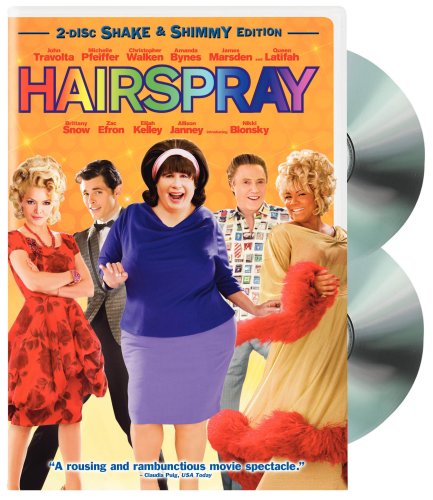
A remake of writer/director John Waters' 1988 cult hit, Hairspray is an exhuberant movie musical that builds off the smash-hit Broadway production to recreate the excitement on film for a new generation. Whether it's bigger and better than previous iterations, I can't say, because this DVD release marks my first Hairspray experience. What I can say is if Waters' original and the Broadway show are even half as good, they're definitely worth your time.

If that doesn't convince you, this Hairspray also presents John Travolta as an obese, middle-aged woman — a transformation that required plenty of make-up and, more importantly, allowed Travolta to finally reveal his true self for all to see.

A remake of writer/director John Waters' 1988 cult hit, Hairspray is an exhuberant movie musical that builds off the smash-hit Broadway production to recreate the excitement on film for a new generation. Whether it's bigger and better than previous iterations, I can't say, because this DVD release marks my first Hairspray experience. What I can say is if Waters' original and the Broadway show are even half as good, they're definitely worth your time.

If that doesn't convince you, this Hairspray also presents John Travolta as an obese, middle-aged woman — a transformation that required plenty of make-up and, more importantly, allowed Travolta to finally reveal his true self for all to see.

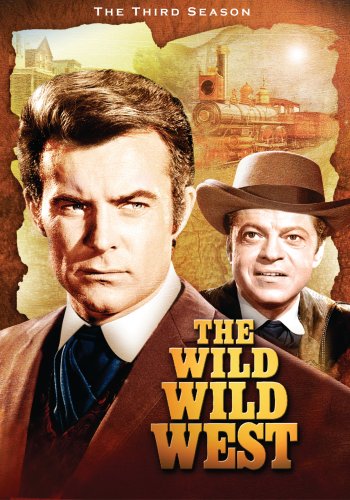
James West (Conrad) was a Union Army vet. He’s the kind of act first think about it later kind of guy. Artemus Gordon (Ross) was a typical con man. He could create the most convincing disguises and was also a master of sleight of hand. Together they worked for the Secret Service in the days of the western frontier. The two of them were the prototype of the future spy. They would use incredible inventions and Bond-like gadgets along with their own skills at trickery to investigate major Federal crimes, often plots against the United States. Think of James Bond in the Wild West.


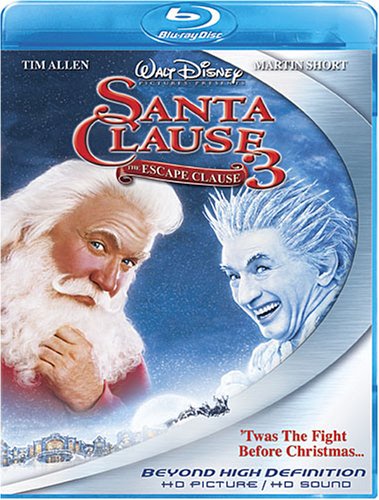
Fans of classic Christmas films need not worry that their perennial favorites are about to be displaced by this third entry into the Santa Clause franchise. In fact, throughout most of the 92 minute running time of The Santa Clause 3: The Escape Clause I was looking for my own escape clause out of watching the film. However, in the true spirit of Christmas and with a feeling of total dedication to duty, I remained firmly affixed to my easy chair and watched every second of the film. It was all for you, my gentle reader, because I know how crunched your time can get around the holidays. I have made this sacrifice to save you an additional hour and a half to commit to your shopping or preparing cookies for the family. You don’t have to thank me. Just send a few cookies my way or raise a glass of eggnog to me this season. There are far too many truly great holiday films to waste on this tripe.


This collection of SpongeBob cartoons has a distinct musical theme, underlined by the main offering, “Atlantis SquarePantis,” a 2-part episode that just aired. SpongeBob and friends travel to Atlantis on a song-powered bus (but of course!) and witness the many marvels of the lost city. Their tour guide is Lord Royal Highness (voiced by David Bowie). The action is cheerfully episodic, and many of the song sequences are very funny (one highlight being Sandy’s ditty which occurs with the cast transported into a 1991 video game). The other shorts are pretty fun, too, with the highlight being “Sing a Song of Patrick,” wherein the starfish writes his own pop tune, with hilariously catastrophic results.

Audio

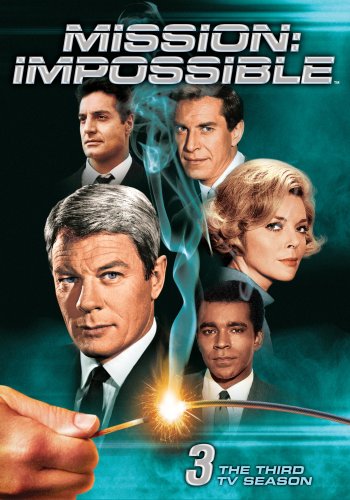
It was in the second year that the format of Mission:Impossible became what we all remember today. By this third year the show was running on all cylinders and full speed ahead. By now the formula was tight, so the audience knew exactly what to expect. They weren’t disappointed. The third year was also a very successful year in the ratings as the show began to come into its own. Mission:Impossible was a companion show to Star Trek. Both were produced at the Desilu Studios and often shared guest stars. If anything changed, it could be said there was a little more action in the third season. A few more fights and gunfights were added without compromising on the style or traditions of the series. A lot of time is still given to show the team performing some elaborate setup, often without any dialog for rather extended periods at a time. The scams were entertaining enough that somehow the audience stuck around for what many broadcast professionals would have called dead air.


Despite its lame title, I've been excited about seeing Live Free or Die Hard since it was announced. The Bruce Willis franchise has been a favourite of mine for a long time, thanks to the original Die Hard which stands as one of the greatest action films of all time.

Willis reveals in the commentary that he and director Len Wiseman (Underworld) set out to make a Die Hard movie that surpasses the middle two in the series and is as good as the first. While Willis apparently feels they succeeded, I beg to differ. Live Free or Die Hard is certainly a good action flick, but nothing can ever surpass Die Hard in my book. Opinions of the film aside, this DVD set is sure to satisfy John McClane fans of any stripe.

You would think that after seven years, CSI would begin to show a little wear and tear around the edges. When you factor in the dilution of the two other versions of the franchise with a combined 8 years of episodes, you end up with 15 years and over 250 episodes of CSI total. Certainly even the best of shows with the most imaginative writers can’t stay fresh for that long. Still, somehow, the gang at CSI continues to crank out compelling drama, rarely repeating itself. Every year I go into a new season of CSI expecting to find it starting to show its age a bit, and every year I continue to be amazed. The fact is that season 7 just might be the best year of CSI to date. Each episode begins with The Who asking the question: Who are you? I have to say that after seven years the answer is, still a fan.


I only know Tea Leoni for a couple of things, the big thing being that she married David Duchovny (The X-Files) and grew a couple of demon seeds with him. But I guess she was bored and inexplicably took on the role of producer and actress in a film starring an Oscar winner, Sir Ben Kingsley (Gandhi), in a low budget independent film named You Kill Me, which was a script that had been kicked around Hollywood for a few years.

Written by Christopher Markus and Stephen McFeely (The Chronicles of Narnia) and directed by John Dahl (Rounders), Kingsley plays Frank, a hitman for a Polish crime family in Buffalo. He is quite the drinker, and drinking has been affecting his work lately. He sleeps through a job where he is supposed to off a rival crime boss (played by Dennis Farina, Midnight Run), so he is banished to San Francisco to dry out. A shady real estate agent named Dave (Bill Pullman, Independence Day) sets him up with an apartment and a job (dressing bodies at a funeral home), but at one of the services, he meets Laurel (Leoni), and decides to go to Alcoholics Anonymous, where he finds a sponsor named Tom (Luke Wilson, The Royal Tenenbaums) who helps him get started on the rehab process.

As a woman commits suicide by leaping to her death on the English seacoast, her daughter in Italy has a vision of her fall. Years later, the now-grown Virginia (Jennifer O’Neill) is married to a wealthy businessman, and is suddenly plagued by visions again. Following the evidence, she discovers the skeleton of a young woman who has been walled up in her husband’s ancestral home for years. He is immediately arrested. Virginia works to prove his innocence by investigating the other mysteries of her visions, but she is letting herself in for more than she bargained for.

Having made quite a name for itself as a purveyor of lovely editions of classic European sexploitation, Severin branches out in spectacular fashion with this 1977 effort by Lucio Fulci. Fans of the director who know him exclusively for films such as Zombie and The Beyond will no doubt be disappointed by the lack of extreme gore. (Exception: the opening suicide, which delivers a nasty jolt as we see the woman’s face smash against the rocks as she falls. Unfortunately, Fulci has to show us the effect more than once, and it loses its effectiveness as its artificiality becomes clear.) But, as clearly derivative as it is of both Nicholas Roeg’s Don’t Look Now and Dario Argento’s Deep Red, this is still evidence that Fulci was more than capable of assembling a film that is gripping at the level of narrative and suspense. Unlike Don’t Look Now, where we are kept as much in the dark as its protagonist as to what the visions mean, here Fulci makes sure we are a few steps ahead of Virginia. We realize quite early that what she saw was a vision of the future, not the past, and watch helplessly as the strands of fate wind inexorably around her. There may not be much to her character, but her plight is so clearly articulated and so unstoppable that we cannot help but feel a soul-deep dread. A excellent slice of Eurohorror.