Posted in: Disc Reviews by David Annandale on November 12th, 2007
After going all the way back to the 20s with the last entry in this series, now Cult Epics gives us a collection from 1960s, a period that marks the beginning of the end for this kind of pornographic short. Theatrical hardcore is just around the corner, and things will never be the same. In the meantime, though, things are remarkably the same. Other than some clothing styles (in those brief moments when clothes are actually on), it’s interesting to note that there is very little to distinguish these twelve entries from those of any other decade, a point driven home by the bonus short from the 1940s, which doesn’t feel very different from the rest of the offerings. Artistically, there is not much going on here (surprise, surprise), but the star rating indicates the fact that, despite this, there is some clear archival value here.
Audio
In the manner of the 1920s release, the audio track that had been standard for the rest of this series (the sound of film running through a projector) has been replaced with a music score. In this instance, it’s a series of swinging grooves, very much in keeping with the 60s, and acting as one of the only reminders of when these movies were actually made. The music is treated well by the 2.0 mix. The movies themselves are, of course, silent.
Video
Posted in: Disc Reviews by Archive Authors on November 12th, 2007
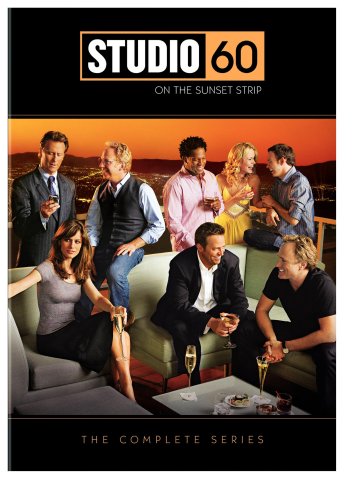
Oh, how the mighty have fallen. Five years ago, Aaron Sorkin and Thomas Schlamme were riding high with the best drama on Television, The West Wing, which is hands-down my favourite show ever. When word got out about a new Sorkin/Schlamme project set for the '06-'07 season, I was more excited than a monkey at the banana harvest. Expectations — mine and everyone else's — were sky-high for this new series, a behind-the-scenes drama about an SNL-type sketch comedy show. It would be the finest new show since The West Wing debuted in '99, Sorkin would once again raise the bar in prime-time entertainment and the collective intelligence of the human race would be elevated to the stratosphere.
Ok, not so much. While Studio 60 on the Sunset Strip premiered with much fanfare and critical praise, the series quickly slumped and never recovered. That made me angry, like a monkey whose monkey-mom made him stay home from the banana harvest. It's just not fair! So this review is about a good show killed by hype. Alas, Studio 60, you died too young.

Posted in: Disc Reviews by Michael Durr on November 12th, 2007
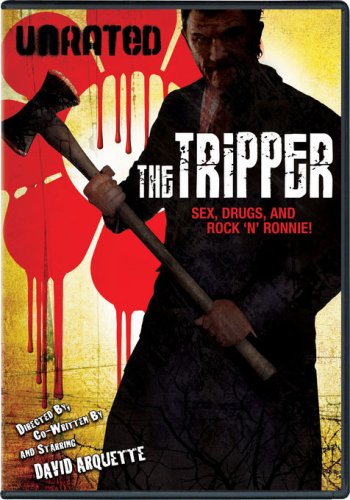
Bad horror movies are like watching a trainwreck. There are bodies all over the place and everybody is screaming in agony like a little school girl. And you can't turn your head away. So imagine my complete enjoyment when I received the Tripper to review. I screamed like a little school girl, my rabbit fainted and my girlfriend actually was able to turn her head away several times. I understand why they are the stronger sex cause I watched intently and was considering therapy when my 90 minutes was up.
The Tripper is the story of Ronald Reagan gone wrong. The back story indicates trauma to a young kid named Gus (played by Noah Maschan ) who chainsawed a tree hugger who was preventing his father, a lumberjack from performing his job. One would assume he spent the rest of his adolescence in a mental institution and then re-appeared as an axe wielding, Ronald-Reagan mask wearing psycho killer (played by Christopher Allen Nelson).
Posted in: Disc Reviews by Archive Authors on November 12th, 2007
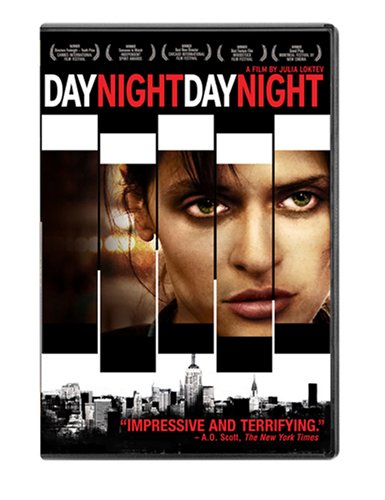
The premise of Day Night Day Night is relatively simple; a young woman decides to be a suicide bomber in Times Square. The motivations for her doing this, as in the outside forces who convince her to do it, aren’t really explained at all, so what makes it unique is that it focuses on the preparation the girl makes. She is portrayed by Luisa Williams, who appears in the film in her first role.
Written and directed by Julia Loktev (Moment of Impact), the film conveys some degree of tension and atmosphere, because you’re wondering what’s going to happen next, but the fact of the matter is that the level of activity that occurs here is almost nonexistent, and the context of the event borders on confusing. You watch the girl wait. And wait. And wait. And then her pseudo-presumably Islamic organizers who have American accents get her ready for it. Then she waits. And waits. And waits. And later on as we get closer to the actual event, she eats. And eats. And eats.
Posted in: Disc Reviews by Gino Sassani on November 10th, 2007
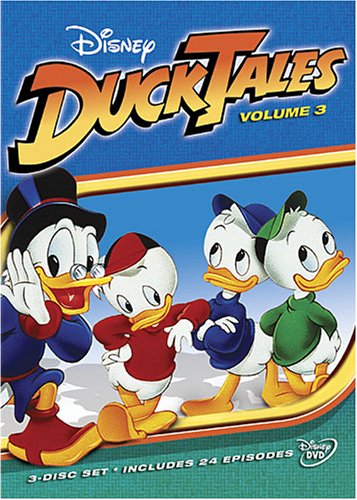
Disney Studios reinvented the afternoon cartoon when they introduced something they called Disney Afternoon. It was the brain child of studio animation head Bob Jacquemin. He saw the potential of taking famous Disney cartoons that were already beloved by millions and spinning them off into regular television cartoons. Not willing to take chances with the studio’s icon, Mickey Mouse, Michael Eisner allowed the Donald Duck universe to serve as the launching pad for this new venture. In 1987 Disney Afternoon and Duck Tales was born.
Posted in: Disc Reviews by Gino Sassani on November 10th, 2007
The Jungle Book was a milestone event in the history of Walt Disney’s animation history, so it shouldn’t come as too much of a surprise that the studio would tap this source for future adventures. The Disney Afternoon series has been a chance for the studio to continue many of the beloved characters. Tailspin was just such a series. The show is set in the Jungle Book world but minus little Mowgli. Now lovable bear Baloo runs an airline service with his new little friend baby bear Kit Cloudkicker. All of the other characters show up, from Shere Kahn to King Louie. This isn’t a musical, so the songs aren’t there, and there is no real mention or connection to the events in The Jungle Book. The stories are a kind of Indiana Jones affairs with plenty of tomb raiding and high flying stunts and narrow escapes. Ed Gilbert takes over the voice of Baloo, and while some of the original intonation is there, it’s clear how much the voice of Phil Harris gave Baloo so much character and charm. Obviously none of the same voice cast returns. The cost would have been prohibative for a television show, and unfortunately many of those voices are no longer with us.
Posted in: Disc Reviews by Gino Sassani on November 9th, 2007
Erle Stanley Gardner wrote crime fiction, and while many of his 100 or so works are unknown to most of us, he created a character that has become as identified with criminal lawyers as any other in fiction. It was in these crime novels that Perry Mason first faced a courtroom. He developed a style where he would investigate these terrible crimes his clients were on trial for. He would find the real killer, and in what has become a
Posted in: Disc Reviews by Gino Sassani on November 9th, 2007
It’s probably a pretty bad sign when a film’s star makes a public apology to his fans for doing the film just when it is getting released on DVD. Brad Pitt did just that, and you know what? He should be sorry. This film is an absolute mess all the way around. I think it’s supposed to be a slasher film, but there are never any good 1980’s slasher moments to be found. It’s true that at this point in his career Pitt wasn’t exactly being offered the cream of the crop. He wasn’t paling around with George Clooney and friends just yet. So perhaps it’s not Pitt but the folks who made this film who should be apologizing. Cutting Class has no idea what it wants to be when it grows up. Is it a comedy or is it a drama? Ultimately it fails on both counts.
Posted in: Disc Reviews by Gino Sassani on November 9th, 2007
Wings was one of those unusual sitcoms that depended more on the characters than the situations they were in. While the setting was a small
Posted in: Disc Reviews by David Annandale on November 8th, 2007
Roger Corman is fond of saying that only one of his movies ever lost money. It was this 1962 release (shot in 1961), and it is his bravest film, and still arguably his most powerful. William Shatner plays Adam Cramer, a white supremacist associated with the “Patrick Henry Society” (read: John Birch Society), who arrives in the southern town of Caxton on the eve of racial integration of the school. The demagogue whips up the hatred of the white townspeople, leading to cross-burning, church-bombing, and worse.
Corman’s film has lost none of its power to shock and appal. Nor has it lost its power to amaze. An absolutely blistering condemnation of bigotry, it makes the likes of Mississippi Burning look mealy-mouthed by comparison, and its unblinking political directness is all the more astounding for when and where it was made. As we learn from the accompanying featurette, the cast and crew operated under the constant threat of violence, and the sort of events they were depicting were actually taking place nearby. One of the first cinematic statements on the struggle for civil rights, it is still hard to find another film as raw and as uncompromised as this. And those whose only impression of William Shatner is of a shameless ham are in for a revelation. His performance is a satanic mixture of charm, smarm, self-love and seething, explosive hatred. He incarnates a textbook definition of “evil charisma.”