AVC MPEG4

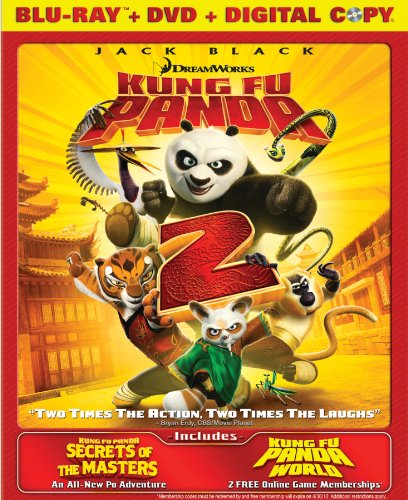
"Long ago in ancient China, the peacocks ruled over Gongmen City. They brought great joy and prosperity to the city, for they had invented fireworks. But their son, Lord Shen, saw darker power in the fireworks. What had brought color and joy could also bring darkness and destruction. Shen's troubled parents consulted a soothsayer. She foretold that if he continued down this dark path, he would be defeated by a warrior of black and white."

We all know who that warrior is, don't we?

"He's a real monster. And he's not brooding or lovesick or noble. He's the shark from Jaws. He kills. He feeds. And he doesn't stop until everybody around him is dead."

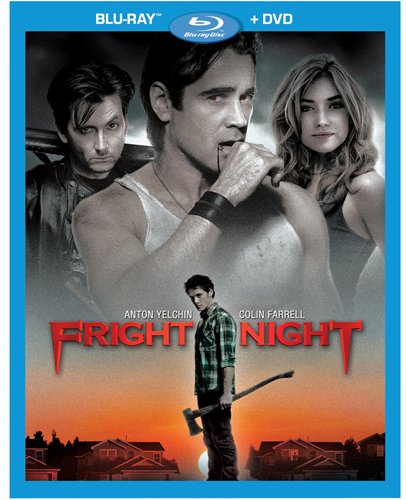
Okay, there's going to be two schools of thought going on when it comes to this movie. There are going to be plenty of fans who, like myself, absolutely loved the original tongue-in-cheek 1980's film. It has endured over the years, and I have found it to be just as charming and chilling now as I did when I first saw it back in 1985. Chris Sarandon was wonderful as the vampire, and who couldn't love Roddy McDowall as the reluctant vampire hunter, Peter Vincent? The fact remains that Fright Night was and is still one of those films that will always be a part of our collective love affair with movies. So there is that school of thought out there that thinks we should leave these classics alone and to remake them is akin to hearsay of the strongest order. And no one has been more critical of the remake/reboot/reimagine/rehash mill than I have. But I'm going to speak just a touch of sacrilege to the brethren: If you haven't yet, give this new version of Fright Night a chance. It's actually a blood-well good time. More on the whole remake thing later.

"Within our lifetimes, we've marveled as biologists have managed to look at ever smaller and smaller things. And astronomers have looked further and further into the dark night sky, back in time and out in space. But maybe the most mysterious of all is neither the small nor the large: it's us, up close."

Another Earth has all the earmarks of a first feature film for director Mike Cahill. It's also quite obvious that the director is far more comfortable in the documentary style of filmmaking. This movie is shot with the same kind of cinema verite style, and while it does follow the story of these two broken people, it is always told from an intimate point of view of a close chronicler who has somehow gained access to the drama as it is unfolding. There isn't a sense that any of this is scripted. The dialog doesn't contain any of the practiced lines or delivery that you would find in most dramas out of Hollywood. In fact, there isn't anything "Hollywood" about the film. There lies its greatest strength and, perhaps its greatest weakness.

“Oh hidy ho officer, we've had a doozy of a day. There we were minding our own business, just doing chores around the house, when kids started killing themselves all over my property.”

A carload of preppie college kids set off for a Memorial Day weekend of partying deep in the backwoods of West Virginia. They encounter a couple creepy looking hillbillies leering at them on the highway. Stopping to gas up they encounter the two rednecks again, but this time one of the two approaches the girls holding a scythe over his head and laughing like a madman. Feeling threatened, the kids get in the face of the rednecks warning them to back off. Later, deep in the woods, an urban legend is shared around the campfire about the Memorial Day Massacre, a series of unsolved hillbilly murders which took place in that same forest twenty years ago to the day. To shake off the scary story the kids decide to go skinny dipping. Unknown to them, the two backwoods hicks watch from offshore in a small fishing boat…

“It's impossible, but it would appear that the Spermupermine has had an adverse effect on your system. It's not only strengthening your spermatozoa, but it's causing it to grow to gargantuan proportions.”

I definitely have a soft spot for the horror anthologies; they’re the equivalent of cinema short stories. Some of the best horror anthology movies were Creepshow, Tales from the Crypt, Tales from the Darkside: The Movie, The House That Dripped Blood, Trick ‘R Treat, Asylum, Body Bags, Dead of Night and Black Sabbath. I mention this because if you are fond of horror anthologies, watch these. However, if you have a taste for bad taste (I’m talking early John Waters bad taste), if you can’t get enough of Grindhouse style B-Movie tributes, if you crave countless NC-17 style sex horror gags topped with an insane fecal spectacle, then I am happy to say Chillerama is your Holy Grail… well, er… more like Unholy Grail.

"'Twas the night before Christmas and all through the house, not a creature was stirring...not even a mouse..."

The poem is a popular one. It was originally titled A Visit From St. Nick and has been a holiday staple since the 1820's. No one knows for sure who wrote it, and there are several schools of thought on its authorship. What is not in doubt is that the lines are about as familiar as Christmas itself. Over the years it has been lampooned and used as an inspiration for many films, plays and songs. In 1974 Rankin & Bass tackled the title, and it has since become a holiday staple. While not quite as popular as The Grinch Who Stole Christmas or A Charlie Brown Christmas, it remains one of those fond memories, particularly with those of us who were children in the 70's.

Look up in the sky. It’s a bird. It’s a plane. No, it’s…. well, Clark Kent. And we finally have to say goodbye to the wonderful universe that this show has brought to the Superman mythology. With the show ending on its own terms we expected a lot from this season, and it was something just short of impossible for the cast and crew to deliver on those fans expectations. The season wasn't perfect, and I'm sure that each fan walked away disappointed in something that happened, or more likely didn't happen. It was a tall order, but I think that the show delivered quite handsomely. For me, it was important that Tom Welling get that chance to put on the suit and fly. I wouldn't think it was any kind of major spoiler to tell you that he does. Those last 12 minutes were payoff enough for me. There were also some rather emotional moments that brought back many past cast members including the much-anticipated return of Michael Rosenbaum as Lex.

There were certainly epic story-lines going on here. There's a Watchmen/X-Men-like story that deals with a law to force masked heroes to register with the government amid a surge of anti-hero public backlash. Of course, it's Lois's father played excellently by Michael Ironside who leads the anti-hero legislative push.

A bar owner hires a hitman to assassinate his wife and her lover upon discovering their affair. What proceeds is a neo-noir packed with ample murder, betrayal and suspicions throughout.

This film is the directorial debut of Joel Cohen, thus making it the first in the line of “Coen Bros.” productions (Joel's brother Ethan naturally contributing as co-writer and co-editor). As well, Barry Sonnenfield is the Director of Photography, which helps to explain the outstanding visual composition of this film. With the combined efforts of the Coens and Sonnenfield, Blood Simple takes a modern, Southern US setting (in full colour I should note) and turns the mise-en-scene into something unmistakably of the noir genre. There are a few more hand held jostling than one would be acclimatized to in Coen Brothers films, which sometimes take away from the strictly “noir” style of framing shots, but do keep it from feeling too stifling or striated.

"On every world wherever people are, in the deepest part of the winter, at the exact midpoint, everybody stops and turns and hugs. As if to say, "Well done! Well done, everyone! We're halfway out of the dark." Back on Earth, we call this Christmas, or the Winter Solstice. On this world, the first settlers called it the Crystal Feast. You know what I call it? I call it expecting something for nothing!"

In 2005 the BBC decided to bring back the gone-but-never-forgotten character. Christopher Eccleston would become the ninth Doctor, and a brand new series was started. The Doctor was revived in a more traditional hour long episodic format. Gone were the cheap f/x, and now with the use of CGI and a more respectable budget, Dr. Who could be given the high-end treatment it deserved. But would all this new slick production be able to retain the magic of the original? As it turns out, much of that charm remains, and a brand new generation has gained access to Dr. Who. Sadly, Eccleston would retain the part for only a year. In the second season David Tennant would take over the role. It is this tenth  Doctor who has changed twice more to the one you’ll find in this sixth season (or series as the British like to call them). The old theme is back but far more modernized and performed by the National Orchestra of Wales.

There have been a lot of films out that deal with the Iraq war and the various political situations that region of the world has had to deal with since that time. Most of these efforts are trying so hard to make some radical political point that they tend to serve their audiences poorly as entertaining films. Happily, that's not the case with Lee Tamahori's The Devil's Double. The film cuts through the polarizing political elements and provides a brutal view of the Hussein regime through the actions of one of Saddam's sons, Uday. Tamahori has created a modern Scarface by using those regime elements to paint the picture of a man overwhelmed with power and driven to excess. Unlike Scarface, Uday is not an outlaw; rather in this environment he is the law, and suddenly we have a film that delivers a unique take on the theme of the corruption of power.

Latif (Cooper) is a simple soldier in the Iraq army in the days before the Kuwait invasion. He has been called to the Royal Palace, summoned by Prince Uday (Cooper) whom he had known in his school days. The two share a remarkable resemblance that Uday intends to exploit. He wants a body double to help protect him from the various threats that his position elicits. Latif attempts to decline, but Uday threatens his entire family if he doesn't accept. Acceptance means that Latif is now dead, and he is to live in the palace with all of the luxury of a prince. Uday refers to him as his brother. But instead of having Latif take his place in public, he merely drags him around with him. It's a poor plan for a body double, because it soon becomes pretty much general knowledge that this look-alike exists. Latif finds himself more and more disgusted as he is drawn closer in toward this world. All he wants now is to escape.