AVC MPEG4

One might have to legitimately ask about the thinking behind this particular children- targeted release. I have to admit that I was a little uncomfortable with the idea of reviewing this film at this particular time. I have two issues that are just unavoidable here:

They both deal with the film's two central stars here. Bindi Irwin is the daughter of famed Crocodile Hunter Steve Irwin. You all remember Steve. He used to approach some of the most dangerous animals on the planet and quite casually tell us just how deadly they were while tempting them to tag him. We all suspected that Steve might one day get a little careless and get himself killed. The truth is that didn't exactly happen. It wasn't a particularly dangerous animal or any carelessness on Irwin's part that led to his rather unexpected death a few years ago. It was a usually harmless stingray that sent a barb through his heart in what can only be described as an unfortunate freak accident. Now, even before his death, the family had been preparing their very young daughter to follow in Daddy's rather unusual footsteps. Bindi's done several documentary films, including her own television show in the wake of her father's death. Here I can't help getting the feeling that the appearance is somewhat exploitive of the whole business. When I look at Bindi's mom in the extra features, I can't shake the feeling that she's cashing in here. I don't know these guys, so I'm not trying to claim that I know their hearts and minds. I can only report the feeling it leaves me with, and it's not a good one.

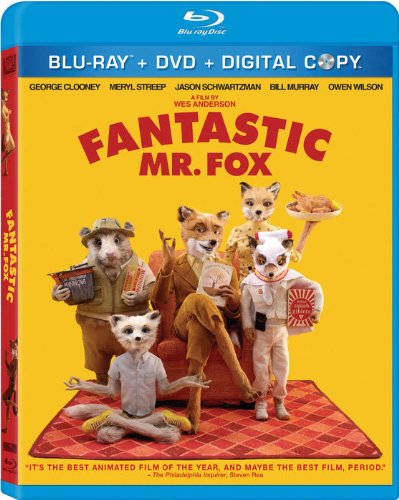
"Boggis, and Bunce and Bean. One fat, one short, and one lean. These horrible crooks, so different in looks, were none the less equally mean."

Roald Dahl was one of the more eccentric writers to come upon the scene. While he often wrote for children, his work is most decidedly dark and often quite sinister. He's most known for such tales as Charlie And The Chocolate Factory. His work has not been adapted to film as often as you might suspect given his popularity. The most famous was certainly Gene Wilder's Willy Wonka And The Chocolate Factory, which was far brighter and more cheerful than the original work. It took Tim Burton and his trademark brand of darkness to create the story Dahl intended in a more recent film which used the correct title of the work. This is not the first stop motion film to be adapted from his stories. Quite a few years ago we were given James And The Giant Peach, which enjoyed little box office acclaim. Wes Anderson is obviously a Dahl fan and immersed himself in the author's world as he prepared his screenplay for Fantastic Mr. Fox. The effort shows in the way Anderson captures Dahl’s pointed wit and social sarcasm. I think that if you're looking for something Dahl himself might have created, this is your movie.

"More of this is true than you would believe."

What was intended as a somewhat thought-provoking quirky comedy looks a lot like something you would expect to see on a late night rerun of The X-Files. All of the subject matter has been covered there, just not quite in this way. It all started with a non-fiction book written by Jon Ronson. He claimed to have researched various government studies in human behavior that entered into the world of the paranormal. It was part of an ideology of waging non-lethal war. It was a strange combination of 1980's new age mysticism and actual studies that showed that soldiers in World War II were, in fact, quite reluctant to kill or even harm the enemy. The study claimed that almost 80% of the soldiers deliberately looked for excuses not to fire or merely aimed inaccurately to avoid killing. The study went further and claimed that of the minority that did shoot with deadly results, most of them suffered terrible guilt over the experience, often making them unable to remain effective soldiers. The study regards the remainder of the study group, the ones who did fire accurately and did not suffer guilt as psychopaths. In short, the book gathered a lot of speculative ideas and put them into a rather oddball collection of "facts".

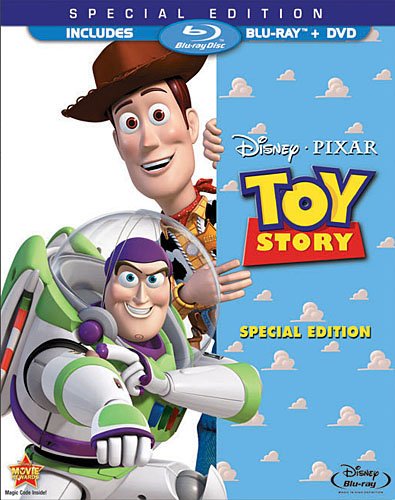
In the long run what was more important to Pixar and its relationship with Disney wasn't the milestone that Toy Story provided being the first computer animated feature. Movies are, as much as we'd like to think otherwise, a business. In the end, a film has to make some money. Toy Story was like a private printing press for the two companies bringing in nearly $200 million at the box office. Add another nearly $200 million in foreign receipts, and this prototype of a movie pulled in nearly a half billion dollars before the first DVD was released. That's huge for what was basically a children's cartoon. The second Pixar film would be A Bug's Life, and it would bring in nearly the same kind of jingle. The cry was too loud to ignore. The people wanted to see more of Buzz, Woody, and the rest of Andy's toys. The edict came down from on high, and what once took them 4 years to do, Pixar was asked to do in about 18 months. Now we would find out if Pixar was a viable company that could produce films reliably and on a faster turnaround. Would the studio compromise on quality just to answer the gate call of millions of dollars waiting to be plucked from the pockets of eager moviegoers? Several films later we know the answer to that question, but it was very much an answer in doubt in 1999. But another $485 million later in worldwide box office settled the question once and for all. Pixar didn't just start the computer animation business. They didn't just define the industry. They would continue to lead it for the next decade ... and apparently, beyond.

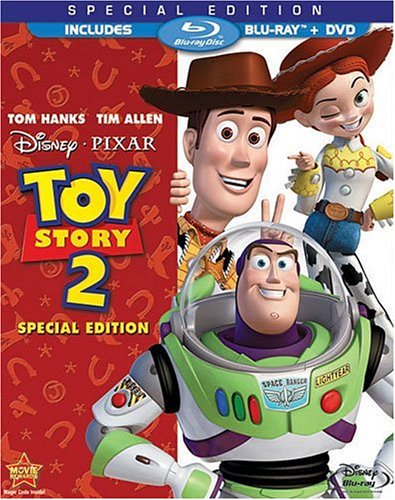
All of your favorite toys came back with their original voice cast. This time Woody (Hanks) attempts to rescue Wheezy The Penguin (Ranft) from the 25 cent box at Andy's mom's garage sale. The rescue brings him to the attention of Al (Knight) from Big Al's Toy Barn. Unfortunately for Woody and his friends, Big Al has the largest collection of Woody's Roundup collectibles on the planet. He's been trying to close a deal with a big Japanese firm who want to buy the collection for huge bucks. But Big Al has been missing only one piece in the collection, the most important piece, however ... Woody himself. The Japanese won't buy any of it without Woody. So Al steals Woody and brings him back to complete the collection. There Woody learns about his roots and the television show that he was based upon. He meets Jessie, The Yodeling Cowgirl (Cusack), Stinky Pete, the hapless old prospector (Grammer), and Woody's trusty horse Bullseye. While Woody's friends stage a rescue lead by his now best buddy Buzz Lightyear (Allen), Woody begins to feel sorry for his new companions. They've been kept in dusty old storage for years waiting for that final piece so they can be put on display at a museum and be admired by generations of new kids. When his friends finally arrive to save the day, Woody must decide between his old friends and his television comrades.

It's hard to believe it, but Toy Story was the very first computer generated animated feature film. CG graphics had already appeared as parts of films starting with the "Genesis proposition video" from Star Trek II: The Wrath Of Khan. It was a rather fitting movie for this Hollywood and technological first to occur. The piece was rather short and not as breathtaking as we've come to expect today, but, it did herald the beginning of a new era in filmmaking, to be sure. What better place for such an historical technological breakthrough than in Star Trek?

Pixar had already been making short subject computer animation. If you ever have the opportunity to check out their collection of shorts, you can't help but be impressed with the evolution of the process as evidenced in these short films. The awards were rolling in for the upstart company, and it was only logical that sooner rather than later they would be the ones to attempt a full length feature film. Of course they were quite a small company at the time with no distribution network in place to launch a major motion picture. There wasn't much of a promotional arm to the company to create the kind of buzz, pun intended, a full length film would require. The truth was that Pixar's small size, which was so much of a creative asset, just wasn't up to the kind of task they were taking on. The first step would have to be to find a partner with the name recognition and resources to back up such an ambitious project. They would likely be betting the future of the company on this one effort. The choice was obvious. They would tie their fortunes together with the same company that took the very same risk 70 years ago. Walt Disney had created the very first animated feature film with Snow White And The Seven Dwarfs. The result started an entire industry and put that one-time fledgling company on the map. Would Pixar be able to make the same impact on the industry that Disney had so many decades before? Anyone who has had the pleasure of seeing Toy Story knows the answer to that question. Lightning did indeed strike twice, and Toy Story would open the floodgates to an entire new industry of computer animated features.

Around Thanksgiving of last year, I started to see trailers of a particular movie that quite literally made me laugh out loud. The reason behind it is because I knew with the title of the movie and the obvious plot, there was no way I was not going to review it when it came to dvd & blu-ray. I have a reputation for certain movies, I guess you could say. That movie was Ninja Assassin. Several months later, I am reviewing it for a mass audience. Funny how that works.

An old man and master of tattoos (played by Randall Duk Kim) is filling in an elaborate tattoo on a young gangster named Hollywood (played by Sung Kang)’s back. A henchman brings Hollywood a sealed envelope. The envelope is opened and out spills black sand. The old man is startled. He starts to spin a tale about ninjas and how he saw an envelope just like that before everybody around him was assassinated.

If you are a regular reader here, you know I'm not much for the romantic comedy department. I tried to pass this one off on the rest of the staff but couldn't find a taker. We finally got a woman to review this stuff, but not even she was enthused enough about this title to take it on. This experience is pretty typical when it comes to Did You Hear About The Morgans. With a $58 million budget and a $30 million gross at the box office, it would seem that a lot of folks took a pass on the movie. In less than 4 weeks it dropped from nearly 3000 screens across the fruited plain to just about 500. We're not talking about an unknown cast here. The real mystery is, why did such an impressive cast take this movie on?  Hugh Grant is pretty well known, if not for his movies, then for his back seat antics with a hooker. So, his judgment should already be in question. I mean, who would give up Elizabeth Hurley for a 20 dollar hooker? Sarah Jessica Parker has been riding pretty high on her Sex In The City fame. Perhaps she was just trying to solidify a romantic comedy image here. Both made horrible choices here, and neither generated a character worth caring about. What's worse, the two share no chemistry and even a devout romantic comedy avoider like me knows enough to understand that the two most important elements in the genre are chemistry and characters that you feel something for.

Paul and Meryl (Grant & Parker) are a married couple who have been separated for three years because Paul had an affair. Both are highly successful in their chosen fields. Paul is the senior partner in a prestigious law firm and Meryl runs a very elite real estate agency. Paul wants to patch things up, but Meryl is not so sure. So the two agree to meet for a date and see if they can talk about their situation. The dinner date doesn't go very well and is completely ruined when the two witness the murder of a man who was about to turn state's evidence. Now their relationship issues are the least of their problems. The killer knows who they are (Meryl's picture is pasted everywhere from billboards to bus stations) and he's not about to let them testify against him. Enter the Witness Protection Program. The two are given new names (The Fosters) and sent to rural Ray, Wyoming where the local sheriff happens to be a Federal Marshall who has experience protecting witnesses. Marshall Clay Wheeler (Elliott) and his wife Emma (Steenburgen) are simple folk who live miles from civilization, making their home the perfect place to hide the couple. Now forced together, the two have to deal with their relationship issues to save their own lives. You know the killer's going to track them down, and through the carelessness of the couple's two personal assistants and Meryl's inability to stay off the phone, he tracks them down.

"If the glass is half empty, at least you can't drown."

When I looked at the title and description of this film I couldn't help but think of that Jimmy Stewart classic It's A Wonderful Life. I'm not sure if it is the close title or the idea of a cynical man finding some kind of epiphany about his life and how he interacts with others. So, maybe it was that connection and inevitable comparison and expectation that caused me to dislike this film as much as I did. It's not fair, you might say, but it is the filmmakers themselves who invite this comparison and apparently welcome it. I'm sure the idea was that it would bring in that particularly large audience of viewers. Unfortunately, it was more of an anchor providing a standard that Wonderful World simply can't meet. But let's forget the comparisons for a moment. This is still a pretty bad film. It made its run of the film festival circuit for a time and even managed a very limited American box office run which barely grossed nine grand in total.

It seems like yesterday, but about a year ago; my cat of 14 years had died. Her name was Burns. She had survived through my college years and the worst period in my life during my 20’s. Sarah had come into my life at that point and I guess my cat finally realized she could let go. Burns was always a loyal companion and there to bring me up when I needed it. I never had a better pet than her, and I probably never will. Hachi, A Dog’s Tale is another story about a faithful animal, adapted from a Japanese true story.

It’s hero day at a local school. One student named Ronnie (played by Kevin DeCoste) starts to spin the tale about his hero: Hachi. Hachi is a dog that was actually owned by his grandfather, Parker (played by Richard Gere). We then start to flash back to a Japanese man shipping an Akita dog that travels cross county and ends up in Rhode Island.

It's back to the 1950's with its telltale alien invasion science fiction matinees. There's Doo Wop coming out of the radio. The cars have tail fins and plenty of color and chrome. That's right. This is 1950's Americana. Well ... almost. You see, the alien invaders are humaniacs. They turn the helpless population into mind-controlled zombies, and they eat brains for breakfast. Those sure are the classic cars, all right. But they're rounded, and instead of wheels they ride on a cushion of air. And then there's the "people". They're green. They have tentacles for hair. And they have only 4 fingers and toes on each hand or foot. Can anyone say, "Give me a high four"?

Meet Lem (Long). He's your typical 1950's teen. His biggest worry is how will he impress Neera (Biel), the girl of his dreams? He holds down a job proudly at the local museum and planetarium, where he teaches that the universe is nearly 500 miles across, containing 1000 stars. Wow! He doesn't have time for the fantastic movies and comics that depict humaniac invasions. His friend Skiff (Scott), on the other hand, reads and watches them all. He's quite well versed in the topic of alien invasion. He's convinced that "they" are coming, if they're not already here, that is. For these innocent and peaceful folks, the nightmare scenario that they've feared their entire lives is about to come true. An alien has invaded!