AVC MPEG4

“I found out that if you wanna know the purpose of a thing, you can’t ask the thing to tell you. A car doesn’t know why it’s a car; only the manufacturer knows what it was meant to do. And I guess that’s the same way it is with God.”

Not Easily Broken was written by a minister, Bishop T.D. Jakes. So you should expect a very spiritual message when you watch this movie. If that’s not your cup of tea, as they say, this really isn’t going to be the film for you.

In 1951 Robert Wise made the Earth stand still. The United States, in fact the entire planet, was in the middle of a frightening cold war. If you believed the media at the time, we were standing just moments from nuclear annihilation. We were given images of a crazy man’s itching trigger-finger poised over a button. School kids were led in air raid drills that promised protection from this powerful menace by the wooden tops of your desks. The government and private sectors were engaged in witch hunts to smoke out “commie” sympathizers. The fear touched every aspect of our lives. Hollywood was no exception.

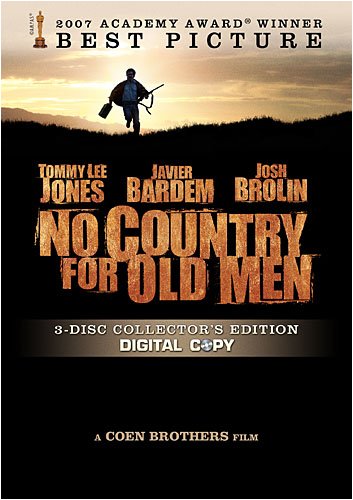
“Some of the old time sheriffs never even wore a gun. Most folks find that hard to believe. Jim Scarborough never carried one, that’s the younger Jim. Gaston Boykins wouldn’t wear one up in Comanche County. I always liked to hear about the old timers. Never missed a chance to do so. You can’t help but compare yourself against old timers. Can’t help but wonder how they would have operated in these times.”

I know I’m getting old myself when a film set in the 1980’s is now considered a period piece. And No Country For Old Men is about as much of a period piece as anything else.

It’s official. I’ve just totally given up on Adam Sandler. Honestly, I haven’t laughed at anything he’s done since the music video for The Lonesome Kicker. How many times can the same absurdity and Romper Room antics work on a film audience? Even in a Walt Disney film that required Sandler to clean up his act a bit, the same sophomoric humor was showing through the threadbare shtick. You just knew there were times he wanted to let loose with some off color remark or obscene gesture. While I was pleased that he gave it the effort, it’s like asking a mute man to talk after you just tied up his hands.

“A dog has no use for fancy cars, or big houses, or designer clothes. A waterlogged stick will do just fine. A dog doesn’t care if you’re rich or poor, clever or dull, smart or dumb. Give ‘em your heart and he’ll give you his. How many people can you say that about? How many people can make you feel rare and pure and special? How many people can make you feel extraordinary?”

In the name of full disclosure, I should probably give you a little background in the circumstances in which I find myself watching and reviewing Marley & Me. If you’re a regular reader of this site and my reviews, you have come to learn that I have a Siberian Husky named Athena.


Slumdog Millionaire has become the latest “must see” Best Picture award winner. While I actually liked the film better than I imagined I would, it’s precisely because the movie is not what it appears, or at times claims to be. If I just took the buzz and advertisement campaign to heart, I would expect a Bollywood picture to the extreme. If you’re not really sure what that term means, I can tell you that this movie will not really clarify anything for you. The traditional Bollywood, Indian made films, feature intense tragedy and love stories. They are usually swimming in song and dance numbers.

For first time screen writer Allen Loeb, Things We Lost In The Fire is quite an ambitious script. It relies almost completely on the writing and the performances that can be gotten from the acting leads. There’s really no place to hide in this story for anybody. And while I certainly found several elements of the story forced or contrived, there was an underlining emotion to the whole thing that carried through strong enough for the actors to find some very solid grounding. With that grounding Halle Berry and Benicio Del Toro delivered what should have been award winning performances.

His name is Craig, Daniel Craig. Love him or hate him, we have to accept the fact that this blue-eyed rather rugged sculpture of a man is the face of James Bond, now and for the foreseeable future. I’ll admit to being more of a nostalgic Bond fan, and have the image of Sean Connery forever etched into my brain as the quintessential 007. But, it’s not only the drastic change in appearance and demeanor that makes this a hard film for me to embrace. For the first time in the franchise’s 22 film and 35 year history we have a Bond movie that is a direct sequel of the previous one.

On January 23, 2002 Daniel Pearl, a reporter for the Wall Street Journal, was kidnapped and eventually killed by terrorists while working in Pakistan. A Mighty Heart is based on this true story. The narrative comes from the book by his wife Marianne Pearl. While this is certainly the tragic tale of a murdered reporter, this film is more the story of Marianne and her struggle to locate Pearl in the 10 days from his capture until a video tape surfaced depicting his beheading.

I was very eager to revisit this film now that it has come our way on Blu-ray and high definition. There are issues that I struggled with in my own viewing that I will discuss later in this review. In high definition this film becomes a case study in contradiction. It’s amazing how pretty a thing can be when it really isn’t very pretty at all. We are witness to bad things, but the director chooses to present these things amid a flurry of beauty. It’s a rather striking contrast, made more so on Blu-ray. It actually made for a much more effective experience, even if most of my initial feelings about the film remain unchanged.