Posted in: Brain Blasters by David Annandale on September 13th, 2008
This is going to be half a review, and half nostalgia.
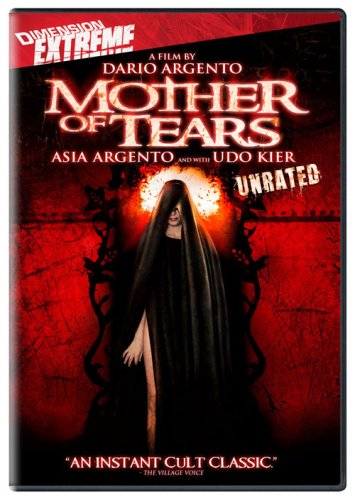
In 1980, Dario Argento’s Inferno was released, and, bizarrely, it was one of the films profiled on a kid’s SF TV show I watched back then. The scenes on display sent my terrified little self fleeing from the room. But the images I saw stayed with me, as did the spookily elegant poster I saw on Paris theatre marquees in the weeks that followed: a purple-and-blue skull with a single drop of blood forming at the still-fleshy lips.
Posted in: Brain Blasters, Regular Columns by David Annandale on September 6th, 2008
We have all encountered films that are less intelligent than they think they are. My favourite example of this syndrome would probably be Contact, the deeply serious Jodie Foster vehicle, directed by Robert Zemeckis, and adapted from the Carl Sagan novel. The film keeps the novel’s primary weakness (the ending, which, smacks of a writer who hasn’t worked out a full outline before starting) and introduces some unintentionally funny visual elements (the alien-inspired technology looks suspiciously like it was designed by Wile E. Coyote, and the first time out works like was designed by him, too). But the film’s biggest sin was not that it has some very silly aspects, but that it is completely unaware of same, and really seems to believe that it is Important Art. Similarly, M. Night Shyamalan has become the undisputed King of Movies Less Intelligent Than They Think They Are.
But what of the converse? Are there films that are more intelligent than they think they are? Or at least, less stupid? Let me put forward the modest proposal that there are. Exhibit A is Massimo Pupillo’s The Bloody Pit of Horror (1965, out on DVD from a variety of sources). This mid-period Italian Gothic tells the charming story of a busload of cover models who descend on a castle that happens to be the home of the obsessed Mickey Hargitay (best known as the husband of Jayne Mansfield, and these days, as the father of Mariska Hargitay). As the models pose to be photographed in and around various torture devices, their host flips out, becomes convinced he is the reincarnation of one Crimson Executioner, and starts using the devices for real on the unfortunate women.
Posted in: Brain Blasters by David Annandale on August 30th, 2008
A few weeks ago, I nattered on about how Mario Bava’s Blood and Black Lace differs markedly from the very slasher genre it helped create. The same is true of Bay of Blood, though the comparison is rather more complicated.
The connection between Bay of Blood (AKA Twitch of the Death Nerve) and the slashers is one of the purest examples of superficiality one could think of. Many of the murders in Bava’s film were lifted holus bolus by the first couple of Friday the 13th films (machete to the face, love-making couple speared in bed, and so forth). However, the fact that the films have near-identical murders turns out to be as irrelevant as the fact that they both take place in similarly sylvan environments. For the uninitiated, Bay of Blood does not offer one killer, but many. Everyone is killing off everyone else in a battle to possess a valuable lake-front property. There is no motivation so pure as revenge here. Greed is what is driving the characters.
Posted in: Brain Blasters by David Annandale on August 22nd, 2008
Apparently, achieving just the right level of success can work against you. This would appear to be the case of the recent Spanish horror effort [REC]. Co-directed by Jaume Balagueró (who gave us the underrated Darkness and The Nameless) and Paco Plaza, this was one of Spain’s biggest box-office hits last year. Does that earn it a theatrical North American release? Not a bit of it. Instead, it earns itself a remake, under the title Quarantine. Though there are, apparently, some changes being made (the unfortunate jettisoning of the supernatural angle being one), from the looks of things, the new version is going to be a pointlessly exact retread (and speaking of pointless, why give us a trailer that shows the very last shot of the film?). Not only is [REC] not gracing the theatres, it is also being deprived, at least for now, of a domestic DVD release. But if I might speak a word to the wise, it is available as a Region 2 release, so those of you with region-free players know what to do.
Going through the effort of seeing [REC] is well worth it, because it is another example of the new wave of European horror at its finest. The set-up is becoming familiar by this point: in the vein of Cannibal Holocaust, The Blair Witch Project and Cloverfield, we have a verité conceit. In this instance, we are seeing everything through the lens of the cameraman for While You Were Asleep, and lightweight news program where the reporter follows around the people who work the night shift. Tonight, she is profiling firemen, and we are along for the ride when a call comes in about a woman trapped in an apartment. The routine assignment becomes everything but when the woman savagely attacks an attending officer. Then residents, media and rescuers are sealed in the building by the authorities. What follows is not unknown territory. We are basically in cannibalistic zombie territory, though these folks have the rage and savagery of the infected in 28 Days Later, and the manner of infection (not to mention the aforementioned pronounced hint of the supernatural) also echoes Demons. Once the bad stuff starts happening, it happens at a frenetic pace, and the skill of the directors in deploying familiar material is astonishing. What we have here is another example of how anything old can be made fresh and vital is handled with inspiration and brio.
Posted in: Brain Blasters by David Annandale on August 9th, 2008
Mario Bava is undergoing something of a revival of interest these days, what with Tim Lucas’ magisterial book Mario Bava: All the Colors of the Dark and the recent Anchor Bay box sets. Over the last little bit, I’ve been re-watching some of Bava’s films, along with a friend who hasn’t seen them before, and I was struck by a comment he made about Blood and Black Lace: that this was the first horror film he’d seen where the victims had no existence other than as victims. This is true, and it made me think about some of the other things that distinguish Bava’s films from the films they would influence.
Released in 1964, Blood and Black Lace is an early giallo. Its Italian title translates as “Six Women for the Assassin,” which is an even more accurate description of what the film is all about. Allow me to quote Phil Hardy on the film: “Bava’s work operates almost exclusively on the level of cinematic style. His films are as plotless and scriptless as it is possible for non-avant-garde cinema to be, using the strict minimum necessary to motivate the mise-en-scène of lusciously flamboyant sado-voyeuristic operas. In this picture the audience is no longer asked to care about who gets killed – the title announces and summarizes the action – and the killer, in his featureless mask, is merely the faceless representative of the male spectator as he stalks, one after another, a series of women guilty of nothing less than provoking desire.”
Posted in: Brain Blasters by David Annandale on August 2nd, 2008
Flipping through the latest issue of Rue Morgue, I happened on a capsule review that mentioned how most grindhouse fare (whether actual or neo) rarely delivered on its promises. This is, of course, absolutely true, and I don’t for a moment pretend that this comes as news to anyone reading these words. I do want to consider this factor from two angles, though.
The first is that the fact that we all know this is in itself telling. Many film fans of my generation would have likely grown up knowing ONLY of the promises. We would see the posters and the ads in the paper, but whether because we were too young, or the movies weren’t playing nearby, or for a dozen other possible reasons, we would never actually get to see the movies themselves. Result: near-mythical status for these forbidden-fruit films. But now, thanks to the magical world of the DVD, just about every film we could ever imagine is now available in immaculate prints. This is a double-edged sword. On the one hand, we can finally see these movies. On the other, seeing them invariably punctures the mythological bubble. Nonetheless, it is now easier than it has ever been before to see just about anything, anytime. How’s that for a golden age?
Posted in: Brain Blasters by David Annandale on July 26th, 2008
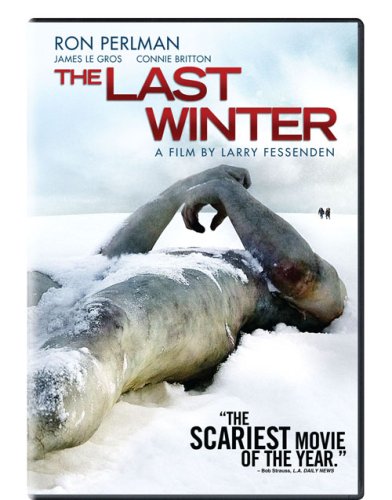
A few years ago, I had the pleasure of reviewing Larry Fessenden’s Wendigo for this site. Recently out on DVD is his much belated follow-up, The Last Winter (not to be confused with the Canadian coming-of-age tale of the same name). I’m happy to report that the skill Fessenden showed in Wendigo is very much on display in his new feature.
Ron Perlman headlines as Ed Pollack, the company man whose job it is to make an oil-drilling project in northern Alaska a reality. His potential nemesis at the camp is James Hoffman (James LeGros), an environmental activist the company hired in an obvious stab at green credibility. Hoffman is concerned not just with what the drilling is likely to do to the pristine landscape, but also with issues already happening. The permafrost is melting and it’s raining in the Arctic in February, for instance. These are all serious problems, but then it appears that the melting land has unleashed something evil, and the team at the camp begin to die one by one.
Posted in: Brain Blasters by David Annandale on July 18th, 2008
Last week, as I was writing about lost films, I was musing about the many films I had read about in my youth but had never seen. Many of those from the early decades of film history are, I assumed, lost forever. I was thinking particularly of the really early stuff, and particularly of the films of Georges Méliès. While many of his films are still extant (and I have extolled the previous Kino release previously), many of those I had wished to see were those Denis Gifford describes in his Pictorial History of Horror Movies. A prime example would be The Merry Frolics of Satan (1906). The single still in the book – of carriage drawn by a skeletal horse with an accordion-like torso – has always fascinated me. So I was going to mention this film as an example of the lost but lamented. Just to be on the safe side, though, I did a quick search, and discovered, to my delight, that it is NOT lost. To my further delight, I found it on a collection which can best be described as mind-blowing.
There have been a number of Méliès collections to date, but not one, I feel safe in stating, has come close to what is on offer in Georges Méliès: First Wizard of Cinema (1896-1913). Five discs. 782 minutes. 173 films. These are, it seems, all the known surviving films, arranged in chronological order, boasting new scores, and, where possible, narrations following the original English text written by Méliès. Those narrations underline just one of the charming, fascinating aspects of these films. They are very clearly documents of cinema aborning, and the language of visual storytelling is only just being created. Méliès was a man of the theatre, and that way of thinking and visualizing carries through in his films. For all that he created the special effects extravaganza, his films are also redolent of filmed theatre: static camera, everything in medium long shot (as if we were in a good seat at the theatre), entire scenes played out in what is in effect (if not reality) a single continuous shot. The spoken narrations are thus often necessary for the audience to make sense of what is happening on the screen. For instance, because of the lack of close-ups and the like, the meeting of the astronomers at the beginning of A Trip to the Moon (1902) is nothing more than wildly gesticulating chaos, and no clear narrative is possible to discern without the narrator telling us where to look. As Méliès’ career was winding down, D.W. Griffith was busy pushing cinematic storytelling to full maturity, taking visual storytelling to a level of sophistication that is still what we are most familiar with today. But this very shortcoming in Méliès’ technique is part of the his work’s appeal: when we watch these films, we become conscious of seeing a new art-form in mid-formation.
Posted in: Brain Blasters by David Annandale on July 12th, 2008
So the news this week was very exciting for fans of vintage films, and especially for those whose dreams are haunted by thoughts of lost films rediscovered. Hot on the heels of Kino's announcement of a new DVD release of Fritz Lang's Metropolis, due next year and apparently a further improvement on their previous (superb) release, came word that a completely uncut version of the film had been found in Argentina. That, friends and neighbours, is BIG. The full three-hour-plus version of the film hasn't been seen since the original release, and not everywhere at that. In recent years, we've seen some pretty fine editions of the film, but all of them have had to make do with extensive summaries and mouth-watering stills to fill in the gaps. Certain characters that barely show up, if at all, in what has been seen to date, actually have quite substantial roles in the full version. And now it has been found. True, it's in pretty rough shape, but it exists, and no doubt a full restoration effort is underway. Kino has apparently said that the found footage might well be added to the forthcoming DVD.
So let's savour the thought for a moment. An uncut Metropolis. Who would have thought that we would ever see the day. I know I didn't. One can't but think that just about every lost film that might be found, has been found, and then this happens. One begins to hope again. Maybe other mythical beasts will turn up after all.
Posted in: Brain Blasters by David Annandale on July 5th, 2008
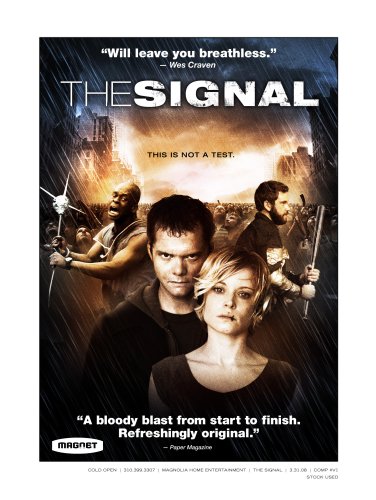
We’re all familiar with the zombie movie, most particularly the post-1968 zombie flick. That was the year George Romero permanently transformed the zombie into a flesh-eating ghoul – perhaps the only instance of a long-standing monster having its rules of behaviour altered almost beyond recognition, and to the point that there have been virtually no NON-flesh-eating zombies on film since Night of the Living Dead. But that’s a topic for another time. Co-existing with the neo-zombie movie, and sometimes fusing with it (as in 28 Days Later and its sequel), is the tale of mass psychosis. A recent example is the 2007 film The Signal, directed by David Bruckner, Jacob Gentry and Dan Bush.

In the nondescript city of Terminus (no doubt twinned with Racoon City), a strange signal is broadcast across all media. It has the effect of turning anyone who watches it into a murderous loon. Chaos descends quickly as one might imagine. The film is structured as three semi-distinct but overlapping stories (not entirely unlike Pulp Fiction, as has been pointed out elsewhere, though The Signal is far more linear than Tarantino’s movie). In the first, Anessa Ramsey leaves the home of her lover (Justin Welborn) to find her husband (A.J. Bowen) descending into the signal’s embrace. In the maelstrom of violence that erupts, she ultimately flees the apartment, unable to trust anyone. The second story is Bowen’s, as he tries to find his wife, and falls in with two other people in various stages of signal-mesmerism. This segment, often blackly funny, shows us the behaviour of the psychotics from their own perspective, and drives home the fact that they believe their actions to be entirely rational. In the third story, we track Welborn’s struggle with Bowen as he tries to find and rescue Ramsey.