VC-1

When I saw the title for this movie my immediate thoughts went to that old Neil Diamond song of the same name. I don't know why, but I absolutely expected to hear it at some point in the film. So I actually found myself smiling a bit when the first guitar chords for the song began during the opening credits. I was a little disappointed to hear the song, but performed by the Man In Black, Johnny Cash. Not that I dislike Johnny. I just was expected something else. You know the feeling. Did you ever pick up someone else's drink by mistake and sip it, expecting it to be yours? It doesn't matter how much you might actually like what that someone was drinking. It completely throws you and tastes bad for a split second. Well, that's what happened with Solitary Man, the song and the film.

You see, the box art and studio buzz calls this film a sophisticated comedy. It's neither. It's actually quite good for what it is, but the studio's misrepresentation means that I was ready for something entirely different than what I got. That makes it so much harder to give a film a chance. I was all set to laugh. Instead I got a very moody and often dark character study. It took me a bit of a readjustment to finally begin to appreciate the movie for what it was. Michael Douglas can still deliver a solid character study. Here he takes a character that's almost impossible to like, and makes you enjoy it all the way.

I'll be honest, at first Chuck sounded like a pretty bad idea to me. I expected it to be a kind of modern Get Smart with a reluctant geek hero. And that's pretty much what it turned out to be. Except it turned out to also be pretty darn entertaining as well. It all really starts with a solid cast and tightly written stories. Each episode manages to capture just the right blend of drama and comedy. I resist the trendy word dramedy, but if any series fits the mold, it would have to be Chuck.

In the first season we met Chuck Bartowski (Levi). He was a super-smart student at Stanford when his best friend Bryce Larkin (Bomer) set him up to take the fall as a cheater and be kicked out of school in disgrace. The only job he can get now is working at the Buy More (Best Buy) on the Nerd Herd (Geek Squad). But Bryce wasn't done with Chuck yet. Turns out that Bryce is a CIA agent who has been working on the top secret project called Intersect. The Intersect is a computer program that can download the entire government's database into a person's brain through a series of coded flash images. Not content with getting him kicked out of school, Bryce tricks Chuck into getting the Intersect inside his brain. Now Chuck is an important government asset and in need of protecting. Enter CIA agent Sarah Walker (Strahovski) who is Chuck's CIA handler. Their cover is boyfriend and girlfriend, which confuses Chuck's family and friends, who never thought he could get such a hot girlfriend. The muscle for the team is Agent John Casey (Baldwin), who resents being assigned to such a lame mission. Not only do they have to keep Chuck and the Intersect safe, but they must take untrained Chuck on their missions because of the intel stashed in his brain. While Chuck is not consciously aware of the information he carries, when he sees something that triggers a piece of the data, something they call flashing, he is able to access the relevant data. The bad guys are part of an organization called Fulcrum, which is this show's Kaos or Spectre.

Vampires are hot right now, at least that's what everyone keeps telling me. The truth is that everyone is absolutely wrong. Vampires are not hot right now. They've always been hot. Since at least since 1897 when Bram Stoker took the world by storm in one of the earliest examples of a horror novel. Of course, I'm talking about Dracula. Dracula, as a character, might have been based on the historical figure of Vlad the Impaler, but the vampire legend that Stoker perfected in Dracula is pure fiction. Still, it wasn't quite Stoker's novel that created the vampire craze, it merely lit the fuse. The explosion came just a couple of decades later with the Broadway production and Universal film based on the story. It was first on stage and then in the very first talkie horror film where Bela Lugosi would change Bram Stoker's rules and become the iconic symbol for vampires for nearly a century and beyond. Stoker's Dracula was a hideous, wretched creature who was not going to be seducing any ladies without his supernatural powers. It was Lugosi who delivered the vampire in the evening coat and cape. Here we see the cultured, handsome man who doesn't even need all of that vampire mojo to get the ladies. Of course, it doesn't hurt, and between the novel, play, and film vampires got hot, and they still are.

We've all seen the young girls out there swooning over the Twilight films and books as if the whole vampire idea had just been invented. It shouldn't come as too much of a surprise that the television networks and cable channels would be taking notice. No, it's not the swooning teenagers, it's the green being transferred from their pockets to their coffers. But vampires on television are not new either. Dracula itself was a series. In the 1960's and 70's there was Dark Shadows and the vampire Barnabas Collins. I rushed home from school every day to watch that show. Maybe that's why I missed so many homework assignments. I should have tried the "under a vampire's spell" excuse. Tim Burton and Johnny Depp are about to bring that franchise back to life. I can't wait. In the 1970's Kolchak began his monster chasing career going after a vampire or two. Then there was Buffy, and the craze reached another crescendo. The spin-off Angel only made the genre even hotter. Before that there was Forever Knight and The Hunger. I could go on for pages talking about vampires in television and movies. The Underworld franchise gave us Selene, and the sexy female vampire was reborn. Yeah, there were scary ones as well, but I was a bit distracted. HBO is mining vampire gold with yet another series of vampire books in True Blood. If you think this is going to end any time soon, you just haven't lived long enough ... yet.

"The truth is, I've done dreadful things. My life has been a monstrous corruption. And there will be a price to pay."

The Picture Of Dorian Gray was actually Oscar Wilde's only full-length novel. It was quite a controversial subject when it first arrived on the scene in 1890, but not because of the horror element. The book is often sexually explicit and contains more than a flirtation with homosexuality. The main themes have survived, but much of the work itself has been forgotten. We know the work almost exclusively from the classic film from 1945 where Hurd Hatfield played the title character. The more notable members of that cast included Peter Lawford, Donna Reed, and Angela Lansbury. That film downplayed the debauchery elements and focused on the one element that appears to remain strongest in our collective memories, that of the picture aging instead of the man. It's that deal with the devil that most of us think about when we hear the name Dorian Gray, or Dick Clark for that matter.

It was hard for me to find any real solid information about The Diplomat. At first I decided that it was because the film was obviously not a movie at all, but a British mini-series. The piece is broken up into two parts that you must play separately, much like a mini-series is often presented when released on home video. That was still not enough to research the title, because it hadn't really been a mini-series at all either. Finally, a stroke of luck led me to the fact that The Diplomat hadn't been its original name either. The release was broadcast on British television as False Witness. Apparently, it had begun as something more ambitious, perhaps a single-season limited-run series. Whatever grandiose plans might have been in store of this title, whichever title you use, it fell pretty flat almost from the start.

Ian Porter (Scott) is a diplomat returning to London from his eastern European post. He is immediately stopped at the airport by Scotland Yard and charged with drug smuggling among other things. A cop was badly burned and nearly killed in a bust related to his arrest, and Chief Inspector Julie Hales (Blake) wants Porter rather badly. Porter's not talking, but the investigation leads to a Russian mobster named Krousov (Hany). Porter's ex-wife Pippa (Forlani) is threatened by the Russian mobsters, and the pair end up in protective custody. They are taken to Australia, where they will supposedly be safe so that Porter can tell his story. But Porter can't really tell his story at all. The crimes he is accused of committing were actually part of a plan to get Porter close to Krousov for MI6. A rogue agent there has started a black ops mission to bring the Russian down. Porter carries a key around his neck, but it's not related to drugs at all. This key sets a suitcase nuclear bomb that the Russians plan to explode in Australia. Wasn't that a lucky break? Some tension exists with his ex-wife. They lost a son, who drowned in their pool. She wants very much to get closer to Ian, but he's focused only on finishing his mission, something he hopes will atone for the guilt he feels over his son.

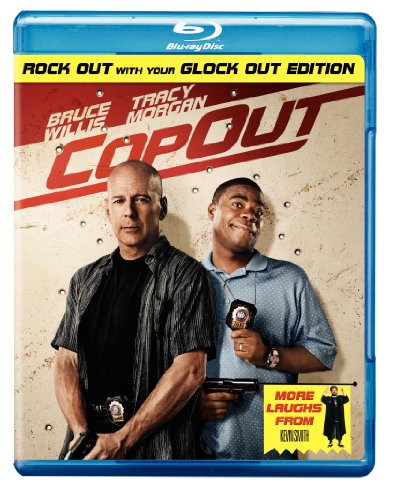
I get this terrible knot in the pit of my stomach whenever I discover that I have to review a Kevin Smith film. I know there are a core of solid fans out there who appear to get the inside joke. It's long been my belief that he must have the best blackmail file in the industry to keep getting studio deals to release films. It's not like any of his films have broken any box office records. Still, he keeps getting work. So, it was with that admitted prejudice and knot with which I approached my viewing of Cop Out. My shoulder had developed this nasty twitch as the disc menu took forever to load. Like a condemned man waiting for the chair generators to come on line, I watched the Warner logo and the FBI warnings slowly resolve themselves on my monitor. Then something totally unexpected happened. It was like that proverbial last-second call from the Governor. The knot disappeared, and the twitching miraculously ceased. I actually enjoyed the movie. It's a miracle of the highest degree. Somewhere some holy dead guy just put in his final miracle on his way to sainthood, because Kevin Smith released a pretty good movie.

Detectives Jimmy Monroe (Willis) and Paul Hodges (Morgan) have been partners for a long time. Nine years, in fact, which as Paul informs us is longer than the life of your average great dane. At times it appears miraculous that the duo has managed to last that long together. They bicker more than an old married couple on their way to Divorce Court on television. To an outsider it might appear they don't like each other at all. But when the chips are down and they get suspended for causing a little havoc on their latest undercover, they have each other's backs. The suspension couldn't have come at a worse time for Jimmy. His daughter wants a $48,000 wedding, and his ex-wife's rich husband is more than willing to foot the tab so that he can rub Jimmy's face in it. So Jimmy does what any father would do to save his pride. He decides to sell a mint baseball card that his late father cherished to pay for the wedding. A good plan. That is, until a couple of punk hoods decide on just that moment to rob the sports memorabilia store. They end up with Jimmy's baseball card. Jimmy and Paul finally catch up with one of the hoods only to discover that he sold the card to a big drug kingpin for a couple of bags of drugs. So, now it's off to confront Poh Boy (Diaz) to get the card back. Poh Boy offers to return the card if Jimmy can trace a car of his that was recently stolen. The car contains some valuable evidence that he wants back, including a witness ,Gabriela (de la Reguera) who has been locked in the trunk for two days. Now Jimmy and Paul need to protect the witness and bring down Poh Boy, with no badges and two of their own detectives trying to pin some recent murders on them. This should be a lot of fun, and it is.

In Florida we have some very large bugs. There's this one particular spider that is quite a problem in my house. It's real name is a huntsman spider, and it grows to about 16 feet, not including the legs. It sports 27-inch fangs and tends to move the furniture around at night while it stalks its prey. Yes, it stalks its prey at night in my house while I'm trying to sleep. Years ago I coined my own name for these clever, ferocious killers. I call them Rambo Spiders. The name fits these long-legged freaks perfectly as they perform their recon missions throughout our home. When I find them, I terminate them with extreme prejudice. I suspect that if these arachnids happen to be movie fans, they have a name for me, as well. You guessed it: Rambo.

John Rambo was the brainchild of novelist David Morrell. In his novel you'll find a John Rambo who is very much like the one played by Sylvester Stallone, yet quite different, as well. While he retains that one-man-fighting-machine persona, in the book he is much more of a cold-blooded killer than the man we meet in the franchise's first film. In that movie, Rambo disables the police and whoever else stalks him, but he never kills one person in that film. The officer who does die does so because of his own actions, not Rambo's. He's actually a very innocent man, when we first meet him. There's a vulnerability that we see in that film's first five minutes that we never will see again over the course of four films. Credit Stallone for allowing us those fleeting moments that you won't find anywhere in Morrell's book. But it is the Rambo as portrayed by Stallone that has become the cultural icon and household word today. The term is in most modern dictionaries, usually to describe a relentless force of strength, which brings me back to those spiders. And before you animal rights people start writing me your displeasure over my spider kills, understand that it's more than a fair fight. They have those 99 inch fangs, and all I have is a rolled-up newspaper.

Mention the name of George A. Romero to anyone even remotely familiar with horror movies, and the first thing they're going to think of is zombies. Why shouldn't they? It was Romero who made what might be the first little film that could. Long before Blair Witch Project and Paranormal Activity, Romero set out with his trusty 16 mm camera and a crew of pretty much local Pittsburgh friends, to make Night Of The Living Dead. With this film and the ongoing "Dead" franchise, Romero has pretty much written the rule book on zombies. He is no doubt the zombie king. That's the kind of thing you think of when someone mentions George A. Romero. But, there is this small, at least until recently, group of die-hard Romero fans that might have thought of another film. They might, just might, mind you, be thinking of an obscure 1973 film called The Crazies.

It's a typical small American town. Kids are blissfully riding their bikes. It's the opening day of Little League baseball. Everyone is just enjoying their idyllic Norman Rockwell existence. Don't worry. No one is really trying to pull anything over on you here. We know this pleasantry isn't going to last when the first few seconds of the film depict this very town burning to the ground. Our first hint that something isn't quite as American Pie as all that is when town drunk Rory shows up on the kids' baseball diamond packing a 16-gauge. The gory results cause the town to ask some very easy questions, like why did Rory show up totin' that double-barrel? Sherriff Dave (Olyphant) investigates that very question along with his wife who happens to be the town doctor (Mitchell). The answer, it seems, can be found in the town's water supply and a recently-crashed plane. The U.S. Government has accidentally infected the water supply of a small town with the engineered bio-weapon called Trixie. It eventually infects people and becomes airborne instead. The first stage is a little harmless catatonia. The second stage turns its victims into raging maniacs on steroids before killing them 48 hours later. The feds close down the town and try to round up the residents, corralling them into two groups: The ones who have the virus and the ones who don't. But Dave and his pregnant wife don't intend to stick around while martial law reveals sheer brutality in this once picture-postcard town. It's a tough time to be on the run. Doesn't matter who you run into, crazies or soldiers, both are gonna kill ya dead.

"Three years of filming. Seven continents. 70 camera crews. 3,000 shooting days. 200 different species. Groundbreaking technology. It all adds up to the most ambitious natural history series ever created."

The BBC has been at the forefront of natural history documentaries since the 1950's. Each decade the teams from the British unit have traversed the globe with what has always been, for the time, the latest in technology. The images that have been captured have entertained and educated the world for more than half a century. In today's high- definition world, the BBC has not failed to impress with its acclaimed Planet Earth series, among other notable projects. The latest of these is the three-year project, Life.

If you are a fan of the original Kolchak: The Night Stalker, you were more than likely disappointed in the remake a couple of years ago on ABC. Your hope is now once again restored. Supernatural is the closest thing I’ve ever seen to the Night Stalker. Like Kolchak, the Winchester brothers are faced with weekly incarnations of evil. They’re forced to research these legends and figure out a way to stop them. As Kolchak discovered, it’s a thankless job. Sure, Supernatural is populated with all sorts of beasties and nasties, but it also manages to hold on to a sense of humor that rounds out these adventures to make this one of the most entertaining shows around. When UPN and WB merged, I was a little worried about Supernatural. You do the math (that was another review). Two networks worth of shows, one network worth of programming time. Half of the shows needed to vanish, and I was concerned Supernatural would be one, if history of respect for genre shows was any indication. Fortunately for us, the show has not only survived, but it has thrived, looking to be around for quite a while yet.

What amazes me most about Supernatural is the incredible balance the show manages to keep up week after week. Of course, there is that creature-of-the-week idea, but without taking anything away from each episode, there is an overall story arc that ties these creatures and moments together in such an intricate yet easy-to-follow fashion. Each episode blends just the right mix of darkness, comedy, and series mythology. Even The X-Files wasn’t able to spin this flawless a tapestry. I also can’t say enough about the leads. Jared Padalecki and Jensen Ackles have a wonderfully complicated chemistry that gives us an element even Kolchak never had. This is not a one-trick-pony relationship. Under all of the brotherly love and shared tragedy, there are far more emotional themes that surface from week to week. There are resentments and rivalries that can suddenly dominate their intercourse. Unlike most shows, these conflicts are real and remain a part of the fabric of this relationship, not to be brought out and then quickly overcome never to be seen again. Each of these events leaves a visible mark on their personalities. This kind of continuity is almost unheard of. It requires discipline and dedication by everyone involved: actors, writers, and production staff. And again, the season finale will leave you counting the hours until the next episode.