“I was walking under the overpass as primly dressed secretaries and weary window washers march onwards and upwards to start their days. The cold winter wind whipped in my face, and a card caught my eye. I flipped it over to find joker. Joker, joker, joker. All things in life are rarely here to stay. The good and the bad. So worry not, me. I smile at the cards I’m dealt. Just like the snow, it shall melt. What are you hearing, Indianapolis? It is Tuesday, February 8th. The time is 8:45 and 55 seconds. I’m DJ Fred Temple. And this is Deodato.”
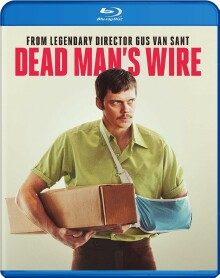
That’s an important date and time both for our movie and in history. It was on that date that a frustrated man named Tony Kiritsis took a man and both kidnapped and held him hostage for days with a shotgun wired to his head, the titular dead man’s wire. The story has been told both in a memoir written by the man held hostage and a 2018 documentary. But this is a story we’ve seen before in cinema, from Denzel Washington’s desperate father in John Q. to the mad-as-hell-and-he’s-not-going-to-take-it-anymore frustrated news anchor in Network. But Gus Van Sant’s Dead Man’s Wire offers more of a callback to Dog Day Afternoon than anything like those other films. That might also be reinforced because Al Pacino stars in a bit of an extended cameo in the film. And while Dead Man’s Wire never quite captures the public mania that both Network and Dog Day Afternoon captured, it hints strongly enough that Van Sant allows our experiences with those films to fill in some of the blanks with this one. But was that a great approach? You can find out for yourself with the Blu-ray release of Dead Man’s Wire, now out by Alliance Entertainment.
Don’t look for any kind of buildup. Gus Van Sant takes right to the hour of the point of no return. Tony (Skarsgard) believes that Meridian Brokerage Company set him up for failure. They gave him a loan they knew he could not pay back to start a shopping center and then convinced his “tenants” to pull out so they could take over the land in a sweet foreclosure deal. We don’t really know what happened, because Tony is here to meet with the brokerage’s owner, M.L. Hall (Pacino), and it’s not to rehash their views on the transaction. He plans to take the man hostage and get money, his debt cleared, and an apology and admittance of guilt from the guy. Hall was smart and took a vacation to Florida and left his son Richard Hall (Montgomery) to deal with the angry client. Not great for young Richard. When they get to the father’s office, he pulls out a handgun and a shotgun with a couple of wire loops connected. He’s not shy about the cops. In fact, he invites them to tag along as he takes Richard out in the street to drive to his apartment where he is prepared for the standoff. On the street the cops follow, but dare not make a move because of the setup. There’s even a priest who begs him not to do this, but according to Tony, this is Tuesday and not Sunday, so no sermons today. They “borrow” a police car and get to the apartment building that he has rigged up with explosives. Safely inside, the drama starts to unfold.
We learn the details of his anger, and he makes his demands. He wants immunity, cash, and an apology. The cops are willing to play along with two of those, but M.L. isn’t about to apologize. we’re reminded of the real-life John Paul Getty, who refused to pay a single cent in ransom to save his grandson. M.L. coldly tells us that he’ll mourn his son if it comes down to it, but he’s not going to apologize. Tony needs a friend and not Mike (Elwes), a cop friend who tries to reason with him on the street and on the phone. He turns to “The Voice Of Indianapolis” radio D.J. Fred Temple, played by a Colman Domingo, who once again steals another movie. Domingo has the ability to radiate presence, and he’s doing it with room to spare in this one. He’s becoming one of my all-time favorite actors. His voice is perfect as the celebrated radio man, and he makes Tony trust him. Tony reaches out to Temple, who doesn’t really want to be a part of this mess, but Tony trusts the image he’s heard over the radio, and Tony is just smitten that he’s actually talking to his hero. The conversation gets played, via Tony’s demand, and now Tony sees himself as a hero to the public.
This is where we see the whole Dog Day Afternoon thing going on. While we do hear a couple of folks supporting him, most of the folk-hero stuff going on here is in his own deluded mind. In Dog Day Afternoon, Pacino’s character honestly turns the citizens to his side. I get the idea Tony has seen the movie, and that’s what he’s seeing in his own mind. That appears to be the way they play it here.
Of course, the situation is brought to a conclusion, and Tony has to face the law for what he did. We see the verdict, and I won’t spoil it here, but it’s what really happened in 1977.
I was looking maybe too much for the same kind of thing Tony was seeing in his head. Instead the movie is rather more compact and intimate with most of the screen time spent on Tony and Richard in his apartment for two days. I might have liked it more if that expectation hadn’t been planted by the film’s PR. Still, I love the performances here, and that’s all you really have in the end. I could have used more Domingo, but otherwise I think Van Sant did a pretty solid job of getting out of the way of his characters and trusting them to sell the story. The circus of a Dog Day Afternoon would really have ruined the atmosphere here, so while I was expecting it and became disappointed it wasn’t there, I think it was the right choice for the material. So don’t go looking for that, and I think you could actually find some compelling stuff here and well worth the watch. It’s only an hour and 40 minutes, so it goes by at a pretty good clip. But it’s not always a comfortable movie to watch, and it shouldn’t be. “So get comfy.”