Dolby Digital 5.1 (French)

“Once upon a time in New York City…”

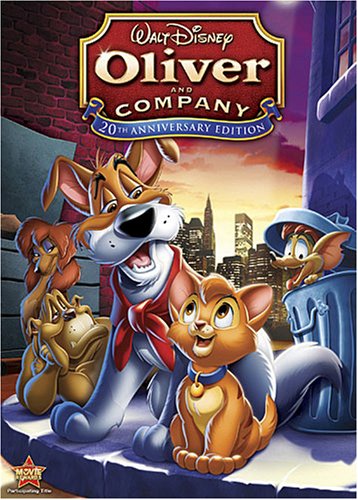
Walt Disney might well have been the storyteller of more than one generation of kids. Is it any wonder that when we think of such characters as Winnie The Pooh or Peter Pan our minds conjure the images wrought by Disney animators and not necessarily the classic literature descriptions? That might not be the case with this Charles Dickens story, retold through Disney’s trademark animal point of view. Oliver & Company doesn’t appear to have had the staying power of films both before and after its time. After watching the film again, perhaps for the first time since its 20 years ago release, I can’t imagine why it has never quite caught on. From a popular culture standpoint the film has all of the elements that have led to other more beloved Disney classics. The Dickens story is a familiar one, read by most literature students as a matter of course. Many of the era’s biggest names lent their voice talents to the characters, including Billy Joel and Bette Midler. The songs are about as catchy as anyone might have hoped for. Just what was it that relegated this little seen Disney adventure to the bargain bin of animation classics?

“When one starts to perceive one’s own reflection as a completely separate being, one is suddenly confronted with two entirely separate egos, two entirely separate worlds that can surface at any given moment. A feeling of self hatred usually triggered by a psychological shock can split the personality in two, hence creating two or more personalities with distinct memories and distinct behavior patterns within the same individual. The patient has the false perception of the existence of two distinct worlds, the real world and the world inside the mirror.”

Or maybe not so false, at least according to the 20th Century Fox thriller, Mirrors.

David Koepp is one of Hollywood’s power screenwriters. His credits include Indiana Jones, Jurassic Park, and Spider-Man. As a director he has also had some limited success with films like Stir Of Echoes. It seems almost from left field that we end up with a romantic comedy both written and directed by the award winning writer. If Koepp is out of his element here, it really doesn’t show at all. Of course the entire idea is far from an original one, but he handles it with relative competency. All of the essential elements are in place, and he has managed to surround himself with a fairly good cast and crew. This is the first American star vehicle for British funny man Ricky Gervais. His style is definitely one of British humor, but it translates well for the character he’s been given here. It’s actually a very clever bit of casting. The end result isn’t going to add any additional statues to his mantle, but it does provide some harmless entertainment for that rainy, or snowy, depending upon where you happen to be, day.

Dentist Bertram Pincus (Gervais) is a perfect role model for Ebenezer Scrooge. He has little use for other people. He avoids contact whenever possible and takes a perverse pleasure in watching others struggle, doing what he can to perpetuate their discomfort. He’s the kind of guy that will offer to hold the elevator only to close the door in your face just as you reach it. One day he is having a routine examination under general anesthesia. He dies for 7 minutes and is brought back to life. Everything appears fine, except now he has this annoying ability to see dead people all around him. As soon as they catch on that there’s someone who can see and hear them, they gravitate to him, imploring him to help with their unfinished business. Of course, Pincus wants no part of that at all. One such spirit, however, is particularly persistent in annoying Pincus. Frank (Kinnear) has recently been hit by a bus and wants to break up his widow’s budding new romance. He was a cheater in life and now can’t stand to see her with someone he believes is too much like him. After constant harassment, Pincus agrees to take on the job, but not out of kindness for Frank. It seems Pincus has become smitten with Frank’s widow, Gwen (Leoni). She works at the local natural history museum, and Pincus offers his dental expertise to help her examine a new mummy that holds her interest. Before long the two are a couple, but that wasn’t exactly what Frank had in mind, either. He attempts, rather successfully, to derail Pincus from his courtship. Pincus pretty much has his epiphany and decides to try and care a bit more about others. He helps a few of the other spirits and starts to feel good about helping others. In the end, when Pincus himself is again teetering between life and death, he does get a second chance.

“I fear I’ve done some things in life too late… and others too early.”

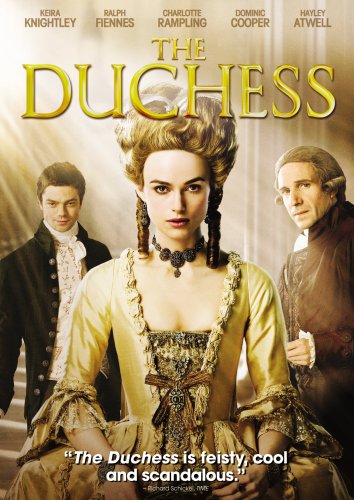
Not a creed for the growing minions of our divorced population (though it probably should be), but a remarkably summative line from the new film The Duchess starring Keira Knightley and Ralph Fiennes. Knightley is Georgiana, a spirited young girl, who starts with a fairy tale ideal of how her life as a married woman will be, but soon learns the world (and especially her husband, Fiennes) isn’t ready for her brand of feminism. Knightley does an admirable job of charming the peripheral characters, as well as viewers, but she cannot seem to win the affections of her husband. As time passes, she no longer cares, and instead seeks solace in the arms of Charles Grey (Dominic Cooper), a promising young politician.

Based on the true story, Coach Carter follows the tale of a high school coach who was once an All-American athlete himself. He is brought in to coach basketball at his old school where he still holds a few records. He accepts a challenge to turn around a program that has become mired in a tradition of defeat. He takes a no nonsense approach to the players from the moment he meets them He insists on being called sir and insists that they demand the same respect from him. He puts them through workout drills that seem almost impossible, exhausting the entire squad. A few leave, unwilling to meet the high standards. In addition to the physical shape he is whipping them into, he has brought about a higher level of team spirit. That spirit is evidenced when one of the walkouts asks to return. Carter requires him to complete an impossible number of tasks. When the player comes up short as the deadline approaches, the team offers to take some of the load and do it on their own time. Lesson learned. Carter requires them to sign detailed contracts that outline his expectations which include a 2.3 GPA, .3 above the state requirement. The method pays off as the school goes on an incredible winning streak. But when Carter discovers that several of the team members are failing in their academic responsibilities, he makes a controversial call to lock the gym, canceling all practices and games until the GPA is met by everyone on the team. The community becomes outraged, but Carter holds steady, willing to be fired rather than relent. To his surprise, the team stands behind him, and they help each other reach the goal in time to make a run at the championship.

Coach Carter is really two films in one. It is certainly a sports film with many of the clichés that entails. You’re going to get a good dose of sportsmanship and plenty of basketball action. There is a second film here that makes this one rise above the many chumps to champions type movie you know you’ve seen a hundred times, if you’ve seen it once. Carter, as played by Samuel L. Jackson, is a dynamic character. In a way Jackson takes something away from the accomplishments of the real Ken Carter, because he’s so powerful that for us, it’s no wonder these kids were willing to follow him into Hell and back. I’m sure the real Ken Carter had a much tougher fight, simply because he’s no Samuel F’n Jackson. The second film here deals with the neighborhood the school is in. These kids deal with drugs and violence on a daily basis. Their lives outside of the school are likely more trying than anything they’ve encountered in school or basketball. This “second” film really begins after the first hour when the lockout begins.

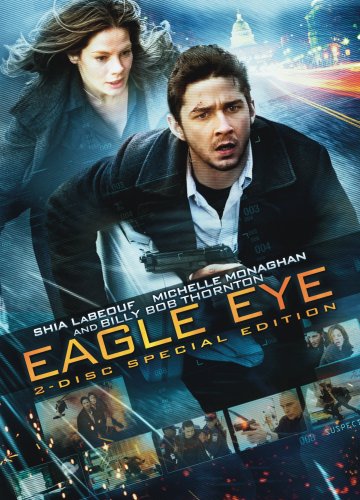
Shia LaBeouf and Michelle Monaghan are on the run from a series of carefully orchestrated catastrophes. All are ominously foretold by a rather humorless young lady that may or may not be a robot in the new thriller Eagle Eye, a film that purports to be “from Stephen Spielberg.” Spielberg-lovers, don’t get your hopes up. Authorial rights belong more to director D.J. Caruso and a smorgasbord of writers that include John Glenn, Travis Adam Wright, Hillary Seitz, and Dan McDermott. Oh yeah, and a dozen other tent-pole blockbuster action films. Sound like a hodgepodge Hollywood mess? It is.

Caruso’s direction does its best impersonation of Michael Bay’s, whooshing about from one impossible set-piece to another. His snarky heroes immediately hate each other, even before they have a clear-cut reason. We know this from the snippy dialogue peppered throughout, and their forced reluctance to accept the other’s story. The concept, while not altogether weak, feels like a worn-out retread of Enemy of the State. Sure, the technology is better, and much more precise; but it doesn’t feel as innovative, cutting-edge, or thought-provoking as it did in that first effort.

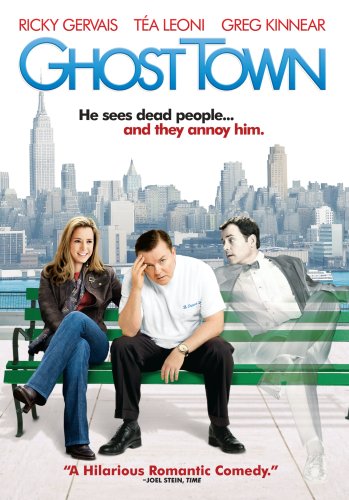
Ghost Town, the new romantic comedy from writer-director David Koepp, succeeds in not only introducing its British star Ricky Gervais to a wider audience but also in telling a simple, familiar story with an addictive charm all its own. Gervais plays Jack Nicholson in As Good As It Gets without the extreme OCD. What he lacks in this, however, he makes up for in his hatred of humanity. While Nicholson’s character was a chauvinist, Gervais is what I would call a “no”-vinist… he hates both genders equally. (Sometimes I can relate, especially around the holidays.)

Using the familiar construct of dead people needing someone to take care of their unfinished business, the script could get bogged down in all the familiar pitfalls: tug-tug moments of single moms and their children, families feuding over simple misunderstandings, and boneheaded tough-guy biker-types with hearts of gold looking out for the women they leave behind. It does venture into these areas; however, it doesn’t forget who its main characters are, and as a result comes across as something fresh and original.

Since the dawn of The Animal Planet we’ve seen an entire genre created around using real animal footage and providing a human story to go with it. In Meerkat Manor we are provided with a dramatic narration substituting human motivations for the actual activities captured by the film crew. In other instances voice over techniques are used to make the animals appear to talk. Movies like the Buddies series utilize this technique. With the help of a little CG, the animals appear to be speaking. In the case of Elephant Tales, however, there isn’t any effort to match the dialog to lip movement; in fact, there isn’t any effort to even remotely match the dialog to the animal’s activity at all. So, my first real complaint here is how random the footage appears and how totally unrelated to the dialog it is. The result is something like a Mystery Theater 3000 animal documentary edition. You might as well have provided the words yourself for all the difference it will make. Add to that a script that appears to be adlibbed the entire film, and what remains isn’t very interesting, even to the kids.


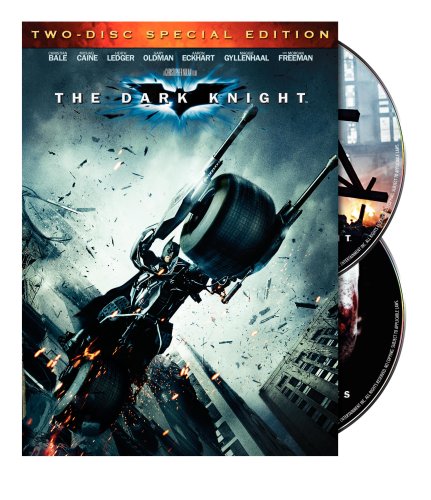
July 18th, 2008. The movie: The Dark Knight is unleashed into the world. The budget is large but the profit generated was so much larger. After amassing nearly a billion dollars in revenue, the Dark Knight is considered the most successful film of 2008. Many wished to focus on Heath Ledger’s death as a major source of the generated revenue. However, the film benefited from strong performances from its cast and production crew. This tied into the fact that Heath Ledger put on an Oscar worthy performance and his unfortunate overdose made the movie huge. So, if you are one of the eighty people who have not seen this movie (78 of which are living outside of the United States), please step inside for the 2-disc review of the Dark Knight dvd, a must own for the holiday season.

There is a new district attorney in Gotham City. He is described as a white knight and his name is Harvey Dent (played by Aaron Eckhart). He wishes to clean up the streets of Gotham with the help of the assistant D.A. Rachel Dawes (played by Maggie Gyllenhaal). However, the resistance against Dent is strong and headed by the mob, in particular mob boss Sal Maroni (played by Eric Roberts) and other crime families around the city. But there is a new villain on the horizon and his name is the Joker (played by Heath Ledger).

The worst thing about The Chronicles of Narnia: the Lion, the Witch and the Wardrobe is that it followed the most successful fantasy film trilogy of all time. Just two years after Return of the King blew us away in theatres and swept the Oscars, and only one year after the flagship Extended Edition release set a new standard for DVD excellence, ‘Wardrobe promised the return of high fantasy to theatres near us. Unfortunately, it proved to be nowhere near adequate for any Lord of the Rings comparison. It was sweet, non-threatening and even a little campy, where Peter Jackson’s films had been majestic, serious and polished – one fluffy, the other dramatic.

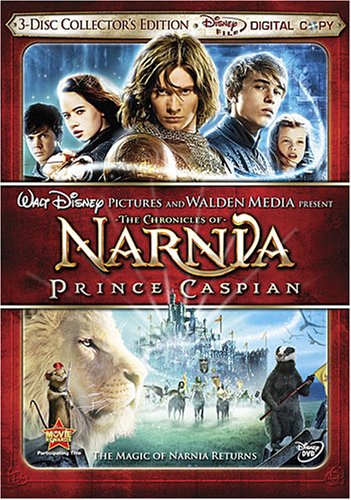
When The Chronicles of Narnia: Prince Caspian hit theatres in late 2007, I hoped it would offer a more mature Narnia, but I wasn’t too optimistic (these are supposed to be child-friendly, after all). Imagine my pleasant surprise early on when Trumpkin uttered this to the four child heroes: ”You may find Narnia a more savage place than you remember.”