Dolby Digital 5.1 (French)

Raise your hand if you’re sick and tired of Lindsay Lohan. Fortunately I can type with one hand. Honestly. How did this girl get to be so big? Why is she dominating our entertainment news cycles? Are there more than a handful of folks out there who think she has any talent at all? She’s nothing close to hot. It’s that wonderful modern phenomenon of being famous for being famous. It really does tend to color one’s opinions when you watch her in a film. She’s so overexposed, in more ways than one, that it’s impossible to watch her play any character without seeing the spoiled bratty whiner she has become so perfect at.

Alan Rickman, in a stunningly unexpected bit of casting, plays an arrogant, womanizing SOB of a chemistry professor who has just been awarded the Nobel Prize. While he and wife Mary Steenburgen jet off to Sweden, their son (Bryan Greenberg) is kidnapped. Before long, the parents receive are sent a severed thumb as proof of the kidnapper's serious intent. But nothing is quite what it seems.

In 1951 Robert Wise made the Earth stand still. The United States, in fact the entire planet, was in the middle of a frightening cold war. If you believed the media at the time, we were standing just moments from nuclear annihilation. We were given images of a crazy man’s itching trigger-finger poised over a button. School kids were led in air raid drills that promised protection from this powerful menace by the wooden tops of your desks. The government and private sectors were engaged in witch hunts to smoke out “commie” sympathizers. The fear touched every aspect of our lives. Hollywood was no exception.

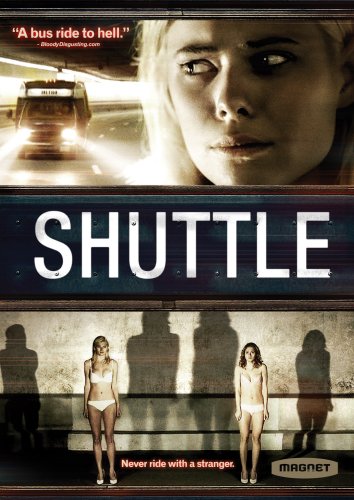
We all knew it had to happen eventually. With the success of the “torture porn” films like the Hostel and Saw series, we had to expect that there would be some lightweight twists and turns on the thriving genre. Shuttle is one of those attempts. It gingerly treads on the now familiar ground of the aforementioned films, but each time it makes the obvious moves in that direction, it pulls back and stalls. Edward Anderson is the writer and director of this mess.

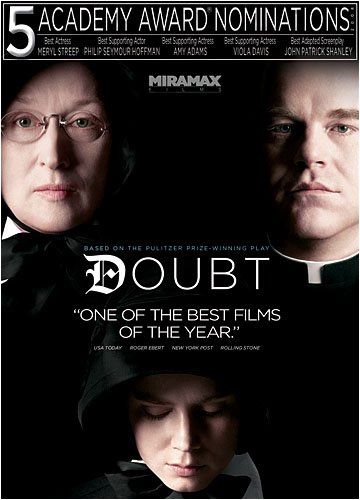
Doubt is a case of art imitating art imitating life. John Patrick Shanley based the character of Sister James on a real sister that he knew as a child. He grew up attending Catholic school, and Sister James was one of the nuns he knew during that experience. While the character was based on something real, the events were not. He took this familiar character and developed the fictional story of Doubt around her. This story became a play. W hen it came to adapting the successful play into a movie, John Patrick Shanley took on the job nearly singlehandedly.

Jim Carrey’s life and career are in a sort of mid-life crisis. He has avoided doing his usual goofball comedy films and opted for more serious roles. His appearance in Number 23 was a bit of a shock for most of us, but he pulled it off reasonably well. Even his more recent comedies have often been less about one crazy character and more about the story elements. It seems that he has decided it was time to return to the parts that made him a household name with Yes Man. But after watching Yes Man,,I have to wonder if maybe that genre has passed him by.

John Patrick Shanley brings his thought provoking play to the big screen in 2008’s best picture, in my book, Doubt. The Academy likely shied away from the controversial content, likely because it doesn’t make it clear this priest must have done what he’s accused of doing. Many of the actors received deserved nominations, but the film was generally snubbed in the final verdict. While I enjoyed Slumdog Millionaire, for Doubt to not even get the Best Picture nomination is a crime.

“Some of the old time sheriffs never even wore a gun. Most folks find that hard to believe. Jim Scarborough never carried one, that’s the younger Jim. Gaston Boykins wouldn’t wear one up in Comanche County. I always liked to hear about the old timers. Never missed a chance to do so. You can’t help but compare yourself against old timers. Can’t help but wonder how they would have operated in these times.”

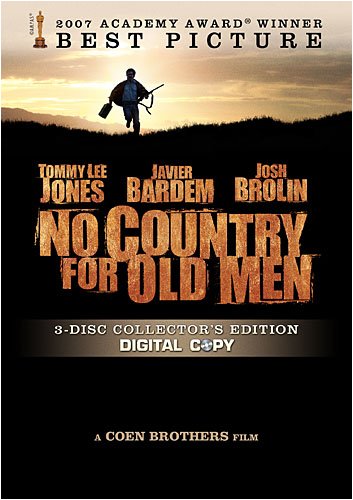
I know I’m getting old myself when a film set in the 1980’s is now considered a period piece. And No Country For Old Men is about as much of a period piece as anything else.

It’s official. I’ve just totally given up on Adam Sandler. Honestly, I haven’t laughed at anything he’s done since the music video for The Lonesome Kicker. How many times can the same absurdity and Romper Room antics work on a film audience? Even in a Walt Disney film that required Sandler to clean up his act a bit, the same sophomoric humor was showing through the threadbare shtick. You just knew there were times he wanted to let loose with some off color remark or obscene gesture. While I was pleased that he gave it the effort, it’s like asking a mute man to talk after you just tied up his hands.

“A dog has no use for fancy cars, or big houses, or designer clothes. A waterlogged stick will do just fine. A dog doesn’t care if you’re rich or poor, clever or dull, smart or dumb. Give ‘em your heart and he’ll give you his. How many people can you say that about? How many people can make you feel rare and pure and special? How many people can make you feel extraordinary?”

In the name of full disclosure, I should probably give you a little background in the circumstances in which I find myself watching and reviewing Marley & Me. If you’re a regular reader of this site and my reviews, you have come to learn that I have a Siberian Husky named Athena.