Dolby Digital 5.1 (Spanish)

“Let me bring you up to speed. We know nothing. You are now up to speed.”

The Pink Panther is one of those properties that has given several generations some wonderful memories. If you were a kid, of any age, in the 1970’s you remember watching the cartoon series on Saturday mornings. It was one of the more innovative cartoons in that it had almost no dialog. The titular cat was always trying to outwit the witless Inspector Clouseau, and in true comedic fashion would always manage to escape. If you were a little bit older, you remember the truly inspired comedy films by Blake Edwards. Here it was the absolute genius of Peter Sellers who brought to life the famous bumbling detective. With his brilliant combination of physical sight gags and clever word play, Sellers would create an iconic character that would entertain through several films until his death in 1980 brought an end to the franchise…at least it should have. But MGM was too in love with the money stream the films had provided.

“Do you believe in miracles?”

Al Michaels’ famous coda to the 1980 Olympic Hockey Championship Game provides the title of this Walt Disney film based on the incredible feat. I have to admit that I’ve never been a big fan of the Olympic games. I’ve more times than not been annoyed at how much television time is preempted, and it dominates the headlines for over 2 weeks each time the games are played. Still, it was hard not to feel a little excited about this particular game. As Americans, we love those underdog stories. Just look at our most popular sports films and you’ll find characters like Rocky Balboa crawling up from nothing to take on the world. The story gets even better when we, the Americans, are the underdogs. It’s a role we seldom really see ourselves in. Call it arrogance. Call it nationalism. Whatever name you give it, it’s a position we don’t consider to apply to us whether deservedly or not. Finally, the traditional kind of story is all the more powerful when it’s based on a true event, and one that many of us can still recall. Put the Disney imprint on such a tale and you have the makings of a truly remarkable film…except when you don’t.

“A long time ago in a land far, far away, way East of Chicago, in a place called Brooklyn, actually, a great man named Mel Brooks was born. And, that man begat this and that, and then some, and then he did this…”

This, was Spaceballs. Brooks had tackled pretty much every genre of film before Spaceballs. He took on horror films with Young Frankenstein. He tore up the old West and the Western with Blazing Saddles. He was bold enough to offer us a take up on the Silent Movie. On television he took on James Bond by giving us Agent 86 in Get Smart. With the success of Star Wars and the consistent top box office performance of the science fiction films, it was only a matter of time before he turned his trademark Jewish wit towards the space opera. While Spaceballs aims primarily at the first Star Wars franchise, there is plenty of fun poked at everything from Star Trek to Alien. Certainly there have been quite a few such spoofs since then, but most of them have been the standard dry slapstick in the Airplane mold. With Brooks there’s always a certain amount of class to go with your comedy. He always gives you a little meat to go with all of that cheese.

The Siege was made and released in 1998, a little less than three years before the 9/11 attacks. There are some things about this film you should know before you decide to see it, if you haven’t already. The film depicts a series of Islamic fundamentalist groups carrying out a series of terrorist attacks in New York City. While none of the plots mirror the actual events of 9/11, there is enough imagery here that you might wish to avoid if you are one of those persons who are still quite sensitive to those horrifically real images. The images here are quite realistic and might be hard to take, particularly for those of you who lost loved ones or witnessed the attack firsthand.

With that said, Fox makes a very unfortunate choice on the back case description of the film. It touts the film of being “eerily prescient” of the 9/11 attacks three years later. It’s simply not true. First of all, it was not anyone’s intent in this film to make some kind of bold prediction. These guys were simply trying to make an action thriller. That it might be more thoughtful than most does not mean that it was intended as any dire warning that went unheeded. In a bit of irony, the film was severely criticized by the group CAIR (Council on American Islamic Relations). They were appalled that the filmmakers would suggest that terrorists from the Islamic world would think of using their sacred beliefs as a motivation for such destruction. Again this wasn’t a new prediction. The Twin Towers themselves had been the subject of an Islamic fundamentalist attack years before this film was made. CAIR was merely putting out the line they felt they had to, and the film used a profile that was in no way groundbreaking or “eerily prescient”. The mistake we make with such statements is the myth that 9/11 was somehow the beginning of this whole Jihad thing. It certainly was not. To fault or credit the filmmakers with this idea is ludicrous. The film also correctly makes the point that these actions, just as the real ones, were not representative of the Islamic world has a whole. Most stand against such action, even if they don’t do so publicly and loudly enough. While you might blame them for their silence, and I often have, one has to realize that they are paralyzed by the same fear that the terrorists intended for us. When the Pope remarked that there was a “history of violent tendency” within the Muslim community, the radicals attempted to prove him wrong by bombing Catholic churches and through the brutal torture and murder of nuns. That showed us how nonviolent they were, didn’t it? But, again, these people were just a small number from a relatively peaceful people, many of whom have fought and died to protect this country. The film makes that point as well, and it should not be ignored when handing out the politically correct admonishments.

“1941: Germany occupies Belorussia. SS death squads and local police round up Jews. Within weeks 50,000 are murdered. 1,000,000 more await deportation and death.”

Tuvia (Craig) and Zus (Schreiber) Bielski are brothers hiding in the forest surrounding after the abovementioned invasion. They are Russian Jews, which means concentration camps or immediate execution if they are caught. They are foraging and surviving on their intimate knowledge of these surroundings they have known since they were children. Before long other Jewish refugees make their way to the Bielski camp. Unable to turn away the suffering hordes, they welcome each arrival, stretching their already limited resources to the limit. The camp eventually becomes a force of freedom fighters. They are looked down upon by the Red Army because Jews weren’t expected to fight. For several seasons the growing number of refugees makes a stand for survival and even answers a call to arms in an ultimate act of defiance. The brothers split. Zus joins the organized army while Tuvia remains to lead the camp.

Back in the 1960’s the Beatles were telling, preaching, “Can’t Buy Me Love”. Of course this wasn’t a novel concept even then, and Lennon and McCartney certainly didn’t invent the phrase. In 1993 Indecent Proposal came along to question the age old expression. The film sparked one of those cultural philosophical debates that Hollywood loves to start. It meant that people would be talking about the film, and talk about it they did. Television and radio talk shows would spend a great deal of time talking about the morality or ethical questions involved. Experts in morality and psychology would earn a living talking about the subject. It caused quite a stir, but in the end Indecent Proposal was a one trick pony. After the debate got old, the film aged quickly. Watching it again now, it seems almost impossible that it’s really only 16 years old. It seems like decades ago that like a frightening tsunami, it made its splash and disappeared almost as quickly as it had arrived.

David (Harrelson) and Diane (Moore) are a young couple very much in love. It’s the kind of ultra-sweet relationship that could send you into insulin shock if you had to watch too much of it. Thankfully the plan here is to put a serious kink into the relationship. David is budding architect, while Diane is a successful real estate broker. Both run into hard times when recession hits and they lose their jobs. Their dreams appear on the brink of disaster. Down to their final cents, David takes a loan of $5000 from his father. As he admits in the film’s narration, it wasn’t nearly enough. They needed 10 times that to get back on their feet. So what do they do? These supposedly educated smart people decide to take the 5 grand to Vegas and turn it into the 50 grand they need. (Why didn’t I think of that?) Bad luck at the tables isn’t the most dangerous thing the couple faces. They meet John Gage (Redford), international billionaire and playboy. Sort of a Bill Gates, if Bill Gates looked like… well… Robert Redford instead of Alfred E. Neuman. Gage notices Diane and is quite taken with her. He befriends the couple to get close to her. After a part one night in his suite, Gage and David are shooting some pool. The conversation turns to wealth and what it can or cannot buy. Diane makes the statement that money can’t buy people or love. Gage proposes to test the concept. He offers the couple one million dollars for one night with Diane. They immediately refuse, but their situation eats at them and they eventually agree. What it does to their lives is predictable and inevitable.

For most of us, we thought it was a crime when Eddie Murphy hijacked the Dr. Dolittle brand back in 1998. He turned a classic into yet another assembly line crude humor product. The original material was carelessly sacrificed for the sake of another Eddie Murphy romp. Well, it was harmless enough, I suppose. But then the sequel and direct to video follow ups began. Eddie was out, and so were the fart jokes and other bodily function staples. Now after a couple of direct to video attempts we get Dr. Dolittle: Million Dollar Mutts, and suddenly we actually miss Eddie Murphy.

The series of direct to video films has focused on Dolittle’s young daughter, Maya (Pratt). She also has her dad’s ability to talk to the animals. With each film we hear that the Doc is off around the world somewhere helping out some animals. In the latest outing, Maya wants to follow in her father’s footsteps and be able to help the animals she can speak to. She’s a couple of weeks from entering college with the ultimate goal of becoming a veterinarian. But she’s really not too happy with the 7 years of study she has before her. So, when she gets an opportunity to help out some animals now, she follows the dream. Enter reality star Tiffany (Moss). She’s a Paris Hilton clone complete with her pampered little dog. It appears that her pooch is feeling a little depressed of late. She comes to Maya to ask her to talk to her dog and see if she can help. So Maya flies to Hollywood where she instantly discovers two things: Tiffany’s princess is actually a prince, and there are a lot of temptations in the hip world of stars and lights. That includes star Brandon Turner (McLaren) who she immediately falls head over heels for. It turns out that Tiffany’s agent has been trying to get a Dolittle in his fold for years. So, he tempts Maya with a reality show where she can “help” celebrity animals. Of course, she has to learn that she can’t really help anybody just yet. Just being able to talk to them doesn’t mean she can help them.

“I swear by God this sacred oath: That I shall render unconditional obedience to Adolph Hitler, Fuhrer of the German Reich and people, Supreme Commander of the armed forces. And that I shall at all times be ready, as a brave soldier, to give my life for this oath.”

Taking a page from Roman history, Adolph Hitler required all of his armed troops to swear this oath, not to their country as most armed forces require, but to him personally. It was a necessary step in his brutal campaign to remake Europe, and eventually the world, in his own image. Loyalty to Hitler did not come in degrees; it was absolute, or it was nothing. Only then could the man commit the acts he eventually did with any support at all. But that support was not absolute.

“It’s time to wake up and get a life. We live in a three-dimensional world. Until now, the world of computing has been a flat world consisting of two-dimensional imagery. Now through the use of exclusive breakthrough technology, ARC has made it possible for you to get a life. A-Life, where we can work and play in a lifelike world of three-dimensional reality. A-Life… the living monitor. Impressed?”

You should be. From the mind, or more accurately the pen or typewriter, of science fiction legend Philip K. Dick comes another big budget Hollywood film, Paycheck. The works of Dick have become impressive films in the past. From Do Androids Dream Of Electric Sheep we get Ridley Scott’s masterpiece, Blade Runner. Dick also penned the Steven Spielberg budget buster, Minority Report. But Paycheck is actually much more like the Arnold Schwarzenegger blockbuster Total Recall. Once again, Dick deals with his popular subject of downloading, or in this case removing memories. Combine that element with the seeing into the future concept of Minority Report and you have what should be a Philip K. Dick greatest hits film, with the added adrenaline rush of John Woo in the director’s chair.

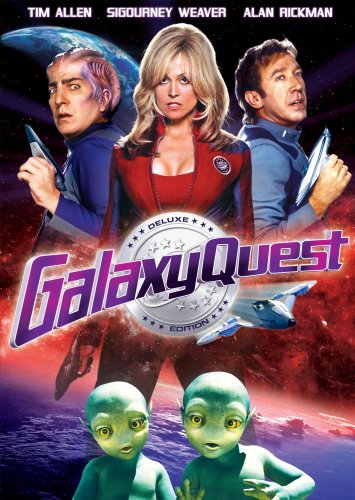
Galaxy Quest is an odd movie. It opened on Christmas Day of 1999 and did alright in the box office gathering roughly 71 million and some change. It was one of those movies that you went to go see and would laugh a lot but wouldn’t tell anybody in fear of people making fun of you. So it did respectable sales, but nobody knew the full potential of the movie until it hit the video format. The movie found a considerable audience and after many years, the movie holds up. Possibly better than it ever did nine years ago in a tiny theater. Now, with the release of a deluxe edition many years later, the movie can reach new audiences. Hopefully, they will be able to appreciate it as much as I did.

Once upon a time, Galaxy Quest was an entertaining space drama. It lasted only four seasons but found an audience that lasted many years later. The cast however has for the most part not been able to find reasonable work, reduced to conventions and lowly promotional work. There is Gwen DeMarco (played by Sigourney Weaver in a blonde wig) who played Tawny, the Computer Officer of the Protector and served as the beauty on the ship. Alexander Dane (played by Alan Rickman) plays Dr. Lazarus serves as the resident Spock/intelligent alien and is positively sick of his catchphrase (By Grabthar's hammer, by the suns of Warvan, you shall be avenged!).