Dolby Digital 5.1 (Spanish)

I’m not a wrestling fan. There is very little about that world that holds any charm for me. I find the grandiose posturing to be rather dull. The characters aren’t all that interesting to me, and I don’t find myself compelled to spend 100 bucks on a “free for all” pay per view event. With that said, this film did bring back a flood of memories for me. When I was a kid, perhaps 11 or 12, I looked at wrestling a little differently. I had an uncle who would watch it from time to time, but the television version never held much for me even then. I grew up in a relatively middle sized town in eastern Pennsylvania. If you play Monopoly, you’ve heard of the Reading Railroad. I grew up in Reading. By the way, it’s pronounced Red not Reed (ing). Nearby in a place called the Hamburg Field House, the regional wrestling federation of the time would film a month’s worth of television episodes in one night. Our parents found out that for about 5 bucks they could drop us off for 5 hours or so and we would be entertained. It didn’t hurt that the place featured 25 cent hotdogs. So my friend David and I would hang out at the joint every second Tuesday and watch live wrestling. To an 11 year old kid, it was as much about being trusted out on our own than it was the event. Still, we did become familiar with the regional names and characters. I even got smacked upside the head by one ranting wrestler’s shoes. It hurt, but it was a bump I wore with some kind of twisted feeling of honor for three days. I don’t even remember the name of the wrestler, but I remember that bump. Times have changed and Championship Wrestling has been gobbled up by the Vince McMahon empire that most of those regional outfits have succumbed to. I haven’t talked to Dave in years, and honestly I haven’t even thought of those summer Tuesday nights at the Field House in a long time, filled up with quarter hotdogs and plenty of soda. Then came The Wrestler.

Randy “The Ram” Robinson (Rourke) is at the end of his career as a superstar wrestler. He’s known for his trademark move, the Ram Jam, where he climbs up on the ropes and leaps down on his helpless opponent. You can feel the pain, not only of his current bout, but the decades of abuse he’s put his body through. In the ring he’s beloved by thousands and respected by his peers. Outside of the ring he’s alone. He seeks comfort in the guise of stripper, Pam (Tomei). Pam is also at the end of her career, finding it harder to compete with the younger girls at the club. She’s drawn to Randy, but resists hooking up with one of her clients. When Randy finally pushes his body over the edge, he has a heart attack. The doctors warn him that he’s got to stop pumping the steroids and growth hormones into his body, and worse, that he has to stop wrestling. Randy tries to acclimate himself to the outside world. He increases his hours at the Acme by working the meat counter and attempts to reconcile with his college age daughter. He even has hopes of breaking through Pam’s resistance. Perhaps it’s too late and he’s too old, but he learns that the only place he was ever really good at anything was in the ring. There he’s accepted and loved for what he is. Randy accepts a rematch, celebrating the 20th anniversary of one of his most famous matches. He’s determined to go through with it and please the crowd, if it kills him.

Sin City arrives in high definition with some pretty high expectations. You get both versions of the movie here, and I have to say that I’m very pleased to see that. By now fans of the movie have seen the recut version of Sin City and likely have your own opinions as to what you thought of it. The fan base appears to be somewhat divided on the effort. For me it’s never been a case of better or worse. It’s merely a case of different. The two versions are very different experiences. Watching the recut version is not really like watching a movie at all. Frank Miller presents them more akin to the original graphic novel experience. For those we don’t already know, this version offers the movie split into four very separate pieces. They each come complete with their own title page and closing credits. You should be warned that these closing credits actually account for more than half the promised 20 minutes of extra footage. They are not even presented in the same order as the original film. Watching the movie this way appears a bit disjointed and leaves many of the movie’s fans feeling like they have been served up their favorite movie in television-like installments. But, there is value to this presentation. It allows you to watch it with a new perspective and a new completeness, albeit within itself. The only segment that just totally doesn’t work is the short The Customer Is Always Right segment, which originally bookended the movie in theaters. On its own it feels rather incomplete and makes very little sense. It’s only after watching the final segment that a newcomer to this material will finally make any connection. There are also many moments where characters appear in the background of one segment leading directly to their own moments. These subtle touches are a bit wasted when one views the parts independently. Of course, there is no escaping the joy of merely watching the original film the way it was presented at the box office. I won’t deny that it is only in that form that the true movie experience can be realized. So what to do with this duality of purpose and divided audience? You give us two complete Blu-ray discs in one release and offer us the choice. That’s exactly what Dimension Films has done for us in this eagerly anticipated high definition release of Frank Miller’s classic Sin City.

For the purposes of this review I spent most of my time in the recut version. I’ve seen the film countless times by now in the theatrical cut and decided to experience my Blu-ray journey with the new version. The audio and video elements are virtually the same, so all aspects of the review remain unchanged. For those new to this incarnation of Sin City, here’s a breakdown of the four segments as they appear on the second disc of this set.

The Last Kiss is based on the internationally acclaimed Italian movie L’ultimo bacio which was written by Gabriele Muccino and adapted for this American version by screenwriter Paul Haggis. From all reports the movie is remarkably similar to the Italian classic with only the ending modified. Haggis tells us in the extras of this release that he attempted to merely translate the original work and performed little in the way of modifications. From the looks of things, the ending was a bit of a struggle for these filmmakers, as there are three different versions available on the release. I think it’s safe to say that the more open-ended version which was ultimately used was probably the best of the choices I’ve seen.

The plot of the film is a rather difficult one to summarize. The movie is less about plot points or beats and is more about the emotional journey of many of the characters. The main story is about Michael (Braff). He’s 29 and fast approaching 30, a time when many people begin that introspective examination of their lives. He’s been with his girlfriend, Jenna (Barrett) for some time but has avoided the ultimate commitment of marriage. We quickly learn it’s a four letter word in their relationship. Now she’s pregnant, and Michael is facing fatherhood. He’s worried that his life is now set out before him with no more “surprises” or diversions left to him. While at the wedding of one of their friends, Michael meets Kim. She’s much younger and is attracted to Michael. Of course, this gives his ego a boost, and he begins to spend inappropriate time with the girl. While he resists actually having an affair until after his secret is out, it damages his relationship with Jenna. Suddenly faced with the loss of his “safe” and “predictable” life, he realizes he had it pretty good and wants it back. All of this doesn’t happen in a vacuum. Around him, Michael’s friends are also going through major life crises. One friend is married with a young child and but wants out. Another friend appears to be happy. He’s on his own and sleeps with a different chick every day. But even he’s beginning to tire of his “carefree” life. Even Jenna’s parents are struggling with the ins and outs of their own “routine” life. Strangely, each character sees another’s life as far better. It’s a perfect example of the old “grass is greener” axiom.

Everybody who is old enough remembers Mutual of Omaha’s Wild Kingdom. It was once one of the highest rated shows on television. On NBC it ran from 1963 until 1971. It would continue to run in syndication for decades. An elder Marlin Perkins would host the show, while a young Jim Fowler would be out in the field. Every week they would show us animals in the wild from all over the world. Long before there was a Crocodile Hunter or Nigel, there was Wild Kingdom. Strange Wilderness attempts to urinate all over our fond memories, all the while trying to tell us that it’s funny. As Terry Bradshaw is fond of saying, “That ain’t funny.” Say it again, Terry. “That ain’t funny at all”.

Peter (Zahn) is the son of a world renowned naturalist and star of the classic television show, Strange Wilderness. He’s gone now, and Peter has taken over the show. No longer an educational platform, Peter doesn’t let things like facts or work interfere with his version of the show. It doesn’t take long before he’s destroyed the show’s credibility and lost any following the show might still have. He’s been relegated to the 3 A.M. timeslot. He’s about to get cancelled when a rival nature show producer, Sky Pierson (Hamlin) pitches his program to the station. He has two weeks to turn the series around, or it’s gone. Enter Bill Calhoun (Baker) an old friend and colleague of Peter’s father. He claims to possess a map that reveals the lair of Bigfoot. So, in an entirely unlikely series of events, the incompetent crew heads off to South America to capture Bigfoot on video and save the show.

Raise your hand if you’re sick and tired of Lindsay Lohan. Fortunately I can type with one hand. Honestly. How did this girl get to be so big? Why is she dominating our entertainment news cycles? Are there more than a handful of folks out there who think she has any talent at all? She’s nothing close to hot. It’s that wonderful modern phenomenon of being famous for being famous. It really does tend to color one’s opinions when you watch her in a film. She’s so overexposed, in more ways than one, that it’s impossible to watch her play any character without seeing the spoiled bratty whiner she has become so perfect at. Here she is supposed to be playing the sympathetic character, but am I just incredibly nasty because I can’t help but take glee in any punishment her character’s given? I’m rooting for the bad guys, or the Mean Girls, as the case may be.

Mean Girls has all the earmarks of a Saturday Night Live skit that ran too long. It could have to do with the production team that includes Lorne Michaels and the writing team that includes Tina Fey. And, while I’m at it, you know, I’m getting sick and tired of Fey, as well. These efforts at times go remarkably well, but more often than not, go horribly awry. Can you guess what direction this one goes? Actually, you might be surprised. Mean Girls is actually quite watchable and at times even very entertaining. It makes you wonder what in the heck happened to Lindsay Lohan.

In 1951 Robert Wise made the Earth stand still. The United States, in fact the entire planet, was in the middle of a frightening cold war. If you believed the media at the time, we were standing just moments from nuclear annihilation. We were given images of a crazy man’s itching trigger-finger poised over a button. School kids were led in air raid drills that promised protection from this powerful menace by the wooden tops of your desks. The government and private sectors were engaged in witch hunts to smoke out “commie” sympathizers. The fear touched every aspect of our lives. Hollywood was no exception. We confronted these atomic fears with giant creatures and post apocalyptic humans, all mutated by radiation fallout. But Robert Wise delivered a morality tale that offered something far different. It offered hope.

I avoided this remake at the box office. This time it wasn’t just because I was too busy. I love the Wise classic and have long considered it off limits for a remake. When I heard about this one, it brought cringes. I had flashbacks to Steven Spielberg’s total rape of War Of The Worlds. Suddenly the new story wasn’t about hope or an interplanetary federation. It was a Captain Al Gore fantasyland come true. I stayed away.

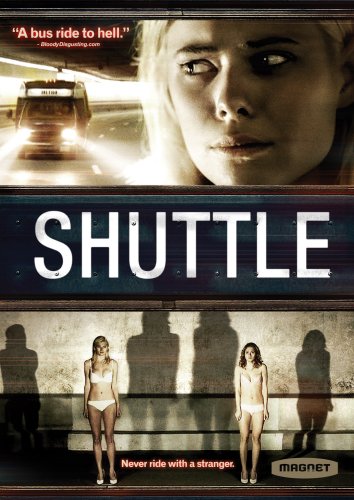
We all knew it had to happen eventually. With the success of the “torture porn” films like the Hostel and Saw series, we had to expect that there would be some lightweight twists and turns on the thriving genre. Shuttle is one of those attempts. It gingerly treads on the now familiar ground of the aforementioned films, but each time it makes the obvious moves in that direction, it pulls back and stalls. Edward Anderson is the writer and director of this mess. It was first attempt at either, and it shows, very badly. He couldn’t decide if he was making a traditional slasher film or one of the more trendy “torture porn” exorcises. So, he ends up doing neither effectively.

The setup was pretty much what we’ve already seen a hundred times. Two young women are on their way home from a Mexican vacation. It hasn’t been going all that well, and the plane ride back to the States was bumpy and plagued by horrible weather. Mel (List) is apparently engaged, and Jules (Goodman) is apparently her best friend. It’s late, and they just want to get home. They opt to accept a ride from a shuttle driver (Curran), who offers to take them for half price, instead of accepting a ride from two guys they just met. They figure the shuttle would be safer. But, of course, if that were true we couldn’t have 106 minutes of movie. By the time this hell ride is over you’re gonna wish they’d just taken the offered ride. The girls would be home safely in their beds, or perhaps the guys’ beds, and your life would now be 100 minutes or so longer to do some of those things you’ve promised yourself needed to be done.

Jim Carrey’s life and career are in a sort of mid-life crisis. He has avoided doing his usual goofball comedy films and opted for more serious roles. His appearance in Number 23 was a bit of a shock for most of us, but he pulled it off reasonably well. Even his more recent comedies have often been less about one crazy character and more about the story elements. It seems that he has decided it was time to return to the parts that made him a household name with Yes Man. But after watching Yes Man,,I have to wonder if maybe that genre has passed him by. For the first time, you really start to see age catching up on the crazy actor, and while he still has tremendous timing, he doesn’t look altogether quite right when he brings out the twisted faces and expressions anymore. It’s not a dig at Carrey at all. Still, it can’t be very good for a comedy, particularly one with a romantic element to it, when your first reaction is that the lead’s starting to look a little old. It’s not even that he looks bad. He just might need to tone down the goofy and concentrate on being more sincere. When Carrey takes that approach in this film he’s far more believable and, yes, that much more funny.

The story is almost a direct riff from his Liar Liar plot. In this one Carrey plays Carl Allen. Carl is a loan officer at a local bank. He was divorced three years ago, but he still hasn’t gotten over it. He’s become somewhat reclusive and self absorbed. He finds all manner of excuses to avoid doing anything with his friends. Instead he spends each night falling asleep watching rented movies on television. What’s worse is that he doesn’t even know that he’s miserable. One day at lunch a former coworker, Nick (Higgens) approaches him as he’s eating lunch in front of the bank. He tells Carl about how a motivational seminar has changed his life. He invites Carl to come to a workshop, but Carl drops his usual no thanks on him. But later Carl begins to realize how detached he’s become and has a scrooge-like epiphany at just how lonely he is. So, predictably, Carl goes to the seminar. Here motivational Guru Terrance (Stamp) preaches the gospel of Yes. He challenges Carl to merely accept every opportunity that comes his way. He commits him to a covenant to say yes to anything. As soon as Carl leaves the building the expected situations arise, where most sane people would say no. In a series of Yes’s that involve a homeless man, Carl begins to have second thoughts when his affirmative replies appear to put him in a bad situation. That is, until he meets Allison (Deschanel). Suddenly his new life appears to bring him a bounty of experiences and pleasures. As you might expect, it’s all leading to some rather uncomfortable consequences. But, as all “feel good” films must, Carrey eventually learns to live his new life in moderation and lives happily ever after.

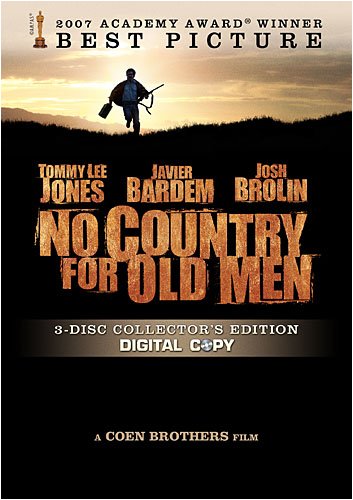
“Some of the old time sheriffs never even wore a gun. Most folks find that hard to believe. Jim Scarborough never carried one, that’s the younger Jim. Gaston Boykins wouldn’t wear one up in Comanche County. I always liked to hear about the old timers. Never missed a chance to do so. You can’t help but compare yourself against old timers. Can’t help but wonder how they would have operated in these times.”

I know I’m getting old myself when a film set in the 1980’s is now considered a period piece. And No Country For Old Men is about as much of a period piece as anything else. More than any part of the story, it’s the mood and the atmosphere of this movie that makes it work on so many levels. Trouble is, no matter how many times you see the dang thing it doesn’t get any easier to categorize what exactly it is. Sure, it is set in the 1980’s, but truth be told it could have just as well been set in the 1880’s. Has West Texas even changed all that much in those 100 years? Watch this movie and you’ll be asking the same question. No Country For Old Men is as much a western as it is anything else. Some call it a “modern western”, but I don’t like that term a whole lot. I mean, when you stop and think about it, what exactly is a “modern western”? I guess you could just as easily answer, No Country For Old Men.

It’s official. I’ve just totally given up on Adam Sandler. Honestly, I haven’t laughed at anything he’s done since the music video for The Lonesome Kicker. How many times can the same absurdity and Romper Room antics work on a film audience? Even in a Walt Disney film that required Sandler to clean up his act a bit, the same sophomoric humor was showing through the threadbare shtick. You just knew there were times he wanted to let loose with some off color remark or obscene gesture. While I was pleased that he gave it the effort, it’s like asking a mute man to talk after you just tied up his hands. There are some moments of genuine warmth with the kids. The guy’s probably a very nice and likable guy, it’s not personal. I’m just tired of the same Happy Gilmore character, just stuck in different situations. Think about it, aren’t they all the same person: Zohan, Gilmore, Little Nicky… The list goes on ad nauseum. A shame, really, because this thing might have had legs with another lead in the role.

Once upon a time in a small hotel, Marty Bronson (Pryce) was trying to run his small family business. Unfortunately, while Marty might have been a great guy, he didn’t have a head for business. He’s forced to sell out to a large hotel chain, owned by Barry Nottingham (Griffiths). The thing that put the deal over the top was Nottingham’s promise to let his son Skeeter (Sandler) run the hotel when he was older. Alas, as I always told my law students in my teaching days: Get it in writing or the promise isn’t worth the paper it’s not printed on. Nottingham does keep Skeeter around, however, as a handyman. Unfortunately he’s treated as a nobody by the entire staff, accept Mickey (Brand). Skeeter’s life is about to change. First, he is given charge of his niece, Bobby (Kesling) and nephew, Patrick (Heit) while his sister, Wendy (Cox) is out of town looking for a job. She’s the local elementary school principal. She’s also a crazy control freak liberal who feeds her kids cakes made out of sawgrass and prohibits such wasteful activities as television watching. Of course, brother Skeeter is going to change all of that. Wendy leaves her friend, Jill (Russell) to help out with the kids and take the “day shift” since she’s also a teacher at their school. But Skeeter’s life might change for the better when he’s given an opportunity to run the new and improved Nottingham Hotel that will replace the current one. If he can come up with a better theme than Nottingham’s future son-in-law and all around kiss up, Kendall (Pearce), he’ll be allowed to finally run the hotel. It doesn’t hurt that he discovers magic in his niece and nephew. It seems that when the three of them engage in some ad lib storytelling (the kids’ books all look like they were written by Captain Al Gore) the stories begin to come true. If he can only manipulate what the kids come up with in his favor, he might just get the big chance he’s been waiting for and even win the girl of his dreams, which he thinks is Nottingham’s Paris Hilton knock-off daughter, Violet (Palmer). Needless to say, it won’t be easy, but Skeeter finds a way to become the hero. Oh, and there’s one of the worst CG creations since Lucas unleashed Jar Jar on an unsuspecting Star Wars fan base. In this case it’s a CG enhanced guinea pig named Bugsy, because of his obnoxiously large eyeballs.