Dolby Digital 5.1 (Spanish)

“Life is a tightrope. You’ve got to learn to dance.”

We’ve all had bad days. Everyone can relate to that. We’ve all had moments when we weren’t at our best, when we’ve said or done something in the heat of the moment that wasn’t exactly our most shining moment. We can only hope that these momentary lapses of reason don’t cause permanent harm to ourselves or to others. We can only plead our case that we aren’t ultimately defined by these brief acts of frustration brought about by mitigating circumstances. Most of the time we get lucky. Sometimes that fleeting moment isn’t so fleeting. Some times you have a bad day, all of it. That’s the premise behind this Samuel L. Jackson and Ben Affleck vehicle.

Director Brad Anderson and writer Scott Kosar were unable to find backing or support from any of the American studios when they were shopping this movie. Apparently there were worries that it wasn’t very commercially viable. It turns out they were correct. The film made just over $1 million in domestic box office. That’s not a mistake. I meant $1 million. Even the foreign market came up short, coughing up only an additional $7 million total. Because of the lack of interest here in the States, the duo went to the Spanish government and received a grant. The grant required the film to be made in Spain and include Spanish cast members. But the movie kept its California setting and shot Barcelona for California, and not very effectively either. The truth is, there’s a lot more wrong with this film than just the lack of studio interest and its forced European locations. The team missed a grand opportunity here. They got to shoot in a rather exotic location but never took advantage of the wonderful surroundings. Instead they insisted on keeping the film urban, and in the end rather generic. The only solid set piece is the machine shop, which was filmed in a working plant.

Trevor Reznik (Bale) is a very odd man. We find him a year into a rather dramatic and steady decline. He hasn’t slept in over a year. He is losing weight to the point of emaciation. He works as a machinist for National Machine, where his bosses think he’s taking drugs and his coworkers don’t like him either. None of that is helped when his inability to focus causes another man, Miller (Ironside) to lose his arm in a machine. The only companionship he has is a hooker, Stevie (Leigh) who he pays a hundred bucks a pop and his café waitress, Marie (Sanchez-Gijon) who serves him coffee and pie. His decline appears to accelerate when he meets an apparent new employee at National. Ivan (Sharian) is a monster of a man with whom Trevor becomes obsessed. He leaves little post-it notes to remind him to do everyday things, but these notes usually disappear, replaced instead with cryptic messages and a hangman game. As his mind and body deteriorate, he becomes increasingly paranoid. His mind is pushing him to accept a reality that is not going to be pleasant.

It’s hard to imagine that this was only Pixar’s second ever feature length CG animated release. While Toy Story was the first, this was actually Pixar’s first film as an independent company. So, for many of us it feels like their first film. There must have been a tremendous amount of pressure on the young team. Toy Story was a break out smash hit that captured the hearts of audiences of all ages. Now on their own the team led by John Lasseter was determined to prove that Toy Story was no fluke and that they could stand on their own feet and continue the tradition of excellence they established from the first frame of their first picture. The film never approached the status of Toy Story, but it would prove that these guys were for real. The film broke new ground with its realistic environments, expressive characters, and solid writing. No one was going to be surprised as the company cranked out exceptional movie after exceptional movie. A Bugs Life fit the Pixar mold perfectly.

Flik (Foley) is a rather inventive ant. He’s always coming up with new and improved ways of doing things. Unfortunately, many of these ideas just miss the mark and end up causing more harm than good. His efforts aren’t helped by the fact that he has the hots for the Princess Atta (Louis-Dreyfus). Mr. Soil (McDowall) has the ants very busy gathering food to offer up to the grasshoppers, who depend on the ants for food to keep them through the winter. Failure to deliver is not an option, at least if the ants don’t want some serious beat downs from the grasshopper gang, led by Hopper (Spacey). The last bit of food is finally gathered just as the gang is about to arrive. But at the last minute Flik inadvertently dumps the cache into the water. When Hopper’s gang arrives, there’s no food. Hopper gives the ants until the last leaf falls from the trees to deliver their winter food or he will kill the Queen (Diller). Of course, everybody blames Flik, so when he comes up with an idea that he should go out into the world in search of warrior bugs to help them defeat the Hopper gang, Princess Atta goes for the idea. She doesn’t expect him to succeed, but at least he’ll be out of the way while the ants try and gather enough food for Hopper and themselves. But Flik does succeed …almost. He encounters a troupe of circus performer bugs, and through a series of misunderstandings sets off back home with his new friends in tow. He believes they are great warriors. They think he’s taking them home to play a circus gig. The warrior/circus bugs include: Slim (Hyde Pierce) a walking stick, Heimlich (Ranft) a German caterpillar, Francis (Leary) a sexually confused “lady”bug, Manny (Harris) a preying mantis with a flair for Shakespeare, Gypsy (Kahn) a moth, Rosie (Hunt) a black widow spider, and the two identical pill bugs Tuck and Roll. When they arrive home, the ants are overjoyed with Flik’s unexpected success. That is, until they discover that the “warriors” are merely performers when their boss Mr. Flea (Ratzenberger) rolls into town looking for them. When the Hopper gang arrives, they have no choice but to put up a fight, led by baby Dot (Panettiere) and her scouts.

For many, Saving Private Ryan has been the measure of the perfect war film in the modern era. Without question the Steven Spielberg film is a milestone in depicting battle on the screen. But I’m going to make the possibly unpopular statement that Enemy At The Gates is a better film, and the standard by which war films should now be measured. The movie is at least almost as good technically as Private Ryan. There are battle scenes that offer the same caliber of shocking reality. And even if this movie falls a little short of the technical marvel that Private Ryan was, this movie captures the human element of war time in a way I hadn’t seen before or since. Certainly all of the necessary hallmarks of the war picture formula are intact. There are plenty of battle scenes and enough ultra realistic bloodletting to satisfy the most insatiable aficionado. But Enemy At The Gates refuses to rely on such brutality to make its point. Instead the hazards of war are merely the atmosphere that allows an excellent cast, under brilliant direction, to bring to life an inspired script.

It’s the heart of World War II. Hitler and his Third Reich are marching across Europe spreading their shadow of fascism and tyranny wherever they go. They have now begun their assault on the young Soviet Union. For the Soviets, troops are weary and supplies are scarce. For the beleaguered soldiers of the Red Army, it is a matter of being shot by the enemy or by your own field commanders should you even think about a retreat. Their mission now is to defend the city of Stalingrad, which bears the name of “The Boss” and stands as a symbol of nationalism to the infant nation. But things are not going well at all. Only every other soldier is armed. The unarmed soldier is admonished to wait until the one holding the rifle is killed to take up arms himself. For these Russian men it is not a matter of if they are killed, but merely when. After a heavy day of fighting, a political officer, Danilov (Fiennes) finds himself pinned down with another young soldier, Vassili (Law). Vassili manages to take out the officers who stand in their way of escape. Danilov decides that Vassili could well be the hero that the Soviet soldiers need. He realizes that fear is not as good a motivator as inspiration. Before long he has written news articles that chronicle the exploits of Vassili as he takes his positions in the city and racks up an impressive score of German officers. Unfortunately, it is not only the Soviet soldiers who hear of these adventures. Vassili comes to the attention of the German brass who bring in their own sharpshooter, the decorated officer, Major Konig (Harris). The two play a dangerous game of cat and mouse in the ruins of Stalingrad. Vassili must also contend with his feelings for an intelligence officer, a young woman named Tania (Weisz). The three become engaged in a love triangle of sorts, causing Danilov to attempt to take down the hero he created. He also begins to doubt the figure he has become to the Soviet people. Konig and Vassili will eventually face each other, and only one of them can survive.

“I don't know who you are. I don't know what you want. If you are looking for ransom, I can tell you I don't have money. But what I do have are a very particular set of skills; skills I have acquired over a very long career. Skills that make me a nightmare for people like you. If you let my daughter go now, that'll be the end of it. I will not look for you, I will not pursue you. But if you don't, I will look for you, I will find you, and I will kill you.”

That pretty much sums things up quite nicely for you. The filmmakers must agree, because the scene figured prominently in their marketing campaign for the film. In the end it’s not really anything that we haven’t seen before with Bruce Willis, Mel Gibson, or a handful of other actors in the role. What might make the whole experience somewhat unique is that Liam Neeson isn’t usually associated with this kind of a character. You usually find him more on the cerebral side of things. He plays the part well in spite of the handicap that he never really looks quite right for the part. Give the thespian credit for making the whole idea at least somewhat believable.

“White supremist world was cancelled.”

When you talk about Wayne’s World 2 you can’t help but talk about disappointment. I mentioned in my review for the first film that over the span of nearly 20 years the skit had lost some of its luster. I certainly wasn’t nearly as entertained now as I had been when I first saw the film in the early 1990’s. That same principle appears to have been true just a year later when Wayne’s World 2 was released. It gathered in a disappointing $48 million off a $40 million budget. While there was talk of a continuing franchise at the beginning, there wasn’t any interest in a third film by the time the second film had crashed and burned. The fact is, I know many fans out there that didn’t even know a second film existed.

Have you seen the Chris Farley/David Spade film Tommy Boy? If you have, then you’ve also seen Black Sheep. The circumstances might have changed, but the general idea is still there. Farley plays the mentally challenged family member, yet again. This time he’s Mike Donnelly, and his brother Al (Matheson) is running for Governor of Washington state. Spade once again plays the faithful employee who is charged with babysitting Farley’s character and trying to keep him out of trouble. Here he’s Steve Dodds, an overlooked campaign assistant who hopes to parley the assignment into a full time job on Donnelly’s staff if he’s elected. Just like in Tommy Boy, there is the rival who is using Farley to hurt the cause. This time it’s sitting Governor Tracy (Eborsole) and her slimy campaign manager Neauschwander (McGill). They set Mike up as an arsonist, among other things. Of course, the Farley and Spade team discover some voting irregularities and take a road trip to the state capital to save the day. They’re aided in their attempt by a Vietnam vet who isn’t dealing with a full deck and is played quite hilariously by Gary Busy.

There are a ton of parallels between the Chris Farley/David Spade comedy team and that of John Belushi/Dan Aykroyd. Both teams began in the Saturday Night Live arena. It was that physical big/little guy combination that has its roots with Laurel and Hardy, and Abbott and Costello. Both teams were at the height of their careers when a drug overdose would claim the wilder member of the team. Both of the deceased comedians left behind at least one successful brother to carry on the name in show business. Tommy Boy was by far the best of the films this duo made before Farley’s tragic overdose in 1997. Black Sheep is a pale imitation.

“Your life is defined by its opportunities... even the ones you miss.”

F. Scott Fitzgerald is one of those great American writers from the classic age. In school most of us were required to read various works from the writer. For many students those works included The Curious Case Of Benjamin Button. The original work is a mere 20 page short story. For the last 15 years Hollywood has made one attempt or another to bring the classic story to the screen. The closest anyone got was Ron Howard who expected to bring in John Travolta as Benjamin Button. The one reason or another these attempts never made it past screenplay drafts. Along comes one of the best and most diverse directors, David Fincher. Fincher’s work needs little introduction and spans the genre spectrum from Se7en to Fight Club. The original short story would be adapted by Eric Roth. That left many, myself included, to expect a remake of Forrest Gump. When you consider that Roth wrote both screen adaptations and that he was once again working with a character spanning many years of history, the concerns were not unfounded. Would Roth take Benjamin Button on a journey through the 20th Century that would find him present at crucial moments in history as he did with Gump? Fortunately, Roth resisted such temptations and delivered a story relatively faithful to the original work, where the main character was a silent witness only to the major events of his life. Of course, I say relatively faithful because Roth also turned that 20 page story into an epic 3 hour film.

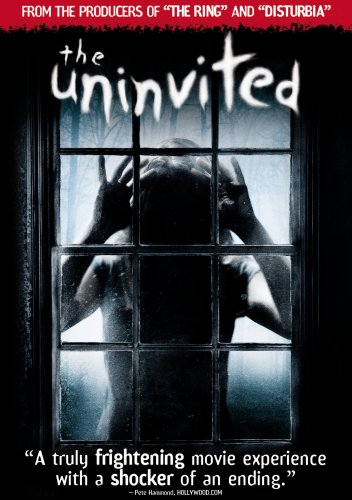
The Uninvited is yet another in a long string of Asian films that are translated and retooled for American audiences. It’s been a rather strong and long running trend that was kicked off with the wildly successful The Ring, from the Asian classic, Ringu. But, for every effective spooky thriller that comes out of this Asian pipeline, there appear to be a dozen or more complete failures. Some American directors think that all they need to do is throw fast moving creepy ghosts at us and often have them inhabit some modern electronic device. Presto! You have a horror movie for the purposes of generated cash. I’m happy to report that The Uninvited is a fresh approach that relies on almost none of these tired conventions to work. There is no morality tale about our modern conveniences here. No ghosts haunt cell phones, beepers, computers, video games, DVD’s, or even toaster ovens. The appearance of spectral creatures is actually quite limited and will disappoint the viewer who is there for the quick scare moments. This film uses the technique sparingly, and ultimately more effectively. The truth is that The Uninvited is really not so much a ghost story as a thriller in the vein of The Hand That Rocks The Cradle. It gives us one of those rare endings that you won’t easily see coming at all. Most importantly, this movie completely shatters the mold of these Asian remakes by making it all about the characters; the human characters, that is. Based on the Korean film that roughly translates to Tale Of Two Sisters, this is a refreshing take on a stale theme.

Anna (Browning) is just getting out of a mental hospital. She’s been there for some time, following the death of her mother in a terrible house fire. She had been haunted by nightmares of that tragic night. Her doctors now think she will be able to cope and return home. Her father, Steven (Strathairn) is hopeful about bringing her home. There she is confronted by a harsh reality. Her mother had been infirm at the time of the fire. Now Anna has discovered that her mother’s former nurse, the very young Rachel (Banks) has moved into the house as her father’s lover and future wife. She notices that in her absence, her mother’s presence has been erased from the home as Rachel has redecorated and removed any connections to her dead mother. She takes comfort only in the company of her sister, Alex (Kebbel) who also hates the woman they see as an intruder in their home. Anna begins to have visions that her dead mother is warning her about Rachel and suspects the fire was not an accident. The sisters investigate, only to find that Rachel’s name is not a real one. Anna is convinced that Rachel killed her mother and will now do the same to her and her sister. When a local boy who claims to have information about the night Anna’s mother died turns up dead himself, Anna decides to get help. But no one appears interested in her story, and now Rachel knows she’s on to her. The film ends in a sort of typical cat and mouse game that ends up not being so typical after all.

Citing personal history, I don’t do really well with horror films. As mentioned in other reviews, my parents let me see scary movies such as Exorcist & Poltergeist (as well as R-rated action films) when I was no more than ten years old. While, Poltergeist sits proudly in my DVD collection, I still have trouble to this day with Exorcist. Yes, I can be a scaredy cat at times. To be also perfectly honest, I was a bit worried when I received The Uninvited in the mail to review. After all, it proclaims proudly on the cover that it is made by the producers of the Ring(which I absolutely hated) & Disturbia. By the end of the movie, I was very pleasantly surprised.

Anna (played by Emily Browning) is out with her boyfriend Matt (played by Jesse Moss) at a local beach party. They start to kiss when Matt tells Anna he loves her and he has a condom. (Wow, that screams love) Upset, Anna decides to leave. She passes her sister Alex (played by Arielle Kebbel) on the way back to the house. Through the woods she goes until she encounters three filled garbage bags. She opens them and the dead body of a redheaded girl spills out. The redheaded girl’s head snaps and speaks. Anna runs again in the direction of the house.