Italian Mono

Even though I like to think I've seen more movies than the average bear, I'll admit to having somewhat of a blind spot when it comes to world cinema. So I'm a little ashamed to say I hadn't even heard of Paolo and Vittorio Taviani — the Italian filmmaking brothers who have worked together all their lives and started making movies in the 1950s — before I picked up this handy three-pack from the Cohen Media Group. The Taviani Brothers Collection features three of the siblings' most acclaimed work: Padre Padrone, The Night of the Shooting Stars, and Kaos.

Obedience is the air you breathe.”

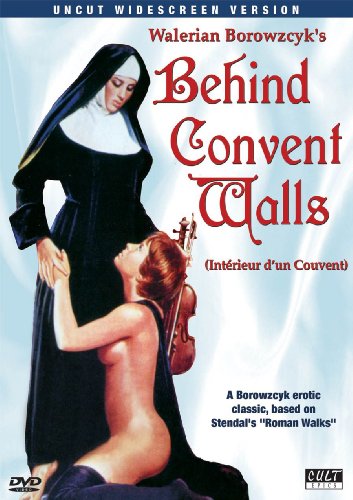
A nunsploitation box set was always an inevitability, and here the good people at Cult Epics chime in with just such a collection, one limited to 2500 copies. There are only two films here, but they are two good ones, the works of strong directors. One is a distinctively idiosyncratic work, showing the unmistakable hand of its filmmaker. The other will quite simply knock you out the back wall.

Behind Convent Walls is Walerian Borowczyk's contribution to the subgenre. A repressive abbess rules her convent with an iron fist (not to mention the blade concealed in her cane), but the sexuality of the nuns will not be repressed, and it will make its presence known, whether through rebellion or madness. The film defies any linear summary, given that it is almost impossible to tell the nuns apart, and the various incidents are not only disconnected, they take place with very little motivation or logic. Instead, we have a strikingly beautiful exercise in pure cinema. The Aurum Film Encyclopedia: Horror, on the subject of Borowczyk's Docteur Jekyll et les Femmes, notes, “Borowczyk's imagery, here fed by his fetishistic fascination with all things antiquarian, is often stunning and the film becomes a sort of still life in which familiar yet alien objects … seem imbued with a secret significance all their own.” Exactly the same is true for Behind Convent Walls. While nowhere near as powerful a film as The Beast, it is nonetheless well worth one's full attention.

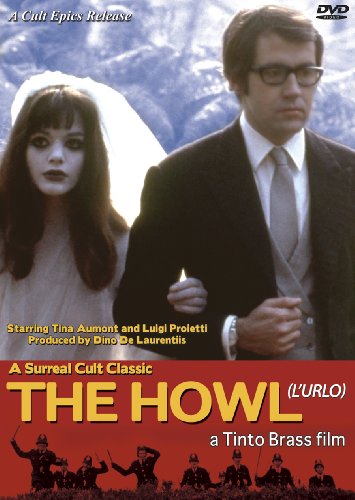
Cult Epics continues its love affair with director Tinto Brass, and here once again delves into one of his early works. For my money, for all that his later erotica is handsomely shot and produced, what I'm seeing of his 1960s output (so far Deadly Sweet and this) is far more interesting. If 1967's Deadly Sweet was demented, it at least followed a semi-recognizable mystery plot. The Howl (1969), on the other hand, defies description. It is basically a surreal picaresque, as a young woman (Tina Aumont) flees her wedding with a stranger (Luigi Proietti) who gives her a come-hither look. Already, this sounds far more sensible than the film really is. The couple race from one lunatic encounter to the next: a resort hotel apparently designed by Sade; a naked, cannibalistic philosopher and his family, and on we go.


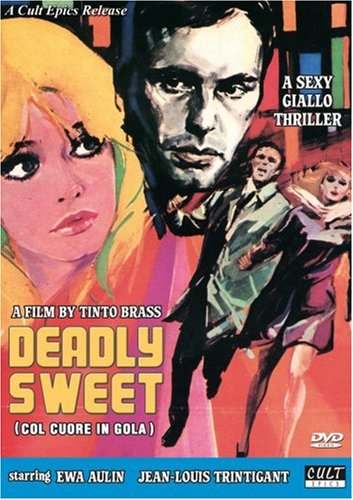
Jean-Louis Trintignant (here dubbed into Italian) is a hard-boiled actor (!). Arriving at a night club to meet the proprietor, he instead finds the man dead, and the luscious Ewa Aulin standing over the corpse, protesting her innocence. Trintingnant believes her, and decides to help her out. The quest for the truth leads them though a series of encounters with various aspects of London nightlife and lowlife, 1967 vintage.

This early Tinto Brass effort is nominally a thriller, though, as he himself points out on the commentary track, the film is only vaguely interested in its thriller aspects. The big influence here is Antonioni's Blow Up, which is name-checked a couple of times. Deadly Sweet has the same kind of meandering plot and love of lingering over various examples of Swinging London counterculture. The other guiding muse is comic book artist Guido Crepax, and Brass mimics comic panels with multiple split screens, shifts between colour and black-and-white, and the like. It is an open question whether all of these games work at a cinematic level, but they are certainly visually interesting. The films is, like so many of its contemporaries, self-indulgent, but in a rather endearing way. For my money, it's a more engaging viewing experience than many of the erotica exercises from the director's mature period.

There really was nothing like the Italian film industry in full exploitative steam. The Beast in Space is a perfect example of what I mean. From where else but Italy in 1980 could there emerge a low-rent rip-off of both Walerian Borowczyk’s high-end erotic epic The Beast and Star Wars? Even the poster somehow manages to conjure thoughts of both films. And the title shamelessly implies that it is some sort of sequel to the former. So what kind of alchemy do these elements produce?

Nothing particularly enticing, beyond its considerable value as demented trash novelty. The plot is a surprisingly convoluted bit of nonsense involving and expedition to a planet that has been producing far too much of a supposedly rare mineral. Meanwhile crew member Sirpa Lane (of The Beast) is having bad dreams about being ravished by some sort of satyr-like creature. None of this ever makes any sense, nor is the combination of gruesomely bad FX and costume design with gruesomely boring sex scenes particularly entertaining. But the release is still worthwhile, if only to prove that There Are Such Things.

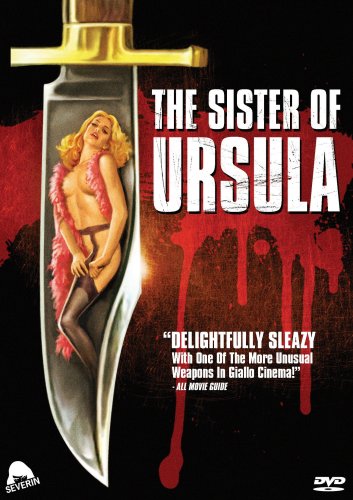
Still grieving over their father’s death, two sisters – the outgoing Dagmar (Stefania D’Amario) and the neurotic, antisocial Ursula (Barbara Magnolfi) – check into an out-of-season hotel. They are almost immediately immersed in a tangled web of relationships and betrayals involving the hotel manager, his estranged wife, a lounge singer and a drug-addicted patron. At the same time, a series of gruesome sex slayings gets underway.

Writer/director Enzo Milioni’s first film is a clumsy giallo. The elements are all there – psychosexual delerium, black-gloved killer, beautiful cast. So too is the aura of misogyny that haunts so much of the genre – the killings here all involve lethal penetration, and while the murders are generally dealt with relative restraint (a hilarious shadow of a looming erection followed by fade to black), there are, late in the film, a number of particularly tasteless shots of naked victims with bloody crotches. Charming. The ineptness of the filmmaking, however, robs these moments of much of their power: the sex scenes are dull and saddled with the same irritating score every time; the editing is rife with nonsensical cutaways (one of which unintentionally suggests that a dog has been masterminding a drug deal); and the story is so choppily told that characterization varies between the risible and the nonexistent. Add to this a resolution that even the most casual viewer of gialli will see coming a mile away, and you have a pretty weak entry. And yet, for all that, there is that delicious ineffable whiff of 70's Italian exploitation that makes even the weakest entries plenty of fun.

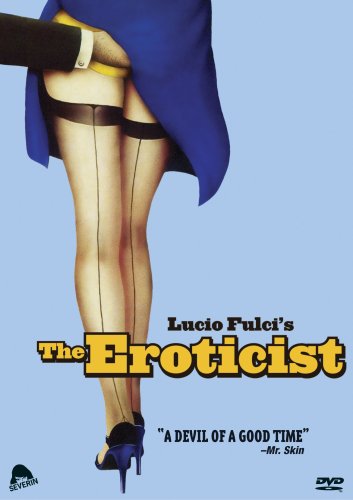
Lando Buzzanca plays Senator Puppis, a telegenic young politician on track to become Italy’s next president. He’s been groomed for the part practically from birth by the Vatican, which plans to re-exert social control over the country through its presidential puppet. But plans go badly awry as Puppis suddenly develops an uncontrollable urge to fondle women’s buttocks (Stephen Thrower has aptly described the character as a “repressed heterosexual”). Even as he seeks help for his condition, various parties around him begin to panic, as the police think Puppis is planning a coup without telling them, the military think they are being left out of the loop by the police, and the Vatican, along with its Mafia catspaws, starts whacking everyone in sight in a desperate attempt to keep everything from completely unravelling.

How’s that for a sex comedy plot? Not exactly of the been-there-done-that variety, is it now? Behind the nonsensical UK release title is one of the most interesting Lucio Fulci films to reach these shores. Fans wanting the Fulci gore will have to look elsewhere, but those open to something new will encounter a level of filmmaking absent in too much of his later work. The sex gags are rather dated (though the moment of the Puppi’s first goose is a bit of wonderful deftness I’ve never seen in Fulci), but the black political satire, which makes up the bulk of the film, while being very tied to the specific Italian context, has lost none of its bite. This is an angry film, one that builds to an utterly appalling resolution, all the more sour for its comic framing. Without going so far as to compare Fulci’s filmmaking skills to Kubrick’s, one might think of this film as Fulci’s Dr. Strangelove – a bitter, hopeless indictment that can only fully express its venom in the form of farce.

Severin unleashes three more entries from Italy’s long-running sexploitation saga, and the result is another fascinating collection. The quality of the movies themselves up and down, but the good stuff is very good, and the collective result is something that is completely fascinating. Exploitation fans should be over the moon.

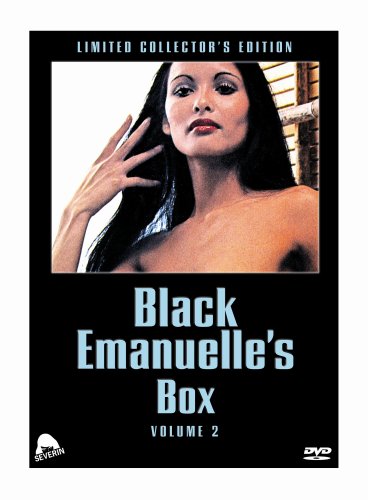
I’ve already gone on at length about Black Emmanuelle/White Emmanuelle (1976) elsewhere, so I won’t rehash everything again. Briefly, though, the set-up has Laura Gemser as Emanuelle (let’s stick to the single “m” version to avoid confusion with Sylvia Kristel), here a model instead of a journalist, arriving with SOB photographer boyfriend at the palatial home of some friends in Egypt. Much aristocratic ennui ensues, until Laure (Annie Belle) arrives to tear down everyone’s comfortable illusions. The most nicely shot and intelligently scripted of the films, there is something absolutely mesmerizing about the display of decadent self-loathing proposed here. Writer/director Brunello Rondi’s effort is emphatically a high point of the series, and invites repeated viewings.

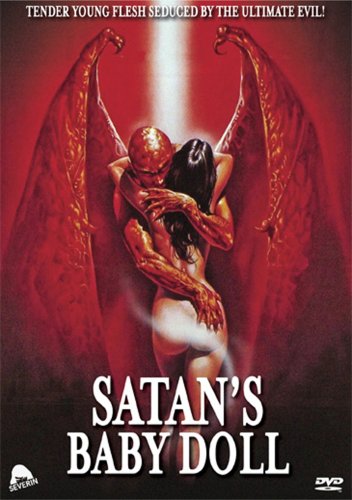
Mario Bianchi’s film is a 1982 remake of the recently reviewed Malabimba. The spirit of a newly deceased woman possesses her daughter, and proceeds to wreak havoc in the gothic castle that is the family’s domicile. Of course, given that the father is a murderous drug-addict, there isn’t that much for the possessed teen to do, as far as the plot itself is concerned. Curiously, this effort is less lurid than its predecessor (barring a couple of insanely OTT performances), with less nudity and taboo-busting, and also a rather less interesting deconstruction of respectable society. Plotting and motivation are haphazard at best. Still, it’s a not-unentertaining late-period Italian gothic, blessed with handsome sets.

Audio

Connoisseurs of Eurosleaze will be pleased with this nasty little variation on the gothic. In an isolated castle, a fractious, failing aristocratic family has gathered. There is no more money in the family, except indirectly: one brother, now in a vegetative state, is married to a rather wanton woman, who now holds the purse strings. The matriarch suggests that her other son marry her, even though his brother is still alive. The man is properly horrified by the suggestion, and he is also still in mourning for his wife. But then something – the spirit of his wife? a demon? – invades his teenage daughter, who then starts acting out sexually and recreating scenes from The Exorcist.

Nothing hugely original here, and many scenes are SO blatant in copying The Exorcist that one might as well assume that Friedkin’s film was the last word on possession symptoms. What is interesting, though, is that, unlike Friedkin’s film, the connection between the possession and the hypocrisy of the upper class is made perfectly explicit (in every sense). In fact, much of the misbehaviour on display has nothing whatever to do with the demon – it serves primarily to force the characters into a realization of what they really are.