Genre

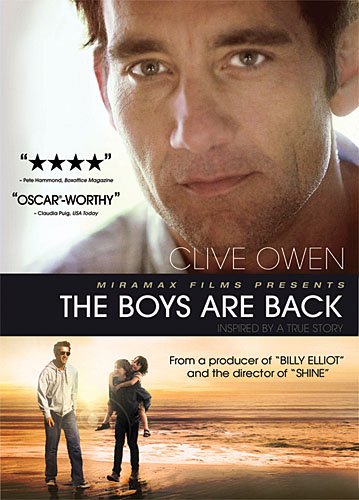
There’s a quote by author Kent Nerburn that says: “It is much easier to become a father than to be one.” The Boys Are Back, based on a memoir by Simon Carr, is the best example of that sentiment on film that I’ve personally seen in a few years. Clive Owen plays sportswriter Joe Warr. He’s good at becoming a father, but not at being one. His one-the-go job keeps him from spending any real quality time with his family, leaving his wife Katy (Laura Fraser) to raise their son Artie (Nicholas McAnulty). When Katy becomes fatally ill, Joe must step up to the plate to take care of his 6-year-old son. His mother-in-law (Julia Blake) tries to offer her advice, but Joe is determined to do it on his own.

Widower Joe must deal with Artie, a firecracker of a boy he knows nothing about, foreign events like parent-teacher conferences, and keeping on the ball with his deadlines at the newspaper. He adopts a hands-free parenting philosophy that allows Artie to have the run of the house with as few rules as possible. That plan is full of flaws from the start.

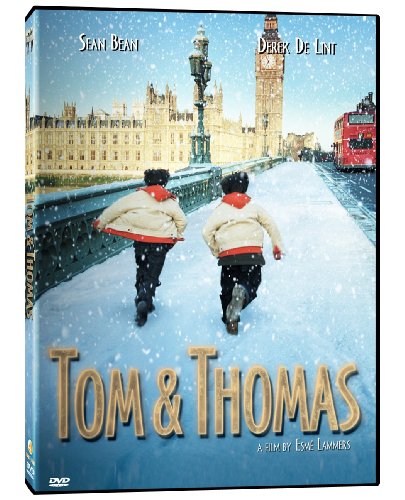
This is the story of two young twins who are living completely different lives, one in a boarding school who is caught up in a child smuggling ring and the other is living with his struggling artist father, but are able to share their physical pain and emotions as if telepathically. Thomas, who is with his father, knows of Tom, the boarding school “orphan,” but everyone believes Tom is just his imaginary friend. Through a chance encounter the two are reunited and both must find a way to escape the smugglers who wish to take them sell them outside of England.

Madea's been everywhere. She's even been to jail. But I Can Do Bad All By Myself is not actually a Madea film, per se. She has a cameo, of sorts, but this film is based on a series of stage acts that Perry has collected under the single title of the film. So much of this movie has been out there on stage. I'm not really a fan of Perry's Madea character and the collection of films she/he's been involved in. I had a friend once who used to get them for another friend of his, and he used to joke about making me a copy. Now you know why we're not friends any more. But this film is very different from anything you've seen from the Madea character, or honestly out of any of Tyler Perry's previous film projects.

When the film begins, it looks like it's going to be another haphazard Madea adventure. She's asleep in her bed when she hears a crashing sound downstairs. Someone done broke into Madea's house. You're already starting to feel sorry for the crooks. That is, until we find out they are three young children. Apparently their parents are dead, and they've been living with their grandma, but she's been AWOL for over four days. Madea does the only thing she can. She feeds the kids, much to the discontent of Perry's other alter ego, her husband Joe. "You feed them and they keep comin' back," he warns. Once she's heard their heartwarming tale, she takes them to their Aunt April (Henson). April is working as a singer at a local nightclub but is ruining her own life on booze and an abusive relationship. Madea comes knockin' while she's trying to sleep and lays the bad news on the wannabe star. April's got no room in her life for three kids, and on top of that, her church has sent over a homeless Mexican named Sandino (Rodriguez) who needs a place to stay and can pay by doing jobs around the house. We all know from the beginning that grandma’s not coming back, so I'm not really spoiling anything for you there. April will be faced with making some changes in her life, both for the kids and for herself. It's through music and faith, and a little help from Sandino, that she manages to open her heart to her new family.

Metaphors are often effective tools in filmmaking. They can be used in a variety of unique and clever ways to either highlight a particular aspect of story and/or character. They can be used to add an artistic flourish to a movie. They can even be used to drive a plot, if you're careful enough to avoid becoming too abstract. Then there are films like The Burning Plain which attempt to create a film that is metaphor itself. What you often end up with, and certainly here, is something difficult to follow and more acceptable at the festival circuit than at the box office. The movie performed abysmally at the box, and that is in spite of some rather glowing reviews. The general public is never going to “get” a film like this. Honestly, I'm not sure that I even understood it. What I do know is that whatever level of understanding or entertainment I might have gotten here, I had to work too hard to get it. There's a simple equation of investment of resources and return that this film just simply fails to deliver. And if they think I'm harsh, wait until they try to sell it to the average viewer. Most people have less patience than I when it comes to movies, but director and writer Guillermo Arriaga demands far more than I was willing to give. And evidenced by the mere 200 grand at the limited run box office, it was more than most of you were willing to give as well.

The story is told from a perspective of several places and times. We learn that Gina (Basinger) and Nick (deAlmeida) were having an affair. Both had families. They used to rendezvous at a trailer out in the middle of an isolated plain. They are killed in a horrible fire and explosion that burned so hot, we are told, that their bodies melted together and had to be cut apart with a knife. In the aftermath, their families develop a severe hatred for each other, each blaming the other for taking away their parent. But in traditional Romeo and Juliet fashion, two of the children, one from each side, fall in love. The identity of these two and the things that they did would be spoilers here. Suffice it to say that you should spend some time attempting to pick up on the details and nuances here. Another story involves Santiago (Pino) who now lives in Mexico with his young daughter. He owns a crop dusting business. Of course, flying small planes can be a dangerous business. Actually flying is very safe. Crashing, on the other hand can be dangerous. When he is injured, a friend helps his daughter track down the girl's mother, Sylvia (Theron), now living in Oregon running a restaurant. Of course, we know that these stories all have common threads and even common characters.

The original movie production of Fame came out in 1980 and followed a group of students as they progressed four years through the New York High School of Performing Arts. It was gritty, it was harsh, but it was a very deep portrayal of budding students trying to get into the world of singing, dancing and acting. Nearly 30 years later, somebody gets the bright idea of doing a remake. Let’s find out if it is anywhere close to the original.

It is another year at PA or the New York High School of Performing Arts, there is a brand new crop of students trying their best to get into this elite school. The teachers are professionals at figuring out who has talent and who doesn’t. Teachers like Mrs. Fran Rowan (played by Megan Mullally) who works on vocals, Ms. Lynn Kraft (played by Bebe Neuwrith) on dance, Mr. Alvin Dowd (played by Charles S. Dutton) as drama coach and Mr. Joel Cranston (played by Kelsey Grammer) who takes on music.

The time is the 1930s, the setting Africa, as Mussolini attempts to recreate an Empire through the colonization of Abyssinia. An officer and poet Elio (Al Cliver) returns from the campaign with the spoils of conquest, one of which is Abyssinian princess Zerbal (Laura Gemser, of D'Amato's Black Emanuelle films). The erotic heat in his home is already pretty torrid, what with wife Alessandra (Lilli Carati) carrying on with secretary Virma (Annie Belle). Zerbal's arrival upsets the emotional apple cart, passions flare, and the supposed slave starts to exert more and more influence over the putative masters.

"Look at yourselves. Unplug from your chairs, get up and look in a mirror. What you see is how God made you. We're not meant to experience the world through a machine."

Since the time we were kids, we were warned that you can't tell a book by its cover. That has never been more true in our modern world of the internet. We play in chat rooms where almost no one is who they pretend to be. We lie about our age, looks, and even our gender, and rationalize it as harmless escapism or merely exaggeration. Everyone does it, or so we believe, so it's actually expected. Police officers often pose as innocent young children to lure pedophiles out of their dark lairs and into a new dark lair, this one with bars and armed guards. So, I guess it's not that large of a leap into the world of Surrogates. Now you can order an entire working body to look like anything you want. You sit in a comfortable pod and live through this artificial skin. You can't feel pain. You can't catch a disease. You can't die ... or, again, so you would very much like to believe. If we can't change the book, we can now at least change the cover.

"Hello. I want to play a game."

I'm a huge fan of Roger Corman. Who isn't, right? But these films are not the typical Corman offerings. Some of them have no apparent connection to the man himself. The ones that do are mostly as producer and not director. Some of the films might be notable for being an early film for this actor or that. But I would hardly classify any of these films as classics of any genre or good representations of the mastery of the B film that was Roger Corman's signature. Most of the films feature merely montages of riding, fighting, drinking, drugging, or sex. Good times for some, maybe, but hardly worth the time it takes to watch even the shortest of these bombs. I feel like Corman's name is used primarily as a catch here and that the man had nothing to do with this release.

Here are the films you'll get in this collection:

Small Wonder ran in the mid eighties on various little networks across the nation. It ran for four seasons and a total of ninety six episodes (4 from the magic number). True to Shout Factory’s form and modus operandi, they have released a boxset of the first season. I remember seeing a few episodes when I was a kid but this might be one of the times when my memories aren’t as good as I think they are.

Ted Lawson (played by Dick Christie) is a robotics engineer. He has an idea for a domestic servant but his boss just doesn’t seem to buy into it. So he brings his project home and works on it. In the meantime, he seemingly ignores his wife, Joan (played by Marla Pennington-Rowan) & his young son, Jamie (played by Jerry Supiran).