Genre

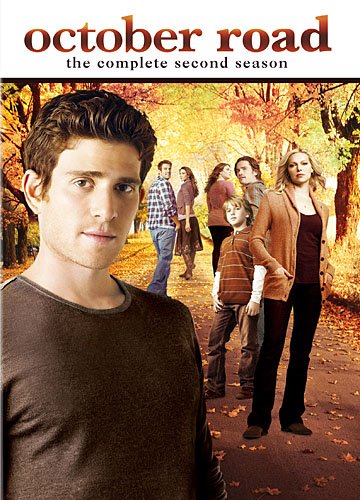
It’s the end of the October Road for Nick and the gang. If you want to blame anyone, there’s plenty to go around here. First of all, the writers’ strike didn’t do anyone any favors by delivering only a 6 season first year. While the cast was made up of good actors, there is never any kind of chemistry between them. They look like actors thrown together because they have to be. The writing is uneven. Did anyone ever really plan out what this show was really about? There are fans; every show has some. But there was never enough to make this one fly at all. Blame me, if you like, for not being kind to the first release and repeating those same criticisms here. The truth is, it was never a good show, and a DVD release isn’t going to change that. You do get to see all of the episodes here. At last count, ABC was not necessarily planning to air all of the completed episodes. That makes it a good buy for the fans. If all 6 of you pool your money, maybe you can share one set.

Enter Nick Garrett. He’s a writer who has published a hugely successful best selling novel. It’s been made into a major film, and busty women approach him in clubs to tell him how much it has affected their lives. The audio version is read by Johnny Depp. You would think Nick has it made. The trouble is that Nick doesn’t have a clue how to begin to write his next book. His solution is to take a trip back home to the places that inspired the first book. His hope is to make a quick hit and run visit, but he ends up staying for a while. Nick soon discovers that you really can’t go home again. Everything and everyone changes, as Nick is finding out. Not everyone is happy about how they feel they might have been portrayed in the novel, and Nick might even have a son. If this is starting to sound a bit like a soap opera, then you have October Road pegged.

They say that it isn’t over until the Fat Lady sings. Did you ever wonder what “it” was or who the heck this Fat Lady is they keep talking about? I can’t help you there, but I do know who the Fat Man is. It’s William Conrad, who came back to television in 1987 as J.L. McCabe, better known as “the Fatman”. McCabe was one of those tough as nails district attorneys. He was actually an ex-cop, so had great criminal instincts. McCabe wasn’t above bending the law to put away the bad guy, and he wasn’t considered a very friendly type of fellow. He majored in stubbornness and plain speaking. He relied on Jake Styles, his private investigator, to do much of the leg work for the office. Jake was a bit of a flashy playboy, but he always delivered the goods for his boss. Again, Styles wasn’t against breaking a few rules to get what he needed. Styles was played by Joe Penny. McCabe also served as a mentor, of sorts, to young District Attorney Derek Mitchell, played by Alan Campbell. Mitchell was quite wet behind the ears and a little too eager sometimes. His ambition often got the better of him, and it was the gruff McCabe who kept him out of trouble. Finally, the team was completed by Gertrude, McCabe’s loyal and trusty secretary, played by Lu Leonard. While The Fatman put crooks away instead of defending innocent defendants, there could be no mistaking the parallels between Jake And The Fatman and Perry Mason. The two shows were from different times, and the styles might not have been the same, but the dynamic was very much the same. You can see a lot of Della Street in Gertrude and more than a little of the Drake/Mason relationship in the two leads. There was far more action, but that was more a reflection of the change in decades than anything else. And like Mason, the Fatman rarely lost a case.

The Fat Lady was warming up after the first season of Jake. The show did not immediately return for its second year. It was delayed until March and so only ran for 11 episodes. That’s why Paramount has issued this as an “entire” season set. The show never really found its footing and struggled for the 5 seasons that it ran. It wasn’t a terribly original program and was steeped in cliché for its entire run. It was never a ratings monster, and there were constant radical changes in attempts to retool the show over the years. In this season McCabe and his staff, excluding trusty Gertrude, moved to Hawaii in an effort to spice the show up Hawaii Five-0 style. Even that exotic location didn’t help matters, and the series returned to California by 1990. These erratic changes in location and style meant that the show never found the solid fan base it needed to survive. It was likely William Conrad that was the only thing that allowed the show to last 5 years. What made the show work at all was the unlikely pairing of the two characters. It wasn’t only their weight that separated the two. McCabe looked angry all the time and had a slower pace to his method. Jake was almost too slick; at least that’s the way they tried to portray him most of the time. In the end the pair really was too unlikely for most viewers’ tastes. While it did get 3 Emmy nominations, it never won. These nominations were for cinematography and music only. Today Jake And The Fatman wouldn’t have gotten past the mid season.

Warner nearly single-handedly invented the cartoon medium as we know it today with the advent of their various Bugs Bunny and associates cartoons. Ever since the early 1930’s these characters have become an indelible part of the American pop culture. Their images became an important part of the World War II effort and even helped to put a face on the issues of the Great Depression. They represent one of the richest histories in animation, second only to Walt Disney. There are some, I’m sure, that would argue they might even belong in front of Uncle Walt. When I was growing up in the 1970’s, I had no idea I was enjoying cartoons and characters that were already 40 years old. The truth is that my grandfather had been a fan of these same cartoons when he was a kid. Today the Warner cycle of Loony Tunes cartoons is over 70 years young. Things might have changed with the passing of Mel Blanc, who provided most of those familiar voices for much of that time, but Bugs and the gang are still out there and going strong.

Which brings us to The Looney, Looney, Looney, Bugs Bunny Movie, which arrived in theaters in 1981. While the film wasn’t a huge box office success, it was pretty cheap to make. The film was made up of bits and pieces from various Looney Tunes shorts. The featured shorts included: Knighty Knight, Bugs, Hare Trimmed, Sahara Hare, Wild And Wooly Hare, Roman Legion-Hare, Golden Yeggs, Catty Cornered, The Unmentionables, Three Little Bops, Birds Anonymous, Show Biz Bugs, and High Diving Hare. All of these shorts were from the time period between 1949 and 1957. The shorts were edited into an opening and a three act film. The cartoons are not necessarily shown in their entirety and are used to create these three separate stories. There is new material that was created more to bridge the shorts and act as a wraparound for the whole affair.

I’ve had to watch and review a lot of crap in my nearly decade long life as a reviewer. Usually there’s something good to say about almost anything, no matter how bad the title is. I have officially gotten the absolute worst piece of garbage that has ever arrived on my front door in Hollywood The Dark Side Collection. Honestly, that’s all I have to say…..

Editor’s note: We finally tracked Gino back down and “requested” that he complete this review. We apologize for any delay this might have caused. –Ed.

Dustin Hoffman is the titular Harvey, a morose jingle composer who, with his job hanging by a thread, arrives in London for his daughter's wedding. He is a complete outsider at the rehearsal dinner, and feels even more cut off when his daughter informs him that she wants her stepfather to give her away. Meanwhile, the scarcely more cheerful Emma Thompson spends her time being set up for disastrous blind dates and being constantly harangued on the phone by her mother. These two losers at the game of love meet, and something blossoms between them.

And that is really about it as far as plot goes. The script is so insubstantial that it threatens to waft away on the first gentle breeze. The film is quite watchable, however, and that is due to the sheer force of its leads. They make the enterprise seem considerably more substantive than it is, their pained expressions conveying worlds to us. The film is at its strongest when it sits back and lets the two banter, and the relationship that develops feels easy and natural. It is all the more disappointing, therefore, that writer/director Joel Hopkins feels it necessary to shoehorn in the obligatory Romantic Comedy Third Act Falling Out by the most contrived and Deus Ex Machina-like of means. This is a turn of events that is a poke in the eye to any viewer who thought his/her intelligence was going to be respected.

Based on actual events at the University of Iowa in 1991 (which I did not know when I began watching), this film follows a young Chinese student named Liu Xing (played by Liu Ye) as he is accepted into a prestigious Cosmology research team based out of a Utah University. While working for a respected Cosmologist named Jake Reiser (played by Aidan Quinn) he makes his own revelations and theories that challenge that of his employer and mentor. This creates an obvious conflict between them which places his dreams of a Nobel Prize, and even just graduating at state if he decides to continue with his own theories and not Reiser's.

The film is sometimes chaptered by Chinese characters, each referring to something in nature, whose profundity is a bit lost on me since they are inconsistently peppered throughout the film and come off as non sequitur since the title and main subject of Dark Matter refers to the unknown parts of the outer universe, not the natural and Earthbound. Letters that Liu Xing sends back to his parents make for far better markers to indicate shifts in the plot and mood. In fact, all of the stylized elements seem to fall flat, such as the aforementioned Chinese characters, musical portions, and CG trips into some sort of dream scape for Liu Xing during points of despair, whereas the film finds its true effectiveness when showing what is actually happening to the characters. The simplest parts to Dark Matter are the most moving.

With the gigantic success that the Blue Collar Comedy Tour has accumulated, it was only a matter of time before each one of the comedians received their own HBO or Comedy Central special.  Jeff Foxworthy is associated with the “Are you smarter than a 5th grader?” game-show. Larry the Cable guy is showcasing his acting range with box office phenomena (i.e. Witless Protection and Delta Farce). Bill Engvall has struggled to find his niche and seems to be on every sitcom pilot that has come out in the last two years.  And then there’s Ron White, if you’re anything like myself, this is your next question, who?  

Ron White is a stand up comedian that gained notoriety with his red neck self-deprecating genre of comedy. White did not want to be associated with Blue Collar TV because he was not interested in being typecast as a blue collar comedian. Unfortunately, his routine begs to differ.  His set is riddled with low brow humor and a genre of observational comedy.  There are still a few laughs and his recounting of his recent drug arrest is well told.  However, multiple times throughout the set, his rants feel forced and the result is tiresome.  There are similarities between this set and Lewis Black’s newer material.  At least Black’s comedic performances take firm political and social stances.  Any political or social stances that White takes are buried beneath piles of profanity, ethnic slurs and sexual humor. The high points of this set are when he struggles with his material. White stammers on his own words and laughs it off. The audience gets to see the natural, unforced side of his humor and these are true comedic moments. If low brow, uncouth and foul mouthed comedy is your interest, this DVD is for you.

As the times change, so do the plots of movies to stick with the time period. But in the same sense of keeping with the time period, the film usually sticks to an old theme. Take for example, the movie of Incendiary. There is the notion of terrorists, especially after 9/11 and this can show up in quite a few films like this one. However, throw in an old theme, let us say adultery. Then we string them together a plot line of what happens to a mother who has an adulterous affair and something that involves terrorists. Well then you hopefully have a hit movie on your hands. Or a giant waste of time.

A young woman (played by Michelle Williams) is finding it hard to cope with her married life. She has a 4-year old son (again not named but played by Sidney Johnson) and a husband named Lenny (played by Nicholas Gleaves). Her husband Lenny is rarely home since he is part of the bomb squad for the London police department. One day, the woman meets up with a news reporter named Jasper (played by Ewan McGregor) at a local pub.

Jean-Louis Trintignant (here dubbed into Italian) is a hard-boiled actor (!). Arriving at a night club to meet the proprietor, he instead finds the man dead, and the luscious Ewa Aulin standing over the corpse, protesting her innocence. Trintingnant believes her, and decides to help her out. The quest for the truth leads them though a series of encounters with various aspects of London nightlife and lowlife, 1967 vintage.

This early Tinto Brass effort is nominally a thriller, though, as he himself points out on the commentary track, the film is only vaguely interested in its thriller aspects. The big influence here is Antonioni's Blow Up, which is name-checked a couple of times. Deadly Sweet has the same kind of meandering plot and love of lingering over various examples of Swinging London counterculture. The other guiding muse is comic book artist Guido Crepax, and Brass mimics comic panels with multiple split screens, shifts between colour and black-and-white, and the like. It is an open question whether all of these games work at a cinematic level, but they are certainly visually interesting. The films is, like so many of its contemporaries, self-indulgent, but in a rather endearing way. For my money, it's a more engaging viewing experience than many of the erotica exercises from the director's mature period.