Genre

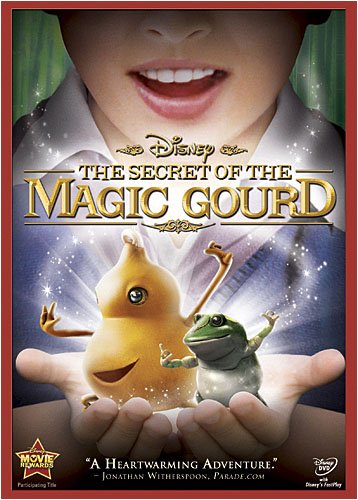
“The Magic Gourd has magical powers. He can carry you high up to the sky, right up to the clouds, where they feel just like cotton candy. Stick out your tongue and they taste like cotton candy. That’s the power of The Magic Gourd. If you become the Gourd’s master, he can grant you anything you wish for…”

Disney films have always had a world wide appeal. Children everywhere on the planet have grown up with the same classic images that we have in the United States. The language might not be the same, but the message and the magic has always been there to discover. So I guess it makes some sense that the studio might begin to do some international joint projects intended originally for children of another country and culture. Would the wide appeal translate in reverse? Could a film based on a Chinese story, made in China with Chinese actors, be able to bring the magic to American audiences as well? After watching The Secret Of The Magic Gourd, I don’t think I’ve found my answer, at least I hope not.

Top Secret comes to DVD in a new "I Love the '80s" edition. The film continues the legacy of David and Jerry Zucker and Jim Abrahams as kings of sight gags and the ludicrously unexpected. Made in 1984, the film stars a young Val Kilmer as rocker Nick Rivers, an artist so clearly modeled after Elvis that he even sings potential lover Hillary Flammond a spoof version of "Are You Lonesome Tonight".


"When you give up your dream, you die."

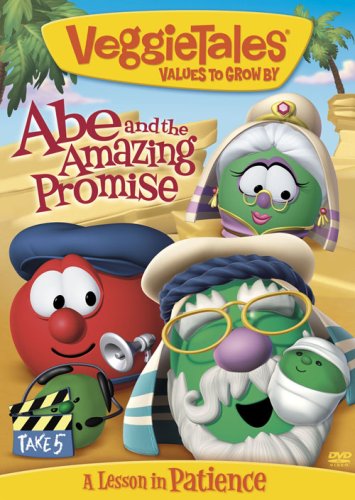
My initial reaction to most kid shows that have references to the bible are a mixture of sarcasm and skepticism. There is one exception to that rule: Veggie Tales. Veggie Tales was started in 1993 when VHS was still strong and kids were still highly impressionable under the influence of a weathered old videotape. They bring together a wonderful blend of a fun children’s show (under the guise of a bunch of talking vegetables) and have very good values to live one’s life by. So in my first title to review from the people at Big Idea, I receive a DVD about Abe and his Amazing Promise. Hopefully this Abe character has a promise about some cookies, I’m hungry.

Bob the Tomato receives a fan’s letter and decides to read it. He is joined by Junior filling in for Larry (the Cucumber). The fan’s letter is about “waiting” for something special. Bob relates his answers to the ancient biblical tale of Abraham and Sarah. This tale tells the story of how Abraham asked for a child and how it took fifteen years for them to receive that child. However, despite the hard pressures and substantial turmoil for Abe and his wife, God kept his promise and delivered them a child as a reward for their faith.

Welcome to 1972, when the sexual revolution is simultaneously in full swing, yet also showing signs of exhaustion (all that swinging can wear a body down, don’t you know). Barbi (Anna Biller) is a model housewife who is awakening to the feeling that there is a world outside her four walls. When she and her husband have a falling out, she hooks up with her more extroverted neighbour Sheila (Bridget Brno), who is also in the midst of a marriage crisis, and the two of them seek new love by taking work at an escort agency. What follows is a picaresque series of encounters, with nary a sexploitation angle ignored.

This film is a textbook definition of “labour of love.” Anna Biller no only stars, she directed, scripted, co-produced, edited, and took care of production and costume design. The latter took ages, since she wanted the costumes to match the decor, but the result was worth it – no small part of the film’s humour comes from its rigorous fidelity to the worst of seventies’ sense of aesthetics. Biller has recreated the classic sexploitation film down to the smallest detail. There are just enough winks to the audience to acknowledge the passage of time (and there is one address to the camera, describing the era as a fleeting utopia for the male of the species, that is as incisive as it is hilarious). The performances perfectly nail their models, capturing stilted, unnatural expressions and their forced enthusiasm. But no matter how much fun is poked at those bygone films, Viva also radiates an enormous love for them. As funny as the movie is, though, at 120 minutes, it is simply too long, and the pace is too measured. Lost of fun, all the same.

What a sordid mess!

Melrose Placelingered in the dark recesses of viewers’ hearts and souls as the guiltiest of pleasures for seven seasons. Wrapping up at the end of its seventh season with a ridiculously clichéd fake death twist for two major characters, the ingredients for it all are here in the fifth season – or the first half of it.

My place of birth was in Jamaica, NY in the summer of 1975. However, my parents decided to move me around a bit and where I grew up was actually a lot more south than that. Many times in my youth I visited New York to see my grandmother and wondered (often aloud) what it would be grow up in New York rather the suburbs of a southern state. My grandparents would tell me stories, my dad would tell me stories as well as people within earshot of my curiosity. Films helped in this respect too and another fine film about that experience ended up in my hands.
A Guide to Recognizing Your Saints was released in 2006 and is based on the true story of Dito Montiel.

Dito (played by Robert Downey Jr) is a successful writer and lives in California. His book speaks of his youth, living in the heart of New York. After all of these years, his mother Flori (played by Dianne Wiest) calls Dito up and tells him that his father, Monty (played by Chazz Palminteri) is ill and will not go to the hospital. After calls from friends and family, Dito decides to make the journey to New York. In the film and his mind, he really travels back to 1986 when he was just a teenager struggling to get by.

Woody Allen lands a terrific cast with his latest attempt at comedy, Vicky Cristina Barcelona, but there is something very off about the way these characters are written. Annoying pretentious dialogue renders a whimsical, fairy-tale-like backdrop ineffectual, causing each moment of silence to come all too slowly.Rebecca Hall is Vicky. Scarlett Johansson is Cristina. They are two differently wired friends enjoying an extended vacation in Barcelona, where they meet up with ruggedly handsome artist Juan Antonio Gonzalo (Javier Bardem), whom both girls can’t seem to resist. Juan Antonio asks both girls to join him in bed the first time he meets them. Vicky is offended, while Cristina finds his approach radically interesting – enough so to decide she’ll take him up on the offer. Unfortunately for Cristina, food poisoning cuts her plans short, and in steps the combative Vicky to fill the empty slot.


Christopher Titus lands in stores just in time for Valentine’s Day with his most recent concert tour Love Is Evol. “Tonight could fix your relationship, or end it,” he says at the opening of the performance. “Either way, you’re welcome.”After discussing the recent developments of his life with tongue planted firmly in cheek, he backs this opening promise up with nearly an hour and a half of comedy that is equal parts storytelling, punchline, and attitude.

Hedda and Neal (Lydia Lunch and Don Bajema) are a couple whose relationship needs work. They have retreated to an old plantation house for precisely that reason, but then Hedda invites over her former lover, Jackson (Henry Rollins). The inevitable triangle that occurs is intercut with flashes of other events from the house’s past.

The fact that the film is barely more than half-an-hour long will be perceived as either a blessing or a curse, depending on the viewer. While this is not as abrasive as Lunch’s collaborations with Richard Kern (Fingered), it will be a hard sell for many viewers due to technical aspects alone (see below). Lunch cuts loose as a femme fatale, but her revealing outfits and pale-face-and-crimson-lips makeup remain resolutely New York Underground, looking rather silly in the rural setting. Some evocative shots, then, and some amusing bits of dollar-store surrealism (check out the bunnies in the kitchen), but also rather more pedestrian than it thinks it is.