Genre

The defendant is charged with impersonating a classic movie, Felony murder of 81 minutes of human life, grand larceny (after review of the film’s sales figures this charge has been reduced to petty larceny), and aggravated assault to my intelligence. The court will show that director Victor Garcia did willfully and with malice and forethought create a sequel to an inferior remake of a classic motion picture. The evidence will clearly show that the film lacks any tangible resemblance to the original film and therefore has fraudulently engaged in a plot to lure the original film’s fans to the video store with false promises of quality and entertainment. The evidence will also show that writer William Massa did in fact commit these horrid lines to script, and in collaboration with others masquerading as actors, did inflict harm on this reviewer and several innocent bystanders. These defendants conspired to take money from unsuspecting DVD renters under the guise of entertainment. I present the following:

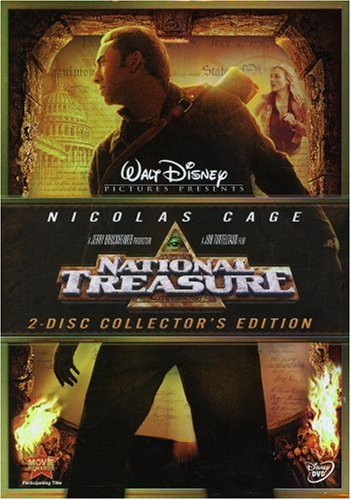
The United States is a young nation compared to most places on the Earth. Our history only recently broke the 200 year mark. Sure, there’s plenty of colonial history you can include, but taken all together you still can’t get more than about 500 years out of the deal. That means Indiana Jones or Laura Croft won’t be spending a lot of their time working their way through New Jersey any time soon. So leave it to the likes of director Jon Turteltaub, producer Jerry Bruckheimer, and star Nicholas Cage to bring us a romp through historical places, and yes, American tombs, in search of the ultimate treasure.


This is a Bruckheimer film from beginning to end. You get all of the standard conventions in National Treasure. Plenty of action, intriguing characters, and a fast and furious ride.

In 1959 Rod Serling changed the face of television. This unimposing thin man stepped in front of a camera and told us we were entering a world of shadow… the Twilight Zone. The anthology series ran for 5 years and included some of the best genre tales ever told. We all have our favorites, and my list is too long to go into here. Even years after when Serling himself had passed it never truly died. Syndication found a huge new following for the series, and it inspired not only revivals of itself but a long list of other anthology shows over the years like Tales From The Crypt and Tales From The Darkside, but none of these imitators ever came close. Serling was a genius in not only picking out great material, but he was a master presenter as well. So in 1983 when 4 of the world’s leading genre filmmakers banded to do a Twilight Zone Movie, the expectations went through the proverbial ceiling.


TV reporter Jason Behr is the reincarnation of warrior from 500 years ago, charged with protecting a woman (Amanda Brooks, also a reincarnation) whose destiny is to sacrifice herself so that a mystical giant serpent (an Imoogi) can become a dragon. Unfortunately, an evil Imoogi named Buraki wants the power for itself, and summons a giant reptilian army that lays waste to LA in the search for Brooks.

The most elaborate South Korean project ever isn’t a patch on the far superior The Host, but is still a very entertaining monster mash. Though shot in English with an American cast (including Robert Foster as a kind of Obi Wan Kenobi), the hilariously nonsensical dialogue sounds very translated indeed. The plot has very little flow to it, what with our star-crossed lovers fleeing Buraki in one scene, but taking time out for a meeting in a coffee shop in the next. Then there’s the fact that the gigantic Buraki seems to be able to arrive in large urban areas without anyone noticing his 200-metre presence. One can also chuckle at the flashbacks within flashbacks that set up the back story. But a great deal can be forgiven thanks to the copious monster footage. This is a film that delivers on its promises, and once the rampage starts, the action is non-stop. The CGI nature of the beasts may be pretty obvious, but the creatures are also very detailed. As a strange cross-cultural mix of period fantasy and urban monster rampage, this is pretty infectious fun.

Long before Clint Eastwood was making our day as Dirty Harry or even roaming the badlands without a name for Sergio Leone, he was working the cattle drive on Rawhide. Rawhide was created to take advantage of the huge Western film and television wave that Hollywood had been riding for nearly a decade. With huge ratings for Gunsmoke and Bonanza among others, Rawhide was a bit of an unlikely success. Here the show explored the West on an endless cattle drive to get a few thousand steer to market. Along the way the crew would find themselves involved in someone else’s troubles or meet trouble head on themselves. The cattle drive theme would rely on the changing landscape to distinguish the show from other more sedentary westerns. More like Wagon Train, the constant movement always gave a sense of action even when there wasn’t much.


I like Robin Williams (Good Will Hunting). A lot. Generally, his presence alone is enough to make me watch a particular movie — an unfortunate fact, given his spotty record. The man can be hilarious, and he has starred in some highly entertaining films over his long career. But he's also done bad movies, flops and failures. License to Wed is one of those.

10 minutes in, I wanted to turn it off. At 18 minutes, I was actively mocking everything and anything onscreen. By the half-way point, I was cursing my obligation as reviewer to sit through the entire film. This movie is an all-around bust. Stop reading now, and check out some other Upcomingdiscs reviews for better films to watch. You can pretty much close your eyes and click to find something that'll top License to Wed.

U.S. soldiers return home from war and find it difficult to re-assimilate into everyday American life. We've seen this idea played out dozens of times, mostly with Vietnam as the conflict of choice. In Home of the Brave, writer-director Irwin Winkler (De-Lovely) transplants the story into more modern times with the war in Iraq, without much success. Panned by critics and moviegoers alike, Home of the Brave feels a lot more like a made-for-TV movie than a major theatrical release, despite the presence of perennial Hollywood badass Sam Jackson (Snakes on a Plane).

It's not that there isn't power in the message that war profoundly affects those involved long after they've left the battlefield, it's just that this film does a poor job living up to that message's raw potential. The disc itself isn't bad at all, but solid DVD production values can't save a movie.

Lando Buzzanca plays Senator Puppis, a telegenic young politician on track to become Italy’s next president. He’s been groomed for the part practically from birth by the Vatican, which plans to re-exert social control over the country through its presidential puppet. But plans go badly awry as Puppis suddenly develops an uncontrollable urge to fondle women’s buttocks (Stephen Thrower has aptly described the character as a “repressed heterosexual”). Even as he seeks help for his condition, various parties around him begin to panic, as the police think Puppis is planning a coup without telling them, the military think they are being left out of the loop by the police, and the Vatican, along with its Mafia catspaws, starts whacking everyone in sight in a desperate attempt to keep everything from completely unravelling.

How’s that for a sex comedy plot? Not exactly of the been-there-done-that variety, is it now? Behind the nonsensical UK release title is one of the most interesting Lucio Fulci films to reach these shores. Fans wanting the Fulci gore will have to look elsewhere, but those open to something new will encounter a level of filmmaking absent in too much of his later work. The sex gags are rather dated (though the moment of the Puppi’s first goose is a bit of wonderful deftness I’ve never seen in Fulci), but the black political satire, which makes up the bulk of the film, while being very tied to the specific Italian context, has lost none of its bite. This is an angry film, one that builds to an utterly appalling resolution, all the more sour for its comic framing. Without going so far as to compare Fulci’s filmmaking skills to Kubrick’s, one might think of this film as Fulci’s Dr. Strangelove – a bitter, hopeless indictment that can only fully express its venom in the form of farce.

Gomer Pyle began life as a one of the down home residents of Mayberry, where Andy Griffith held court as the sheriff and Don Knotts blundered his way to fame and fortune. It’s no small task indeed to find a way to shine as a minor character who wasn’t even there from the beginning; he replaced Floyd after the second year. But shine he did. Much of the character’s charm and success has to be given to Jim Nabors. The shy naive Gomer worked as an auto mechanic in Mayberry, but for his own series he appeared in one of the most unlikeliest of places, the U.S. Marine Corp. There Nabors found the perfect comedic partner in Frank Sutton, who played his superior Sgt. Vince Carter. The chemistry and remarkable timing these two brought to the Andy Griffith spin-off made it an instant hit. Critics at the time were very skeptical of the move, and most of the predictions called for a swift end to Gomer Pyle U.S.M.C. But before you can say “surprise, surprise, surprise”, the series became as popular, if not more so, than the parent series, at least for a time. In syndication the show was always a hit.


Frasier was another one of those unlikely hits. Frasier started as an intended one-off character on the hugely popular Cheers. Kelsey Grammer made the most out of it, and before long he was one of the regular barflies inhabiting a stool at Sam’s. In Cheers the wit worked because Frasier was so unlike his fellow characters. He was a sophisticated, almost snobbish psychiatrist with a taste for fine art and high class entertainment. Instead of a ballgame, Frasier was more at home at the opera or an art opening. The humor was to be found in his attempts to blend in with his crass companions or even make a run at enriching their lives with his cultured tastes. My favorite Frasier moment will always be his plan to expose the bar patrons to Charles Dickens, but instead of his changing them they eventually had him reinventing the brilliant author in his reading of David And The Coppers In The Field. Soon Cheers had run its course, and everyone was expecting a spin-off. There was too much rich material to be found here to let it just die with the closing of Sam’s bar. While Norm or Cliff were the natural choices, it was Frasier who would move on. While most fans were a little confused by the move, the show would go on for 11 seasons that were arguably far funnier than Cheers ever was.