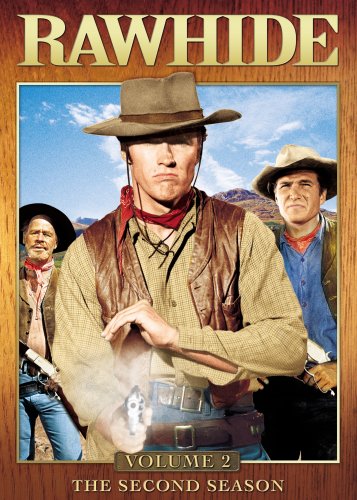
Long before Clint Eastwood was making our day as Dirty Harry or even roaming the badlands without a name for Sergio Leone, he was working the cattle drive on Rawhide. Rawhide was created to take advantage of the huge Western film and television wave that
A very young Clint Eastwood played Rowdy Yates. Unlike any cowboy you ever saw, Rowdy had slicked up hair and looked more like a biker than a cattle hand. He was the greenhorn in the bunch, usually finding each experience a learning opportunity. He had an almost naïve charm that made him popular. Eric Fleming was Gil, the trail boss. The third main character was Pete Nolan, played by Sheb Wooley. Sheb formed a good relationship with Eastwood that would be rewarded years later when Eastwood created a role for him in The Outlaw Josey Wales.Of course, there was a large number of changing support players along on the drive. Every operation needs cooks, ropers, and red shirts. I didn’t really watch the show even in its limited syndication run so knew most of it by reputation only. Of course, I knew the Frankie Laine theme that has been used for everything from selling cars to western spoofs. The tune was also a moderate radio and record hit in the day.
I was rather pleased with what I saw. It takes a little getting used to seeing a much more wide eyed Clint Eastwood. He had not yet developed the gritty speech and laser beam stare that would propel him to superstardom. The production values were pretty good, as they managed to let a limited range of available filming locations appear fresh as the drive moved along. The necessary western clichés are all there, but I get the impression that this series was intended far more as a modern allegory than a true western. Like the others, there was plenty of moralizing and the good guys and bad guys were never that hard to identify. Still, Rawhide processed a certain spirit that went beyond my expectations. It’s all dated now, and it’s not great by any definition of the term, but it deserves a better look. You won’t be disappointed.
Video
Each episode of Rawhide is presented in its original broadcast full frame format. The series was shot in black and white. The transfer is actually a remarkable one. There isn’t much in the way of print defects and the picture is quite sharp. Black levels are rock solid, and working along with sweet contrast makes this a picture with razor detail. You won’t believe this stuff’s almost 50 years old
Audio
Special Features
Final Thoughts