Genre

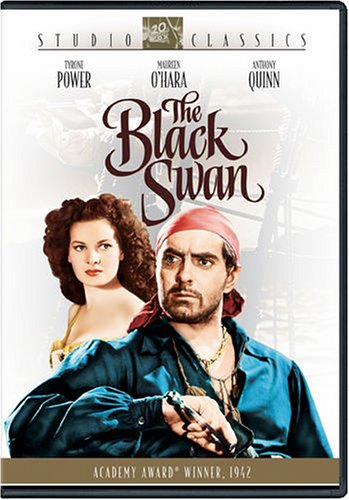
Tyrone Power has been plying his trade as a pirate in the waters near Jamaica. When his former captain becomes the governor of Jamaica, Power goes straight. He has his eye on Maureen O'Hara, who is engaged to a duplicitous aristocrat who is feeding information to unreformed pirate George Sanders (utterly unrecognizable in shaggy red hair and beard). There will be many complications before Power can claim the resisting O'Hara as his own.Compared to the Errol Flynn pirate movies Captain Blood and The Sea Hawk, this one is a bit light on the action, really only getting down to the buckling of swashes in the final act. The romance between Power and O'Hara is a bit difficult to take in this day and age as well, especially in the first part of the film as it dances into rape fantasy territory. But be that as it may, this is still a first-class adventure.

Audio

This is the first Woody Allen film I’ve ever seen.

Something always put me off about the guy. Maybe his infamous personal life plays a part in my not wanting to explore Allen’s cinematic offerings, but I would chalk up my ignorance to Allen’s physical appearance. Shallow, I know. But he’s a little nub of a man who has self-indulgently cast himself as the romantic lead in most of his films. But whatever, he’s a respected filmmaker and the responsibility of being a film buff requires me to keep an open mind -... even when it comes to Woody Allen. In short, I need to shut up and start watching his films.

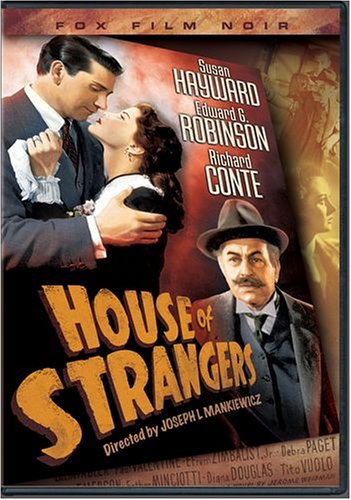
Not having much appreciation for (or just being an aficionado of) the film noir genre, I could probably do one better and say that even if noir was induced on me subliminally, there may be a good chance that I wouldn't even recognize it. So I don't know how cool things like The Blackboard Jungle or some other films are and I can't really rule them out of hand. So when I got House of Strangers to review, I had to give it a try.

Based on a novel by Jerome Weidman (who won a Pulitzer for a Broadway play) and directed by Joseph L. Mankiewicz (who directed a couple of films called Guys and Dolls and Cleopatra), the film centers around several brothers and their father Gino, played by Edward G. Robinson (Soylent Green). Gino's favorite son Max (Richard Conte, The Godfather) is thrown in jail in connection with his father's dealings (he runs a well-known bank in New York). Unbeknownst to Gino, his other sons Pietro (Paul Valentine, Against All Odds), Joe (Luther Adler, Absence of Malice) and Tony (Efrem Zimbalist Jr., Hot Shots!) overthrow Gino in a power play, which leads to Gino's death.

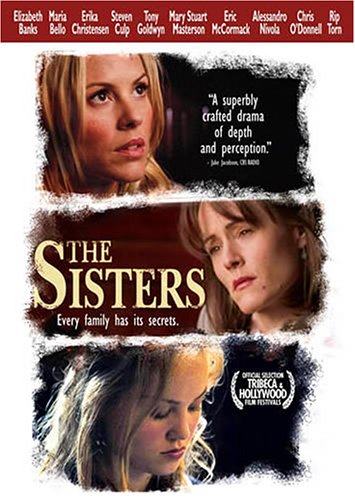
OK, so I've gotta admit that I'm a little bit of an uncultured boob who is not that familiar with the writings of Russian Anton Chekhov. In fact I know a little bit more about Andrei Tarkovsky (Solaris) then anything else, and that Chekhov was (and still is) an influential force in dramatic works today. Well, he has to be if his work "The Three Sisters" gets adapted into a play by Richard Alfieri, then into a film starring a capable and recognizable cast, right?

Directed by Arthur Allan Seidelman, the film chronicles the events of sisters who are living their lives in the shadow of their late, scholarly father. Olga (Mary Stuart Masterson, Fried Green Tomatoes) is the oldest in the family and is in line to be named Chancellor of a University, the middle sister Marcia (Maria Bello, A History of Violence) is a bit of a shattered psyche who lives with her husband Harry (Steven Culp, Desperate Housewives) and they constantly fight, so she seeks the company of Vincent (Tony Goldwyn, The Last Samurai). The youngest sister Irene (Erika Christensen, The Upside of Anger) seems to live a life that her older sisters admire, but she's not without her own demons, despite the thoughts of her fiancée David (Chris O'Donnell, Vertical Limit). There is a brother named Andrew (Alessandro Nivola, Junebug), who the sisters almost seem to subconsciously gang up on, even more so with Andrew's wife, the caustic Nancy (Elizabeth Banks, The 40 Year Old Virgin). There are also some notable supporting character actors in the film also, like the sarcastic Gary (Eric McCormack, Will & Grace) and the creepy but foreign Dr, Chebrin (Rip Torn, Men in Black).

There is no shortage of vampire stories out there. There’s certainly no shortage of kick butt chicks dressed as sparsely as possible running around in depressed future populated worlds. Underworld, without a doubt, does the combination better than anyone. Ultraviolet makes a grand attempt that really ends up being more of a ride than anything else. Now, I can usually follow the most convoluted storylines, but this one gave me some trouble. It seems that while trying to create a super soldier (where is Mulder and Scully when you need them) the government made a big oops and created something akin to a vampire. Those infected with HGV, (I wonder what connection they’re going for there?), possess extraordinary strength. They also develop light sensitivity and a thirst for blood. After realizing these new hybrid beings weren’t going to quite fit in socially, the plan was to round them up and kill them all. That was the plan, anyway, before the likes of Violet. As part of an underground hemophage movement to survive the genocide, Violet finds herself having to protect a child whose blood might contain a cure or a plague. The inevitable chase through a futuristic city serves more to show off some expensive CG f/x than really further any plot.

Ultraviolet makes the fatal flaw of trying to serve too many purposes. There’s nothing wrong with a thrill ride with plenty of eye candy. Still, Ultraviolet is trying to make too many statements. The obvious HIV inferences, combined with the concentration camp mentality of the totalitarian future, overwhelm us most of the time. Another problem is the f/x are often too slick. More often than not the film just doesn’t appear believable. Now I don’t mean “That’s just not possible” unbelievable. I mean, the picture just doesn’t look real. This is what happens when color correction becomes manic. Everything is so smooth and shiny it looks as though it might as well all have been CG. The action is also almost comical. We’re talking Kill Bill on the believability gauge. She just takes on hundreds of enemies at a time. Before long you’re thinking, Who cares? She’s indestructible. Don’t get me wrong, I rather enjoyed it at times. It’s an over-ambitious thrill ride and nothing more. The problem is, it obviously wants to be so much more than that.

Synopsis

Anthony Michael Hall steps into Christopher Walken’s considerable shoes as Johnny Smith, a man who wakes up after years in a coma to discover that not only has life moved on without him, but he has psychic powers, and with them comes visions of politician Greg Stillson (Sean Patrick Flanery, taking on the role essayed by Martin Sheen in the Cronenberg film) bringing about some kind of apocalypse. Smith’s struggle against Stillson makes up the central arc of the series, and this season...opens with Smith trying to stop his friend Rebecca from attempting to assassinate Stillson, and act that will result in her death.

Synopsis

Paul Gross plays Geoffrey Tennant, a once celebrated actor who had a meltdown during a performance of Hamlet. Now he’s trying to mount The Tempest at the head of a broke company about to be evicted from its premises. Meanwhile, his former mentor, Oliver Welles, has just mounted a dispiriting version of A Midsummer Night’s Dream at the New Burbage Theatre, and very shortly thereafter dies. Tennant is brought in as the new artistic director, and his attempts to stage Ha...let are troubled by the ghost of Tennant, a lunatic director, scheming suits and difficult actors.

This is a rather hard review to write. How do you separate the subject matter from the film? What reviewer wants to find himself in the unenviable task of critiquing the likes of a future saint? Certainly the filmmakers must have felt the same burden to do the story justice. But did they succeed? The answer is a not so simple.

The choice of Olivia Hussey was a remarkably inspired one. She portrayed the unselfish passion and self sacrifice as if they were emanating from her very soul. From her first moments on screen it is not hard to believe, while perhaps imagined, that we are seeing just a hint of something divine. The supporting cast does a fine job but can’t help but be overshadowed by Hussey. The location cinematography is also handled nicely with a great realistic approach that creates just the right touch of reality to it all. If the film is flawed at all, it is in its length. At 2 hours, it is overlong to maintain such powerful imagery, yet the running time is far too short to do justice to such a life that has touched and inspired the world. The film doesn’t start at the beginning. We find Mother Teresa already a nun and about to begin her mission to help the poor. Nor is that story complete. Huge gaps in time lead us all too quickly to aged and dying saint apparent. You don’t need to be Catholic to appreciate the film. Few would dare to challenge the purity and good works of Mother Teresa’s life. World leaders have been brought to tears, and more importantly to action, because of her example. Many films have spared no expense in graphic f/x to try and show us a face that is truly evil. Few have attempted to bring us such a picture of goodness. This film shows us how simply it can be done. The film is worth a look on those grounds alone.

Synopsis

Paul Gross plays Geoffrey Tennant, a once celebrated actor who had a meltdown during a performance of Hamlet. Now he’s trying to mount The Tempest at the head of a broke company about to be evicted from its premises. Meanwhile, his former mentor, Oliver Welles, has just mounted a dispiriting version of A Midsummer Night’s Dream at the New Burbage Theatre, and very shortly thereafter dies. Tennant is brought in as the new artistic director, and his attempts to stage Ha...let are troubled by the ghost of Tennant, a lunatic director, scheming suits and difficult actors.

The career transformation that Clint Eastwood has endured over the last several generations can be called nothing short of extraordinary. After all, we are talking about a guy who made a steady name for himself in action films of the late '60s and '70s, first appearing in the spaghetti western films of Sergio Leone, then moving onto the Dirty Harry films of director Don Siegel, before moving on again to more of a directing role. Some of his works were hits and others were plain misses.

Then you have the case of Unforgiven a script that, admittedly he hung onto for years as a bit of a security blanket. In case of career drought, break glass, so to speak. The film helped vault Eastwood into the upper echelon of American directors while simultaneously providing a fitting closure to an earlier level of his stardom. With the help of similar top-shelf acting talent in key supporting roles, Unforgiven also perhaps did something that few other films have failed to do, which was to give a reflective farewell to a treasured genre of film.