War

We Were Soldiers unfortunately, was a film that didn’t really find its audience, and was also a casualty of the 9/11 attacks. Whereas Black Hawk Down was released in late December 2001/early January 2002 and made almost $110 million, We Were Soldiers was released six months later, and made $30 million less. Figure in the then-recent surge of big studio films of that genre in recent years, notably Saving Private Ryan and Band of Brothers, perhaps We Were Soldiers was the film ...hat the moviegoing public wanted to take a break from.

Whatever the case may be, the film didn’t really get a fair enough look in its theatrical release. One of the differences between it and Black Hawk Down was the increased focus placed on the families in this film, including the initial delivery of casualty notices by taxicabs, an event that did occur for a period of time until the Army developed a group specialized in breaking that unfortunate news. Perhaps the focus on families, or family life, may have reminded some of scenes from The Deer Hunter, but this is still a movie full of emotion and heartache.

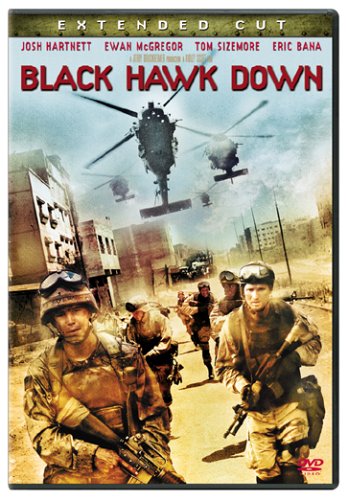
Not being a big fan of Black Hawk Down, I can't really tell you how many releases of the feature this makes from Sony. I know it's a title, which has seen at least two prior offerings. There is nothing new here to recommend the extended cut over the previous three-disc monster edition; however, it may be the way to go if you've yet to add this Ridley Scott war film to your collection. I'll be the first to admit that Scott does some of his finest work as director in this gritty combat picture; but his style is ...lso the reason why I feel Black Hawk Down fails to deliver, and pack the same emotional punch of a Saving Private Ryan or We Were Soldiers. Most of the young stars involved in this film, and in the grisly fighting, stay masked under a thick layer of dirt and grime throughout the 152-minute running time. While that contributes largely to the chaotic and confusing authenticity during battle scenes, it hinders the audience from getting attached to any of the characters.

I know character development needn't be sacrificed on the altar of battle realism; yet that's exactly what happens in Black Hawk Down. It's the kind of film, which needs Mark Bowden's book on which it was based to fill in the gaps left by the dramatization. The contemporary war efforts mentioned above are proof this sacrifice is an unnecessary one. Still, as disorienting as the film is, you can tell Scott is a seasoned director, who knows his way around a camera. And who knows? Perhaps his style creates some of the most realistic battle scenes known to film. And if this is all he wanted to accomplish, then Scott's film succeeds. But I can't imagine a director actively indifferent towards how his audience feels about the characters. And if this assumption rings true in Scott's case, then he can't look back on Black Hawk Down pleased with how it all turned out.

War movies, in my opinion, are one of the rarities in film, where the most recent pics are usually the best ones. I need only cite films such as Full Metal Jacket, We Were Soldiers, and Saving Private Ryan to argue my cause effectively. But that doesn't mean all of the older ones were bad. Most were because they took more of a silly ra-ra viewpoint in relation to the reality of war. They didn't show the nasty details because, in many ways, they were recruiting tools. But Decision Before Dawn> was one earlier work, which took chances with its dramatization. This 1951 film refuses to jump on any bandwagons, instead telling a captivating, and sometimes tragic, story about a strange kind of hero... one that comes not from within our own ranks, but from those of our World War II enemies. In fact, the main character of Decision Before Dawn is a captured Nazi soldier, who makes the decision to spy for the U.S. army - not for freedom, but redemption.

It's no wonder a film such as this was nominated for the 1951 Best Picture - and it's also no surprise it didn't win. This type of subject matter has never been able to avoid controversy, and the Academy hates to honor controversy. However, director Anatole Litvak's handling of the George Howe novel Call It Treason makes for an exciting and tasteful motion picture that was sure to win over audiences - even in its time - with the tale of Lieutenant Rennick, a German POW, who has agreed to go back to his home country and betray his old side to the Allies. Tension builds as Litvak plays with the possibilities of trust. Neither the Allies nor the Nazis know what to think of Rennick, and for a time, neither do we. But as the film progresses, Rennick shows there may be more to his decision of assisting the Allies than simply the proverbial "get out of jail free" card. He's one well-drawn character at the center of an important motion picture, which dared to paint an uglier face on war, and call in to question the line between treason and heroism.

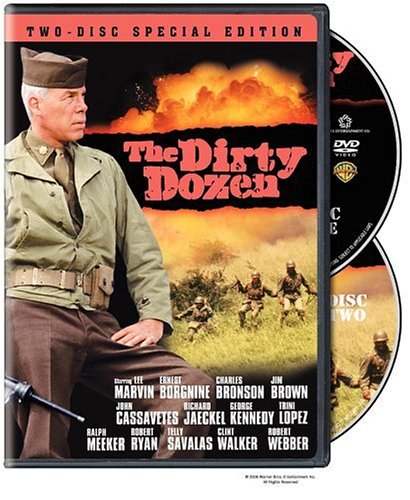
It is exceedingly strange to me that in this unprecedented age of media availability, movies on demand and theaters in our very own homes, more and more men have not seen those movies that were a staple of manhood for so many years. Movies like Bullitt, The Good, The Bad and The Ugly and even The Godfather are less and less familiar to male audiences than ever. There is a reason that these films were so popular amongst men. They are movies about tough guys who weren't afraid to rearrange some fac...s to get the job done. Heavy drinking and hard living men. With more and more of these films being released in Special Edition DVD packages, this is a prime time to see these films, and reacquaint yourself with your male heritage. For the women that may be reading this, I'll just tell you now, you might as well stop reading. This is not a film for you.

The Dirty Dozen is a film filled with true tough guys. Lee Marvin. Telly Savalas. Jim Brown... Charles Bronson, for goodness sake! The biggest tough guys in the movies these days are Vin Diesel, Bruce Willis and The Rock. Willis is cut from the old mold, but he is truly the last of his breed. Somewhere along the way, Hollywood turned its back on the man's man. I feel that the male population in this country is the worse for it.

Synopsis

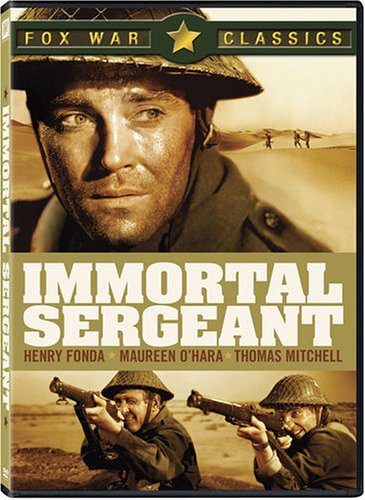
Henry Fonda plays Colin Spence, a diffident, self-effacing Canadian (but of course!) corporal in the British infantry based in Tunisia. Led by the crusty but supremely competent Sergeant Kelly (Irish of course), Spence’s squad is sent out on a recon mission that goes badly awry, and the men are forced to engage in a terrible trek across the burning desert. Spence is forced to assume a leadership role, and along the way has flashbacks to his relationship with Maureen O’Hara, and how his unwil...ingness to take a risk or fight might have wrecked his chances with her.

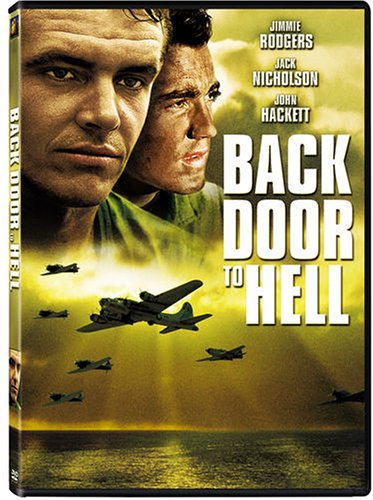
Monte Hellman filmed Back Door To Hell back to back with his better known Flight To Fury. This early Jack Nicholson film plays out very much like the throwaway it seems to have been. It’s certainly a brief affair, clocking in at just 69 minutes. Low budget films can often be impressive masterpieces. I have never seen a war film where that’s been true. After watching Back Door To Hell, nothing’s changed. The location and supporting cast make this at times feel more like Mexico than the Philippines. The settings are strictly back lot looking affairs, even when they are not. Cinematography is very limited and completely unimaginative. There is an odd, cold calmness to everything. Actors deliver their lines mostly in even soft tones. I found these portrayals more than a little unnerving. None of Nicholson’s future brilliance is on display here. I found my attention constantly straying during this film. One thing a war film should never be? Good or bad, it simply can’t afford to be boring.

Video

Synopsis

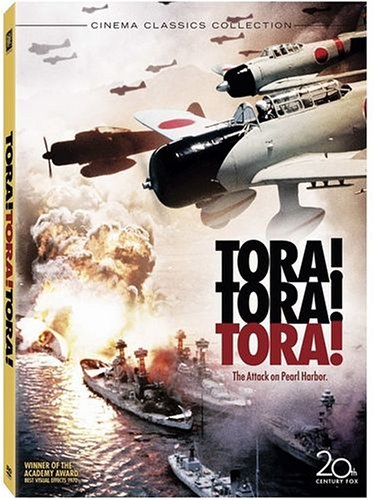
The attack on Pearl Harbor and the days leading up to that fateful event are the subject of the 1970 effort. The narrative jumps back and forth between the Japanese and American perspectives as just enough things go both wrong and right and both sides (the ascendancy of the militant army faction over the reluctant navy in Japan, crucial intelligence always arriving just a bit too late to the right people in States) to make the surprise attack inevitable.

Hollywood can sometimes be so enthused to cash in on a certain type of film many decent projects looking to explore a worthwhile subject topple under the weight of the cash-grabbing, money-hungry throng. Such is the case with Director John Woo’s Windtalkers, coming to DVD a third time on April 25 in this director’s cut. Though it’s sometimes overly melodramatic, this Nicolas Cage vehicle makes good use of its characters to forge an intriguing story about Navajo code talkers, and the presumed military practice ...f protecting the code and not the man. Cage plays Joe Enders, a soldier with a death wish and a lot of survivor’s guilt for having made it through battle-after-battle, only to receive another medal, while all of his friends die around him. He has grown to hate the medals because they remind him of this fact, and it seems like his whole mission is to die in battle with honor… not to go on living in a world so terrible that it welcomes the horrors of war. Then, he receives a peculiar mission: the U.S. has found luck with a form of code based on the Navajo language. It’s vital the Japanese do not get their hands on any of the Navajo code talkers, and Enders must do everything in his power to protect the code… even if that means taking the life of a fellow soldier to do it.

Such a situation lends itself to great drama; however, this is still a John Woo film, and his enslavement to self-imposed convention does cause the film to have a few problems. For one, I would like to see Woo – just once – shoot an entire film, edit, and release it, without the use of one slow-motion moment. The reason for this: if the technique is an option, he will abuse it with zero regard – or knowledge of – having done so. After seeing film-after-film of his resort to this overused tactic, I’d say it’s time he laid off. He has a good story, and characters viewers can get emotionally involved with – so why does each fallen soldier have to take an hour to hit the ground? Also, just about every war movie cliché there is turns up at some point, whether it be the bigoted soldier with a change of heart, or the loving husband telling his buddy to make sure his wife gets his wedding band “should anything happen.” (On a side note, any time a soldier says a variation of this in a war film, you know “should anything happen” actually means “when something happens.”) Lastly, there is the clunky dialogue, mostly given to Adam Beach as the featured code talker Enders must protect. With these things said, something intrinsic about the film still manages to hold everything together in a respectable narrative. And I think whatever it is, the stellar cast consisting of Nicolas Cage, Christian Slater, Noah Emmerich, Mark Ruffalo, and Jason Isaacs, has something to do with it.

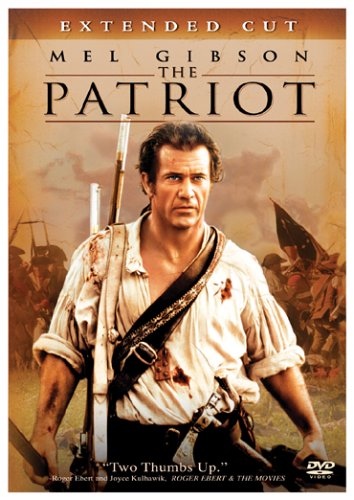
Mel Gibson stars as reluctant guerilla fighter Benjamin Martin in this story of courage, passion, and war, which dramatizes elements from the American Revolution into a gripping fictional narrative that will manipulate every emotion you have until its rousing finale. Martin endures great personal tragedies at the hands of the British - in particular, the despicable Colonel William Tavington (played with the vile gusto of a demon from Hell by Jason Isaacs). Tavington has already killed one of Martin's sons, and it is ...enjamin's concern for his other - as well as his insatiable lust for revenge - that drives him to take up arms for the Continentals and lead them into battle... and perhaps, freedom.

Whether it's tugging at heart strings, or planting viewers right in the middle of primitive warfare (no type of warfare is capable of being anything but), The Patriot maintains control of its audience, and only lets go at the final credits. Be forewarned, if you've never seen it. There will be times when you want to stop the film for fear of what might happen to Benjamin at Tavington's brutal hands. Then, other moments are "damn the torpedoes," kill that expletive-expletive, if it's the last thing you ever do. The point is, it will involve you the way few films can, and will actually have a physical effect on you - of some kind - by the time it reaches its conclusion.

The Academy Awards ceremony continues to devalue itself by giving honors to films, which are mediocre at best, or films that try desperately to force a political agenda down the American people’s throats, while gems such as 2004’s Downfall linger in relative obscurity, and certainly do not receive the recognition they deserve. Director Oliver Hirschbiegel’s study of Hitler’s final days transcends the triviality of being considered a film and instead functions as a window into the past. And for a little more th...n two hours, it feels like we’re actually watching Hitler’s (and a country’s) downfall instead of a movie portraying the events. Part of this authenticity is due to the meticulous recreation of war-torn Berlin in the last ten days of the German dictator’s life. The filmmakers’ painstaking research, which consisted of hours-upon-hours interviewing several of the still-living participants, as well as taking a healthy dose of its story from the memoirs of Traudl Junge, Hitler’s secretary, succeeds in placing us right in the middle of the drama. But the proceedings would be nothing without the criminally overlooked performance of Bruno Ganz, who doesn’t just play Hitler; he becomes him. If Ganz cannot win a Best Actor Academy Award for what he does here, then the whole system no longer contains merit, and the little gold statue means nothing.

Of course, whenever Hitler’s involved in anything, there will always be a lot of controversy that surrounds him. It doesn’t help the film’s global acceptance that Ganz plays Hitler not as a two-dimensional dictator, but as a flesh-and-blood man with his own feelings of pride, uncertainty, and even warmth. But make no mistake. Any critic or viewer that tries to tell you Hitler is shown in a positive light did not even begin to watch the film closely enough. Thus, the only real controversy lay in the fact that Downfall de-poofs stereotypes of what a German under the Reich was… and more importantly, of what Hitler himself was. He is first and foremost a mentally unstable villain. But like all predators, he is not without his share of humanity which does invoke sympathy at times. All the while, the film never tries to justify Hitler. It just tries to understand him, and it is enormously successful in doing so.